
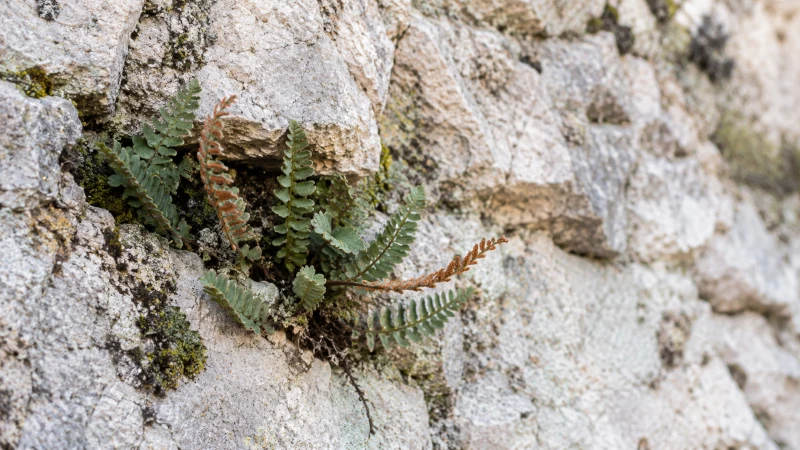
Here is the honest version before you read further. Rustyback fern (Asplenium ceterach, also called Ceterach officinarum) is a small fern that grows out of old walls and rocks, and people have used it for centuries as a cough remedy and as a “water” herb for the kidneys and bladder. When you look for real rustyback fern benefits, though, what you find is a long folk record, some interesting test-tube chemistry, and almost no research in actual people.
There are no human clinical trials, no established dose, and very little formal safety information. This guide covers what the plant is, what it has traditionally been used for, how much of that holds up, how it is prepared, and who should leave it alone.
What is rustyback fern?
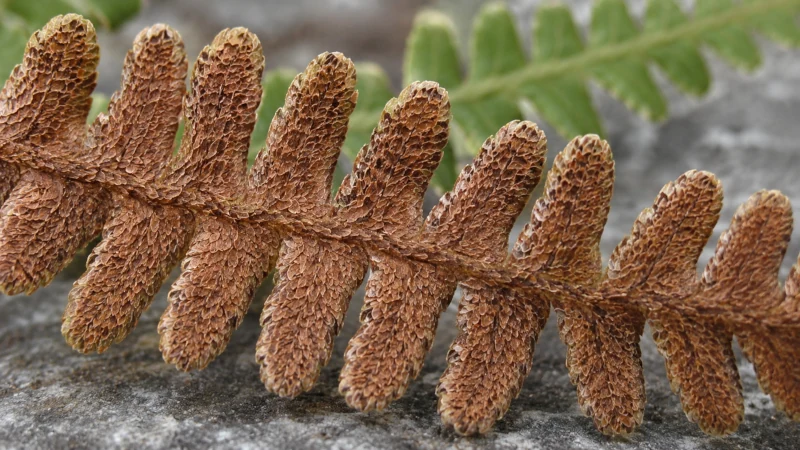
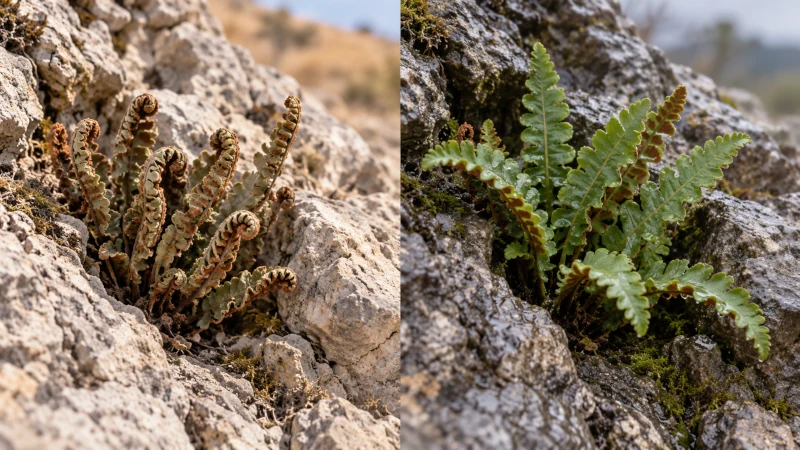
Rustyback is a small evergreen fern that tucks itself into crevices in limestone rock and mortar walls. Turn a frond over and you see why it earned its name: the underside is covered in overlapping scales that mature to a rusty, orange-brown colour. Botanists now file it under the accepted name Asplenium ceterach L., with Ceterach officinarum Willd. as a synonym, in the spleenwort family (Aspleniaceae). Its natural range runs from Europe and the Mediterranean across Central Asia to the Himalayas [Kew POWO].
It belongs to a small club of “resurrection” ferns that can dry out almost completely in a drought and then spring back after rain. Chemically, that toughness is interesting: the fronds are rich in phenolic acids such as chlorogenic and caffeic acid, along with flavonoids, tannins, and xanthones (including mangiferin), which is what has drawn researchers to study its extracts [Živković et al., 2017] [Tomou & Skaltsa, 2018].
Quick plant profile
| Botanical name | Asplenium ceterach L. (synonym: Ceterach officinarum Willd.) |
| Common names | Rustyback, common rustyback, scaly spleenwort, finger fern, scale fern, stone fern |
| Family | Aspleniaceae (spleenwort family) |
| Type / life cycle | Small evergreen, perennial fern; grows to roughly 20–30 cm |
| Where it grows | Crevices of limestone rocks and old walls; native from Europe through the Mediterranean and Central Asia to the Himalayas |
| Parts used | The fronds (aerial parts) |
| Traditional uses | Cough and chest complaints, diuretic, kidney stones, spleen complaints, hemorrhoids |
What rustyback fern is used for — and what the evidence actually says
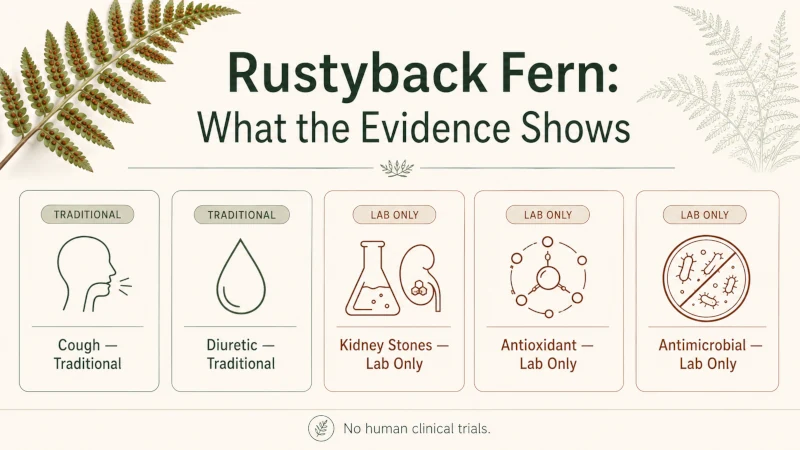
Most of what you will read about this plant comes from tradition, not modern trials. That does not make it worthless, but it does mean expectations should stay modest. Here is where each use stands, using a simple scale: Strong (consistent human trials), Moderate (some human evidence), Limited (small, lab, or mixed studies), Traditional use (long history, little or no clinical work), and Insufficient (not enough to judge).
| Use / claim | Evidence level | What that actually means |
| Antioxidant activity | Limited (lab only) | Extracts scavenge free radicals in test-tube assays. No evidence this translates to a health effect in people. |
| Antimicrobial activity | Limited (lab only) | Moderate activity against some microbes in the lab. Not tested as a treatment for any infection. |
| Kidney stones (antilithiatic) | Limited (in-vitro mechanism) | A cell-free/lab study shows it alters calcium-oxalate crystals. Promising mechanism, not a human trial. |
| Diuretic (‘water’ effect) | Traditional use + a small animal study | Long folk use; one rodent study reports a diuretic effect. No human trial in this species. |
| Cough, bronchitis, chest complaints | Traditional use | Old expectorant/soothing use. No clinical trials. Weaker record than its relative, maidenhair fern. |
| Spleen, hemorrhoids, other old uses | Traditional / historical | Historical belief (the name ‘spleenwort’). Not a modern, evidence-based use. |
Cough, bronchitis, and chest complaints — Traditional use
This is the plant’s oldest use. Herbal writers going back to Dioscorides listed it as an expectorant and soothing “pectoral” remedy for coughs and chesty complaints, and its tannins give it a mild astringent quality [Tomou & Skaltsa, 2018]. What is missing is proof. No human trial shows rustyback shortens a cough or clears a chest infection, and by most traditional accounts it was considered weaker than its better-known relative, maidenhair fern.
Treat a warm rustyback infusion the way you would any soothing tea — a comfort measure, not a treatment. For plant remedies with a stronger paper trail, see our evidence-rated guide to herbs for the lungs, and for eating through a chest cold, what to eat when you’re sick with bronchitis.
Diuretic and urinary use — Traditional use (with a little animal data)
Rustyback has a long reputation as a diuretic — a herb taken to make you pass more urine — and in parts of southern Europe it is still used that way [De Bellis et al., 2019]. Beyond tradition, a small rodent study has reported diuretic and anti-inflammatory effects [Sidhoum et al., 2020], but that work is preliminary, in animals, and published in a minor journal, so it should be read as a hint rather than a result. There is no human diuretic trial for this species. If you want the fuller picture on which “water” herbs have actually been tested in people, our guide to herbal remedies for the urinary system lays out the evidence — and the important caution that a diuretic tea does not treat a urinary tract infection.
Kidney stones — Limited (a test-tube signal, not a cure)
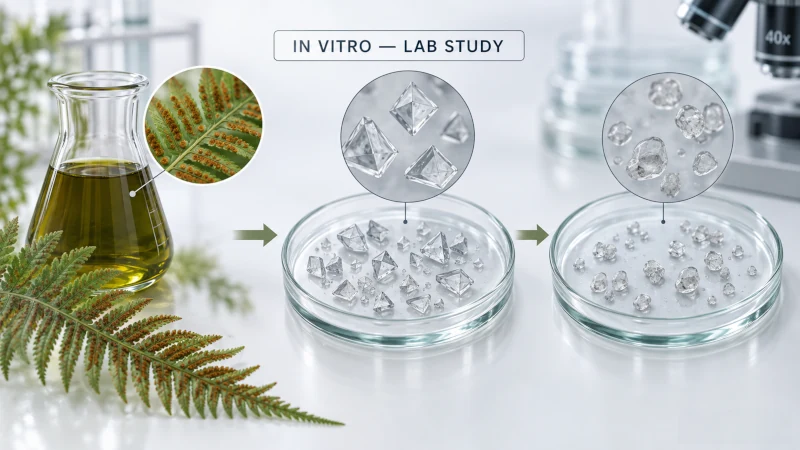
The claim you’ll see most often is that rustyback “breaks” or dissolves kidney stones. The most relevant research is a laboratory study that looked at how an aqueous rustyback extract affects calcium-oxalate crystals — the material most kidney stones are made of. In that in-vitro model, the extract changed how the crystals grew, making them smaller and rounder, shapes that are less likely to stick to kidney-cell surfaces; the authors framed it as a plausible mechanism worth further study [De Bellis et al., 2019]. Read that carefully.
It is a test-tube study, not a trial in people, and “changed crystal shape in a dish” is a long way from “dissolved a stone in a patient.” No herb has been shown to reliably dissolve kidney stones, and the best-supported way to prevent most of them is unglamorous: drink enough fluid every day. For the dietary side of stone prevention, see our guide to foods that cause kidney stones.
Antioxidant and antimicrobial activity — Limited (lab only)
Because the fronds are loaded with phenolic compounds, researchers have measured their antioxidant capacity, and rustyback extract performs well in standard free-radical assays [Živković et al., 2017] [De Bellis et al., 2019]. The same work found moderate antimicrobial activity against some of the microbes tested. These are genuine findings, and they explain why scientists keep looking at the plant — but they are test-tube results. They do not tell you that drinking the tea will “mop up” free radicals in your body or fight an infection.
The spleen, hemorrhoids, and older uses — Historical
The name “spleenwort” is a fossil of old medicine: Galen and others believed the fern could shrink an enlarged spleen, and it also appears in folk records for hemorrhoids and other complaints [Tomou & Skaltsa, 2018]. These are historical beliefs, interesting as background but not supported as modern, evidence-based uses. They are not reasons to take the plant today.
How rustyback fern is traditionally prepared
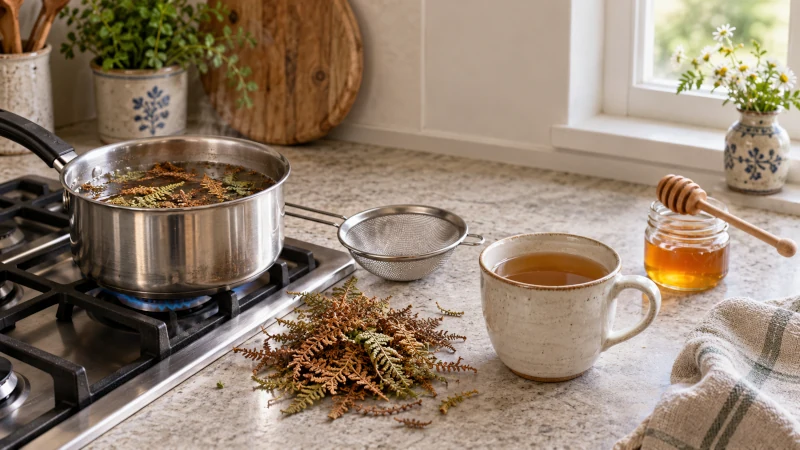
If you’ve spoken with a healthcare professional and want to try it as a soothing drink, this is the traditional preparation — not a tested, recommended dose. There is no established therapeutic dose for rustyback, so the amounts below are folk starting points, not medical advice [Pamplona-Roger, 2000].
- Decoction (the classic method): about 30 g of the dried fronds simmered in 1 litre of water for roughly 15 minutes, then strained. Traditionally taken warm, sweetened with a little honey.
- How much: traditional texts mention up to a few cups across the day. Given the absence of any tested dose or safety data, less is more — and this is exactly the kind of thing to raise with a pharmacist first.
- One firm rule: never give honey-sweetened drinks to a baby under 12 months, because of the risk of infant botulism.
Safety, side effects, and who should avoid it
The most honest thing to say about rustyback’s safety is that we don’t have much data. It has no formally studied side-effect profile, no known drug-interaction studies, and no pregnancy or breastfeeding safety information. A cup of the traditional tea in an otherwise healthy adult is probably low-risk, but “probably” is doing a lot of work in that sentence, so it’s worth applying the standard cautions that apply to any diuretic or kidney-directed herb.
Two general points matter here. First, “natural” does not mean “safe”: in the United States the FDA does not review herbal supplements for dose, content, or purity before sale, so what’s on the label is a claim rather than a guarantee, and products can be contaminated or mislabelled [National Kidney Foundation, 2025].
Second, herbs that act on urine flow deserve extra care in anyone with kidney or heart problems, because some can accumulate or add risk when the kidneys aren’t clearing them well [National Kidney Foundation, 2025]. If you do try a herbal product, favour ones carrying a USP, NSF, or ConsumerLab verification mark, and bring the actual bottle to your appointments so your clinician can check it.
Who should not use it
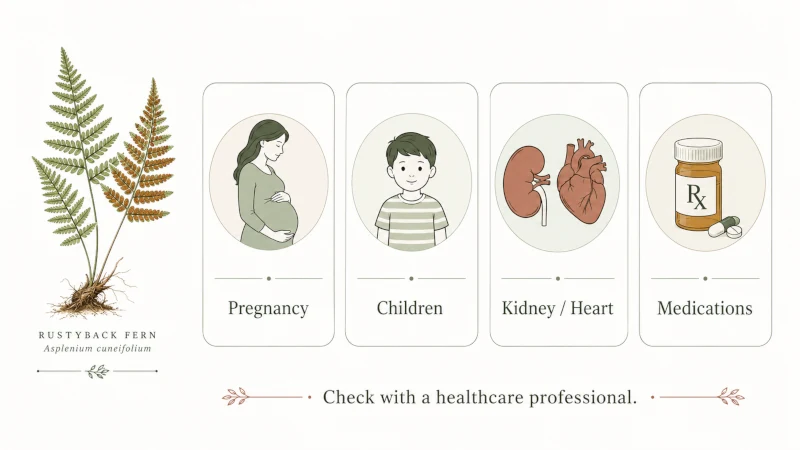
| Pregnant or breastfeeding | No safety data exist for rustyback in pregnancy or breastfeeding, and several diuretic herbs are known to be unsafe then. Avoid it. |
| Children | No pediatric data and no established dose. Don’t give it to children. And never add honey to a drink for a baby under 12 months (botulism risk). |
| Kidney disease, heart failure, or fluid restriction | Do not use a diuretic herb to self-treat swelling — that can delay treatment that works — and herbal products can accumulate or add risk when kidney function is reduced. |
| Taking diuretics, blood-pressure drugs, or lithium | A herb with a genuine diuretic effect can add to fluid and electrolyte loss and alter drug levels. Check with a pharmacist first. |
| A known fern or plant allergy | Skip it, or start extremely cautiously. |
When to see a healthcare professional — red flags
Rustyback is, at most, a comfort measure. Don’t let it delay care. The conditions it’s traditionally used for are exactly the ones that can turn serious, so get medical attention if you have:
- A cough lasting more than about three weeks, coughing up blood, shortness of breath, wheezing, or chest pain.
- Severe pain in the back, side, or lower abdomen that comes in waves, or pain radiating to the groin — possible kidney stone.
- Blood in the urine, or burning, urgency, and cloudy or foul-smelling urine — possible urinary tract infection, which needs assessment rather than a tea.
- Fever and chills, nausea or vomiting with any of the above — which can signal an infection reaching the kidney. Seek same-day care.
- Any new symptom while pregnant.
| Health Disclaimer: This article is for general education and information only. It is not medical advice and is not a substitute for diagnosis or treatment from a qualified healthcare professional. Rustyback fern has not been tested in human clinical trials, has no established dose, and its safety has not been formally studied. Nothing here is intended to diagnose, treat, cure, or prevent any disease. Talk with a doctor or pharmacist before using rustyback fern or any herbal product — especially if you are pregnant or breastfeeding, are caring for a child, take regular medication, or have kidney disease, heart failure, liver disease, or another ongoing condition. Seek prompt medical care for the red-flag symptoms described above. |
Frequently Asked Questions
Does rustyback fern really help with kidney stones?
There’s a promising laboratory signal, not proof. A test-tube study showed a rustyback extract changes how calcium-oxalate crystals form [De Bellis et al., 2019], but no human trial has shown it dissolves or prevents stones. The best-supported prevention step remains drinking enough fluid daily. Painful, stuck, or bleeding stones need medical care.
Is rustyback fern safe to drink as a tea?
For most healthy adults a cup of the traditional infusion is probably low-risk, but there’s no tested standard dose and little safety data, so caution is sensible. Anyone pregnant or breastfeeding, caring for a child, with kidney or heart disease, or taking regular medication should check with a doctor or pharmacist first [National Kidney Foundation, 2025].
What does rustyback fern do for a cough?
Traditionally it was used as a soothing expectorant, and its tannins give it a mild astringent quality. It’s a comfort measure rather than a proven treatment, and it won’t cure a chest infection. Compare it with the better-studied options in our guide to herbs for the lungs.
Is rustyback the same as maidenhair fern?
No. They’re different ferns with overlapping folk uses. Maidenhair fern (Adiantum capillus-veneris) has its own traditional record and cautions — see our maidenhair fern guide. Traditionally, rustyback was considered the milder of the two.
Can I take rustyback fern if I have kidney or heart disease?
This is the group that should be most cautious. Diuretic herbs can be risky when kidney function is reduced or when the body is holding fluid because of heart failure, and self-treating swelling with a herb can delay treatment that actually works [National Kidney Foundation, 2025]. Don’t start it without your clinician’s okay.
References
- Royal Botanic Gardens, Kew. Asplenium ceterach L. Plants of the World Online. Accessed 2026. View source
- Živković S, Skorić M, Šiler B, et al. Phytochemical characterization and antioxidant potential of rustyback fern (Asplenium ceterach L.). Lekovite Sirovine. 2017;37(1):15–20. DOI 10.5937/leksir1737015z. View source
- De Bellis R, Piacentini MP, Meli MA, et al. In vitro effects on calcium oxalate crystallization kinetics and crystal morphology of an aqueous extract from Ceterach officinarum. PLoS One. 2019;14(6):e0218734. PMID 31238335; DOI 10.1371/journal.pone.0218734. View source
- Tomou EM, Skaltsa H. Phytochemical investigation of the fern Asplenium ceterach (Aspleniaceae). Natural Product Communications. 2018;13(7):849–850. DOI 10.1177/1934578X1801300715. View source
- National Kidney Foundation. Herbal Supplements and Kidney Disease. Updated Sep 2025. View source


