
If you’re hoping a machine can break up your gallstones with sound waves so you can avoid an operation, here’s the straight answer: for stones sitting inside the gallbladder, that approach has mostly been set aside. The technology genuinely works — it can shatter a stone — but the stones tend to come back, which is why doctors rarely aim it at the gallbladder anymore. Sound wave therapy for gallstones still has a real role, just a narrower one than most search results suggest: breaking up certain stones that get stuck in the bile duct or pancreatic duct, usually so they can be cleared out with another procedure.
Knowing that distinction — stones in the gallbladder versus stones stuck in a duct — is the difference between chasing a treatment that’s largely been retired and understanding where it can actually help.
What “sound wave therapy for gallstones” actually means
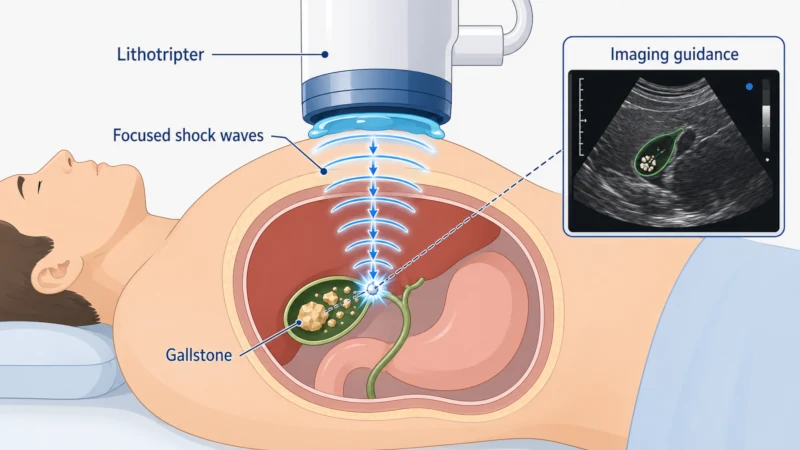
The medical name is extracorporeal shock wave lithotripsy, or ESWL. A machine called a lithotripter sends focused pressure waves through the skin and soft tissue; the waves are aimed at the stone using X-ray, ultrasound, or both, and the energy cracks it into smaller fragments [Johns Hopkins Medicine, 2022]. It was introduced in the early 1980s and transformed the treatment of kidney stones, and the same idea was then tried on gallstones [Johns Hopkins Medicine, 2022].
What happens to the fragments depends on where they are. Kidney and ureter fragments usually leave in the urine. Fragments from stones in the bile duct or pancreatic duct often still have to be removed with an endoscope, because a broken-up stone in a duct doesn’t reliably clear on its own [Johns Hopkins Medicine, 2022].
Why it’s no longer the go-to for stones in the gallbladder
The main problem is recurrence. Lithotripsy breaks the stone but leaves the gallbladder in place, so the same conditions that formed the first stones are still there — and new stones commonly develop over the following years. Johns Hopkins states it plainly: shock-wave lithotripsy isn’t effective at keeping gallbladder stones from coming back, so minimally invasive gallbladder removal is now the more common treatment for gallstones that cause symptoms [Johns Hopkins Medicine, 2022]. That recurrence is the reason laparoscopic gallbladder removal became the standard treatment in the first place, according to a published review marking the technique’s first two decades [shock-wave lithotripsy review, 2005].
The federal patient guide is blunt about it too: for symptomatic gallstones, treatment is usually surgery to remove the gallbladder, and nonsurgical treatments are rarely used [NIDDK]. Mayo Clinic makes the same point from the other direction — dissolving medicines aren’t commonly used and are reserved for people who can’t have surgery, partly because gallstones frequently recur without it [Mayo Clinic, 2025].
There’s a practical catch as well: even when the stone is fragmented, the pieces still have to travel out through the bile ducts, and along the way they can trigger pain or lodge somewhere new.
Where sound-wave lithotripsy still earns its place
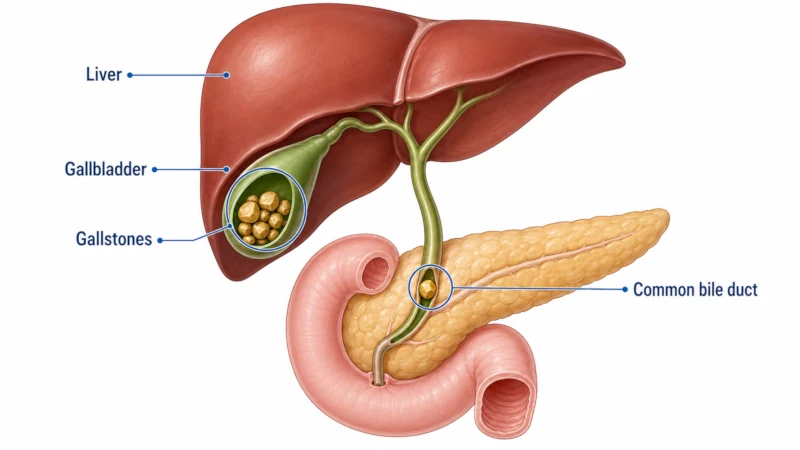
This is the part that gets lost online. Lithotripsy hasn’t vanished — it just moved to a more specific job.
Bile duct stones that resist endoscopic removal
Gallstones can travel from the gallbladder into the bile duct and get stuck. Most are removed with an endoscope during a procedure called ERCP. But for some large or hard-to-reach duct stones, lithotripsy can break them up first so they can then be extracted [Johns Hopkins Medicine, 2022]. In fact, clearing bile-duct stones that resist standard endoscopic removal is one of the few settings where shock-wave lithotripsy kept a defined role [shock-wave lithotripsy review, 2005].
Pancreatic duct stones
Chronic pancreatitis can lead to stones in the pancreatic duct that block flow and cause pain. Here, ESWL is often the first treatment for large pancreatic-duct stones, usually followed by ERCP to remove or help pass the fragments [Johns Hopkins Medicine, 2022].
The honest summary: sound waves may help with a stone that’s stuck in a duct — not the stones sitting quietly inside the gallbladder itself.
Who might still be a candidate — and why so few qualify
When lithotripsy is considered for gallbladder stones at all, it’s usually for someone who can’t or won’t have surgery and whose stones fit a narrow profile. Broadly, that means one or only a few small cholesterol stones that don’t show up as calcified on imaging, in a gallbladder that still empties well. Stone composition, size, and location all affect whether shock waves work [Johns Hopkins Medicine, 2022].
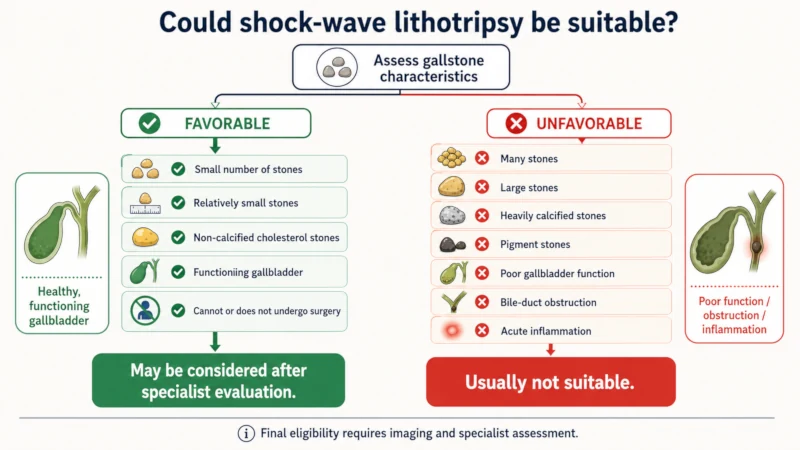
Most people don’t fit those criteria. In studies that measured eligibility using different entry rules, only about 10–25% of patients with gallstones qualified [gallstone lithotripsy eligibility study, 1994]. Larger stones, many stones, calcified (pigment) stones, or a poorly functioning gallbladder generally rule it out. Because size and number matter so much, it helps to know where your stone sits on the scale — our guide to what different gallstone sizes mean breaks that down.
| Feature that helps candidacy | Feature that usually rules it out |
| A single stone, or just a few | Many stones |
| Small (roughly under 2–3 cm) | Large stones |
| Cholesterol stones (radiolucent on X-ray) | Calcified / pigment stones |
| A gallbladder that still empties normally | A poorly functioning gallbladder |
| Someone who can’t or won’t have surgery | Someone who needs urgent, complete stone removal |
Eligibility features summarized from Johns Hopkins Medicine (2022) and a gallstone lithotripsy eligibility study (1994).
What the procedure is like, and what to watch for
A lithotripsy session takes about an hour, sometimes longer depending on the size and number of stones. You lie on a table with the shock-wave machine and imaging equipment; you’re given anesthesia to keep you comfortable; and once the stone is pinpointed with X-ray, sometimes combined with ultrasound, the machine delivers several hundred to several thousand shock waves, with the power adjusted as needed [Johns Hopkins Medicine, 2022]. It’s generally considered safe, and the waves are targeted precisely enough that they usually don’t damage surrounding organs [Johns Hopkins Medicine, 2022].
Because this is the same shock-wave technology used on kidney stones, recognized effects include soreness or bruising where the waves enter the skin, and cramping as fragments move through the ducts; minor blood in the urine can also occur with lithotripsy. Fragments left in the bile or pancreatic duct may need to be removed with an endoscope right afterward [Johns Hopkins Medicine, 2022]. Your care team should walk you through the specific risks for your situation.
Who should avoid it
- Pregnancy — lithotripsy is not advised during pregnancy.
- A pacemaker or other implanted device that the shock waves could disrupt.
- Bleeding disorders or blood thinners — aspirin and other blood thinners typically have to be stopped about a week beforehand, on your doctor’s guidance.
- Anyone who needs stones removed urgently and completely, which lithotripsy can’t guarantee.
Cautions above per Johns Hopkins Medicine (2022).
The option most people choose instead: gallbladder removal
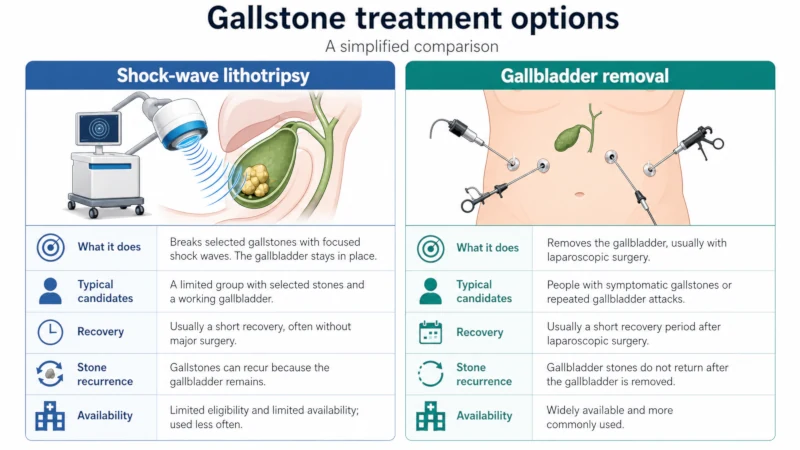
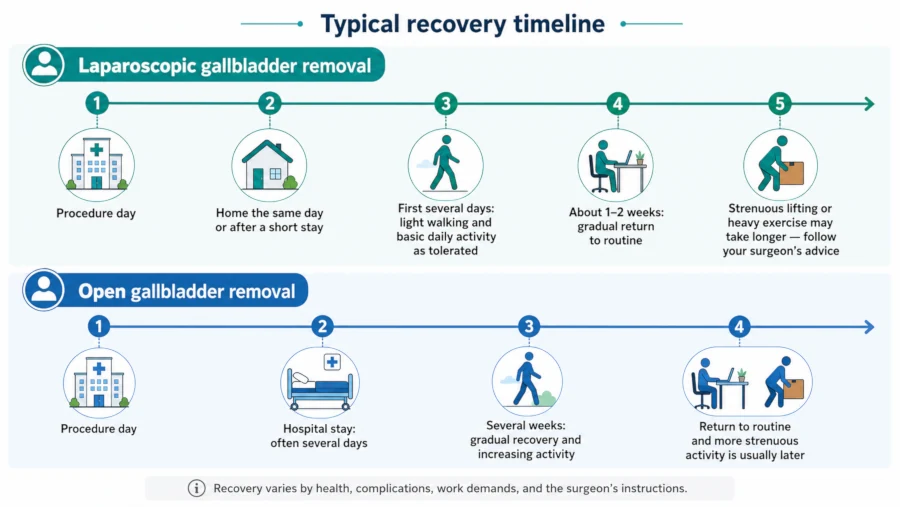
For symptomatic gallstones, the standard treatment is a cholecystectomy — surgery to remove the gallbladder. It’s a common, generally safe operation, most often done with keyhole (laparoscopic) technique through a few small incisions, and many people go home the same day [Mayo Clinic, 2025]. A laparoscopic procedure usually takes one to two hours, with about a week to feel recovered and a return to work in roughly one to two weeks; an open operation means a two-to-three-day hospital stay and four to six weeks of recovery [Mayo Clinic, 2025].
Every surgery carries some risk — for cholecystectomy that includes bile leak, bleeding, infection, injury to nearby structures, and the usual risks of anesthesia [Mayo Clinic, 2025]. The reason it’s the default, though, is durability: removing the gallbladder prevents gallstones from returning in most people, which conservative approaches generally can’t do [Mayo Clinic, 2025]. You can live a normal life without a gallbladder; some people notice looser stools for a while, which usually settles [Mayo Clinic, 2025].
What about flushes, diet, and dissolving pills?
It’s worth being clear-eyed here, because this is where a lot of hope gets misdirected. No food, tea, herb, or “gallbladder flush” dissolves a gallstone or clears a blocked duct. What diet can do is help with day-to-day comfort and lower the odds of forming new stones — building meals around fiber, whole grains, and healthy fats, keeping a healthy weight, and losing weight gradually rather than rapidly [NIDDK]. If you’re working out what to eat, our practical guides to foods to eat with gallstones and a broader gallbladder-friendly diet list are reasonable starting points — as support around the condition, not a cure for it.
Dissolution medicines (ursodiol or chenodiol) are a genuine but limited option: they work only on small cholesterol stones, can take months to years, and the stones often return once treatment stops. They’re generally reserved for people who can’t have surgery [Mayo Clinic, 2025; NIDDK].
When to get help now
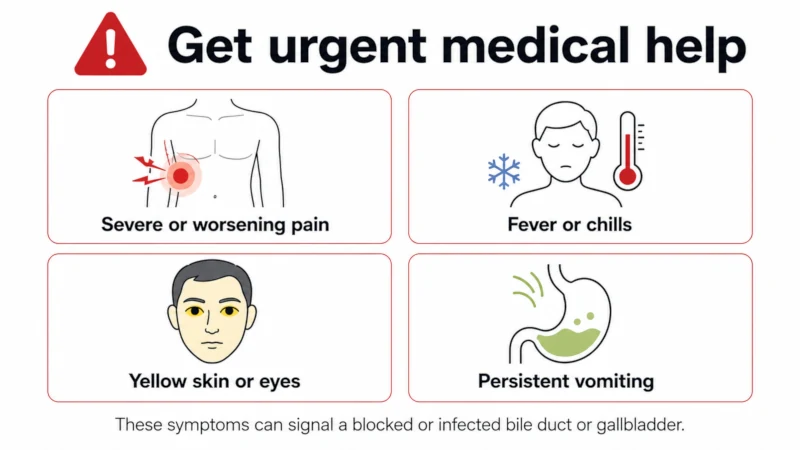
Most gallstones never cause trouble. But a stone that blocks a duct can turn into a genuine emergency — a gallbladder infection (cholecystitis), a bile-duct infection (cholangitis), or pancreatitis, any of which can become life-threatening if ignored [NIDDK]. Don’t wait these out. Seek urgent or emergency care — in the U.S., call 911 or go to the nearest emergency room — if you have:
- Abdominal pain so intense you can’t sit still or get comfortable
- Belly pain that lasts more than a few hours, or spreads to your back or shoulder with vomiting
- A high fever, or feeling hot and cold and shivery
- Yellowing of your skin or the whites of your eyes (jaundice)
- Persistent vomiting
Warning signs per Mayo Clinic (2025) and NIDDK.
| Health Disclaimer: This article is for general education and is not medical advice, a diagnosis, or a treatment plan. Gallstones can cause complications that need urgent care, and no food, supplement, herbal remedy, or “flush” dissolves a stone or clears a blocked duct. Whether shock-wave lithotripsy, medication, or surgery makes sense depends on your symptoms, your stone type and size, and your overall health, so those decisions should be made with a licensed clinician who knows your history. If you have sudden or severe abdominal pain, a high fever or shaking chills, persistent vomiting, or yellowing of your skin or the whites of your eyes, seek emergency care now — in the U.S., call 911 or go to the nearest emergency room — rather than waiting. |
Frequently Asked Questions
Can sound waves remove my gallstones without surgery?
For stones sitting inside the gallbladder, this is rarely done today, because the stones tend to return [Johns Hopkins Medicine, 2022; NIDDK]. For a stone stuck in the bile duct or pancreatic duct, shock-wave lithotripsy is sometimes used to break it up so it can be cleared with an endoscope [Johns Hopkins Medicine, 2022].
Is this the same treatment used for kidney stones?
It’s the same technology — extracorporeal shock wave lithotripsy — but a different job. It remains a main noninvasive option for many kidney stones, while for stones in the gallbladder it has largely been retired in favor of gallbladder removal [Johns Hopkins Medicine, 2022].
Will my stones come back after lithotripsy?
For gallbladder stones, often yes. The gallbladder stays in place, so the conditions that produced the first stones remain, and new ones commonly form over time — which is exactly why surgery became the standard [shock-wave lithotripsy review, 2005; Johns Hopkins Medicine, 2022].
Does it hurt, and what are the side effects?
You’re given anesthesia during the procedure. Afterward, recognized effects include soreness or bruising where the waves enter the skin and cramping as fragments pass; minor blood in the urine can occur with lithotripsy [Johns Hopkins Medicine, 2022].
Who shouldn’t have shock-wave lithotripsy?
People who are pregnant, who have a pacemaker or other implanted device, who have a bleeding disorder or take blood thinners, or who need stones removed urgently and completely [Johns Hopkins Medicine, 2022].
How much does it cost?
Cost varies widely by facility, region, and insurance, and there’s no single reliable price to quote. Because lithotripsy is rarely offered for gallbladder stones, the most accurate step is to ask a specific center and your insurer for an estimate — and to ask them to compare it against gallbladder removal, which is the more common treatment [Mayo Clinic, 2025].
References
- Johns Hopkins Medicine. “Extracorporeal Shock Wave Lithotripsy (ESWL).” 2022. View source
- National Institute of Diabetes and Digestive and Kidney Diseases (NIDDK). “Gallstones” and “Treatment for Gallstones.” U.S. National Institutes of Health (content last reviewed 2017). View source
- Mayo Clinic. “Cholecystectomy (Gallbladder Removal).” 2025. View source
- Mayo Clinic. “Gallstones — Symptoms & Causes.” 2025. View source
- “Extracorporeal shock wave lithotripsy of gallstones: 20th anniversary of the first treatment.” Review, 2005. PubMed PMID 15827443. View source
- “Eligibility for extracorporeal shock wave lithotripsy of gallbladder stones using different entry criteria.” PubMed PMID 10148598. View source
- Natural Health Message. “Gallstones Size Chart: What the Size of Your Stone Really Means.” (internal) View source
- Natural Health Message. “Gallbladder Diet Food List.” (internal) View source
- Natural Health Message. “9 Powerful Foods to Eat with Gallstones.” (internal) View source
