
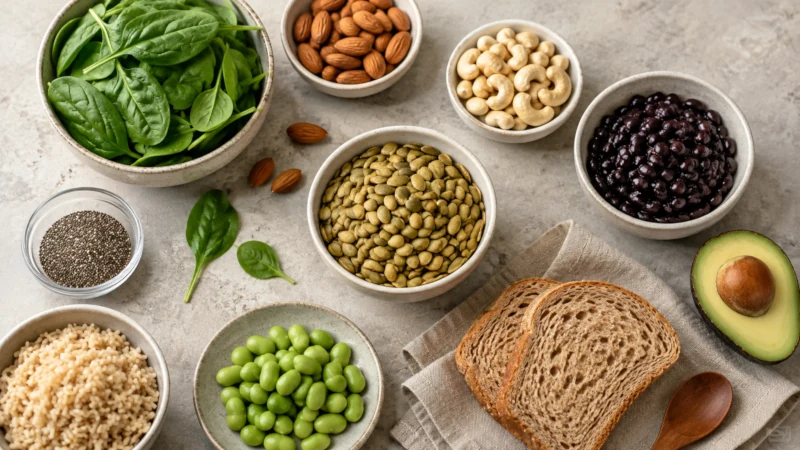
The most magnesium-rich foods are seeds, nuts, beans, leafy greens, and whole grains — pumpkin seeds, chia, almonds, spinach, black beans, and brown rice sit near the top. Build meals around those and you’re most of the way to your daily target. Lean instead on white bread, white rice, fast food, and not much produce, and you may be one of the many Americans who fall short: an analysis of national survey data found that about 48% of people in the US take in less magnesium than they need from food and drink [NIH Office of Dietary Supplements, 2026].
Magnesium is worth the attention. Your body uses it as a helper in more than 300 enzyme systems that run everything from energy production and protein building to muscle and nerve signaling and a steady heartbeat [NIH Office of Dietary Supplements, 2026]. The good news is that hitting your number is mostly a grocery problem, not a pharmacy one. Here’s exactly what to eat.
The best magnesium-rich foods, by how much they deliver
Seeds and nuts lead the list
Ounce for ounce, seeds are the densest everyday source. A single ounce of roasted pumpkin seeds delivers about 156 mg of magnesium — roughly 37% of the Daily Value in one small handful. Chia seeds bring about 111 mg per ounce, and almonds and cashews land in the 74–80 mg range [NIH Office of Dietary Supplements, 2026]. Sprinkle them on oatmeal, blend them into a smoothie, or just keep a jar of pumpkin seeds within reach.
Beans, greens, and whole grains do the heavy lifting
The reason greens and beans matter so much is volume: you eat them in real quantities, and they show up at nearly every meal. Half a cup of boiled spinach gives about 78 mg; half a cup of black beans about 60 mg; edamame about 50 mg. Whole grains carry magnesium in the germ and bran, which is exactly the part refining strips away — so two large shredded-wheat biscuits provide about 61 mg while a slice of whole-wheat bread gives around 23 mg, and white rice trails far behind brown [NIH Office of Dietary Supplements, 2026]. Even your water counts a little, though the amount swings widely by source.
A magnesium food chart
Values are milligrams (mg) per serving and the corresponding Percent Daily Value (%DV); the DV for magnesium is 420 mg. A food supplying 20% or more of the DV counts as a high source, but the smaller contributors still add up across a day [NIH Office of Dietary Supplements, 2026]; [USDA FoodData Central, 2026].
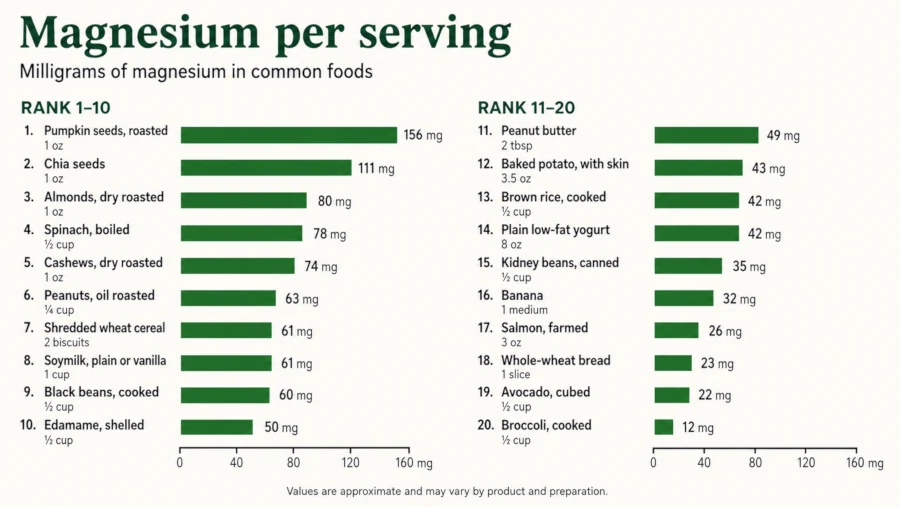
| Food | Serving | Magnesium (mg) | %DV |
| Pumpkin seeds, roasted | 1 oz | 156 | 37% |
| Chia seeds | 1 oz | 111 | 26% |
| Almonds, dry roasted | 1 oz | 80 | 19% |
| Spinach, boiled | ½ cup | 78 | 19% |
| Cashews, dry roasted | 1 oz | 74 | 18% |
| Peanuts, oil roasted | ¼ cup | 63 | 15% |
| Shredded wheat cereal | 2 biscuits | 61 | 15% |
| Soymilk, plain/vanilla | 1 cup | 61 | 15% |
| Black beans, cooked | ½ cup | 60 | 14% |
| Edamame, shelled | ½ cup | 50 | 12% |
| Peanut butter | 2 tbsp | 49 | 12% |
| Baked potato, with skin | 3.5 oz | 43 | 10% |
| Brown rice, cooked | ½ cup | 42 | 10% |
| Plain low-fat yogurt | 8 oz | 42 | 10% |
| Kidney beans, canned | ½ cup | 35 | 8% |
| Banana | 1 medium | 32 | 8% |
| Salmon, farmed | 3 oz | 26 | 6% |
| Whole-wheat bread | 1 slice | 23 | 5% |
| Avocado, cubed | ½ cup | 22 | 5% |
| Broccoli, cooked | ½ cup | 12 | 3% |
How much magnesium do you need per day?
Your target depends on age and sex, and it counts magnesium from everything — food, drinks, and any supplements combined [NIH Office of Dietary Supplements, 2026].
| Group | Recommended daily magnesium |
| Men, 19–30 | 400 mg |
| Men, 31 and older | 420 mg |
| Women, 19–30 | 310 mg |
| Women, 31 and older | 320 mg |
| Pregnancy | 350–360 mg |
| Breastfeeding | 310–320 mg |
| Teens, 14–18 | 360 mg (girls) / 410 mg (boys) |
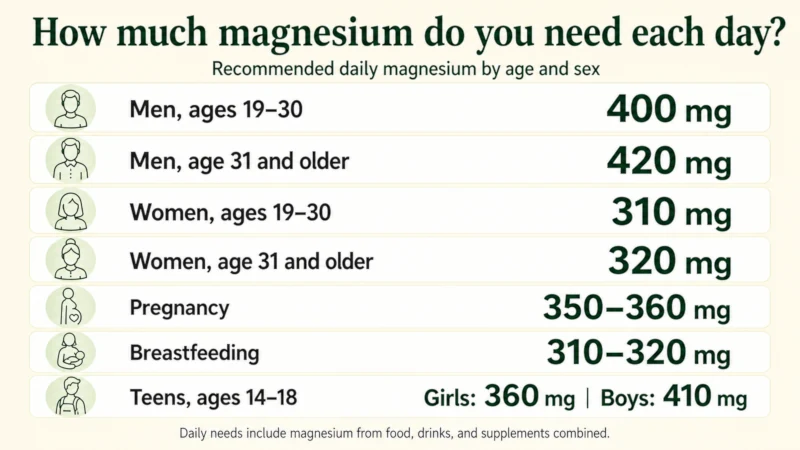
Put the chart and the target together and the math gets encouraging fast. An ounce of pumpkin seeds, half a cup of black beans, a serving of spinach, and a couple of slices of whole-grain bread already carry you a long way toward a full day.
Getting the most magnesium from your food
Your body absorbs roughly 30% to 40% of the magnesium you eat, which is normal and nothing to engineer around [NIH Office of Dietary Supplements, 2026]. You’ll read that compounds like phytates in whole grains slightly lower how much you take up — that’s true, but those same grains, beans, and greens are among the richest sources to begin with, so they remain a net win. Variety beats optimization here.
Two practical moves matter more than any absorption trick. Choose whole or minimally processed grains over refined ones, since refining removes the magnesium-dense germ and bran [NIH Office of Dietary Supplements, 2026]. And keep your minerals coming mostly from food, where magnesium arrives alongside potassium, fiber, and — in foods like almonds and greens — calcium, rather than trying to balance isolated high-dose pills.
What magnesium actually does for you (and what it doesn’t)
It helps to separate what’s well established from what’s still promising or genuinely mixed.
Well established. Magnesium is required for hundreds of enzyme reactions, for building bone (which stores 50–60% of the body’s supply), and for normal muscle contraction, nerve signaling, and heart rhythm. Correcting a real shortfall supports all of that [NIH Office of Dietary Supplements, 2026].
Promising but limited or mixed. For blood pressure, supplement trials show only a small effect — on the order of a few millimeters of mercury — and in 2022 the FDA allowed a qualified claim while stating the evidence is inconsistent and inconclusive. People with higher magnesium intakes tend to have a lower risk of type 2 diabetes, but that comes from observational studies, and the American Diabetes Association says there isn’t enough evidence to recommend magnesium to control blood sugar.
For migraine, the American Academy of Neurology and the American Headache Society concluded magnesium is probably effective for prevention — but the doses used are typically above the safe supplement ceiling, so that’s a clinician’s call, not a DIY one. For bone health, higher intakes are linked with better bone density, though more research is needed to say supplements prevent osteoporosis [NIH Office of Dietary Supplements, 2026].
The honest throughline: getting enough magnesium is clearly good for you, and food is the safest way to do it — but magnesium is not a cure for high blood pressure, diabetes, or migraines.
Signs you might be running low — and who’s most at risk
In healthy people, a true deficiency is uncommon, because the kidneys hold on to magnesium when intake drops [NIH Office of Dietary Supplements, 2026]. When it does develop, early signs are easy to miss: loss of appetite, nausea, fatigue, and weakness. As it worsens, it can bring numbness, tingling, muscle cramps and contractions, personality changes, abnormal heart rhythms, and in severe cases seizures or dangerously low calcium or potassium. These symptoms overlap with many conditions, so they point to “get this checked,” not “self-diagnose.”
Some people are more likely to run short: those with digestive conditions such as Crohn’s or celiac disease, people with type 2 diabetes (high blood sugar drives magnesium out through the urine), people with alcohol dependence, and older adults, who tend to eat less magnesium and absorb it less efficiently [NIH Office of Dietary Supplements, 2026]. If you’re in one of those groups, it’s worth raising with your primary care clinician.
Food first, supplements second
Food should be your default, and for most people it’s enough. A supplement makes sense mainly when diet falls short or a health professional recommends one. If you do supplement, the label detail that matters is elemental magnesium — the actual amount your body gets — and the form: citrate, lactate, chloride, and glycinate tend to absorb better than oxide, while oxide and citrate are more likely to loosen stools [NIH Office of Dietary Supplements, 2026]. Our deeper guide to magnesium supplement forms and dosing walks through the trade-offs.
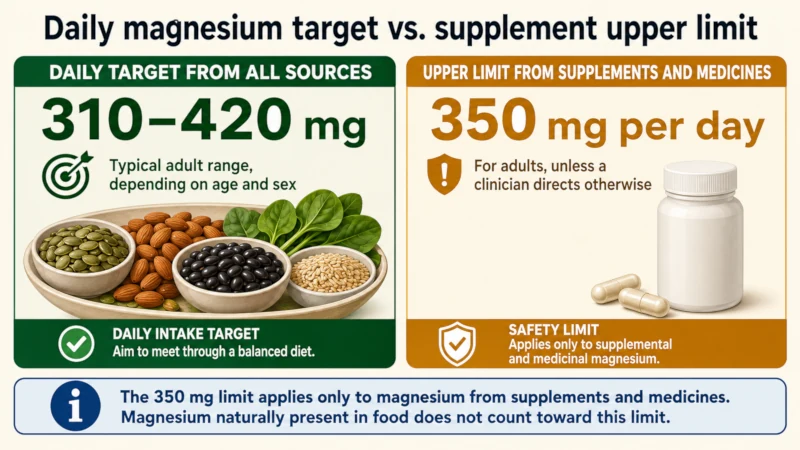
One number to remember: the upper limit for magnesium from supplements is 350 mg per day for adults, unless a doctor directs otherwise [NIH Office of Dietary Supplements, 2026]. That ceiling applies only to supplements and medicines — not to the magnesium naturally in food, which is why the number can look lower than your food target.
Safety, interactions, and who should be careful
Too much magnesium from food isn’t a risk for healthy people, because the kidneys clear the excess. Too much from supplements or magnesium-containing laxatives and antacids is a different story: it commonly causes diarrhea, nausea, and cramping, and very large doses can cause true toxicity — low blood pressure, facial flushing, confusion, muscle weakness, irregular heartbeat, and, rarely, cardiac arrest. That risk climbs sharply when the kidneys can’t keep up [NIH Office of Dietary Supplements, 2026].
Who should check with a professional first: anyone with reduced kidney function or kidney disease, who should not take magnesium supplements without medical supervision; people who are pregnant or breastfeeding; and anyone on the medications below.
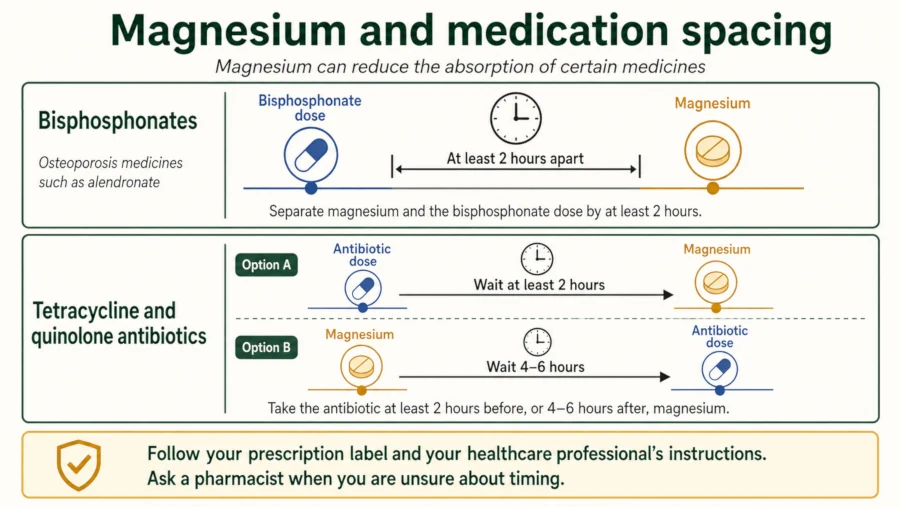
Interactions worth knowing:
- Bisphosphonates (osteoporosis drugs like alendronate): magnesium can block absorption — separate doses by at least 2 hours.
- Antibiotics (tetracyclines and quinolones such as ciprofloxacin): take the antibiotic at least 2 hours before, or 4–6 hours after, magnesium.
- Diuretics: loop and thiazide types increase magnesium loss; potassium-sparing types reduce it.
- Proton pump inhibitors (long-term acid reducers like esomeprazole): prolonged use can lower magnesium levels.
When to seek care: get prompt medical attention for severe or persistent diarrhea and vomiting, fainting, confusion, muscle weakness, or a slow or irregular heartbeat — and call 911 for chest pain, trouble breathing, or collapse. Food-based magnesium won’t cause these; supplements or laxatives taken in excess can.
| Health Disclaimer: This article is for general educational purposes only and is not a substitute for professional medical advice, diagnosis, or treatment. Magnesium needs and cautions vary from person to person. Talk to a qualified healthcare professional before starting a supplement — especially if you are pregnant or breastfeeding, have kidney disease or a heart condition, or take medication. Seek urgent care for severe or sudden symptoms such as chest pain, fainting, confusion, severe weakness, trouble breathing, or an irregular heartbeat, and call 911 in an emergency. |
Frequently Asked Questions
What food has the most magnesium?
Among everyday foods, roasted pumpkin seeds are the densest source — about 156 mg in a single ounce, roughly 37% of the Daily Value. Chia seeds, almonds, cashews, spinach, and black beans follow [NIH Office of Dietary Supplements, 2026].
Can I get enough magnesium from food alone?
For most people, yes. A daily pattern that includes seeds or nuts, beans, leafy greens, and whole grains comfortably reaches the 310–420 mg adult target. Food is also the safest source, since the kidneys clear any excess magnesium that comes from eating [NIH Office of Dietary Supplements, 2026].
How do I know if I’m low on magnesium?
Early signs — low appetite, nausea, fatigue, weakness — are vague, and worsening deficiency can cause cramps, numbness, or abnormal heart rhythms. Because these overlap with many conditions and blood tests don’t fully reflect body stores, the right move is to see a clinician rather than guess [NIH Office of Dietary Supplements, 2026].
Does cooking destroy the magnesium in food?
Heat itself doesn’t. The main loss is when magnesium salts dissolve into cooking water, so using less water (steaming rather than boiling, or reusing the liquid in soups) keeps more of it. Refining grains removes far more magnesium than cooking does [NIH Office of Dietary Supplements, 2026].
Who should be careful with magnesium supplements?
People with reduced kidney function should not take magnesium supplements without medical supervision, and anyone who is pregnant, breastfeeding, or taking bisphosphonates, certain antibiotics, diuretics, or long-term acid reducers should talk to a professional first. The supplemental upper limit for adults is 350 mg per day unless a clinician advises otherwise [NIH Office of Dietary Supplements, 2026].
References
- National Institutes of Health, Office of Dietary Supplements. Magnesium: Fact Sheet for Health Professionals. Updated January 6, 2026. View source
- U.S. Department of Agriculture, Agricultural Research Service. FoodData Central. 2026. View source
