
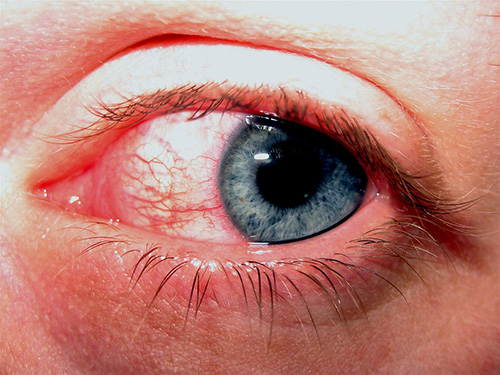
Natural remedies for red eyes can ease mild irritation, but the safest options are simple: a clean cool compress, lubricating artificial tears, rest from contact lenses, and avoiding the trigger. Redness can also come from infection, dry eye, eyelid inflammation, injury, or a more serious eye problem. Pain, light sensitivity, or a change in vision needs prompt medical care. [CDC, 2024] [NHS, 2025]
Do not put homemade boric-acid mixtures, herbal rinses, tea bags, or nonsterile water into your eyes. The U.S. Food and Drug Administration warns that products used in the eye must be sterile because contamination can cause serious infection and vision loss. [FDA, 2025]
First check: when red eyes need urgent care
A mildly irritated eye often improves with basic care. But a red eye is not a diagnosis. Get same-day advice from an optometrist, ophthalmologist, urgent-care clinic, or other qualified clinician if you wear contact lenses and your eye is red, especially if it hurts. Contact-lens wearers have a higher risk of corneal infection. [NHS, 2025]
| Seek urgent medical care now if redness comes with any of these signs A change in vision, blurred vision that does not clear with blinking, or vision loss Moderate or severe eye pain Strong sensitivity to light A severe headache, nausea, or vomiting A chemical splash, injury, or something stuck in the eye Unequal pupils, a very dark-red eye, or rapidly worsening redness Redness in a newborn, or redness while your immune system is weakened |
For a chemical splash, begin rinsing the eye with clean running water or sterile saline right away and get urgent medical help. Do not delay rinsing while looking for a home remedy. [NHS, 2025]
Why eyes look red
The clear membrane over the white part of your eye is called the conjunctiva. When its small surface blood vessels widen, the eye can look pink or bloodshot. Common triggers include viral or bacterial conjunctivitis, allergies, smoke, dust, dry air, dry eye, and irritation from contact lenses or screens. Redness after a long day at a computer may be related to dryness or eyestrain rather than infection. [NEI, 2025] [NEI Dry Eye, 2025]
A solid bright-red patch on one part of the white of the eye is different from diffuse bloodshot redness. It may be a subconjunctival hemorrhage: a tiny broken surface blood vessel. These patches often look alarming but usually cause no pain, discharge, or vision change and clear on their own over days to a few weeks. [Mayo Clinic, 2025]
Natural remedies for red eyes that are generally safe
These steps are meant for mild irritation. They can make your eyes more comfortable while you watch for improvement. They do not replace an eye exam when warning signs are present.
Use a clean cool compress
Wet a clean washcloth with cool water, wring it out, and place it over your closed eyes for 5 to 10 minutes. Use a fresh cloth each time. A cool compress can soothe mild irritation, allergy-related itching, and the discomfort of conjunctivitis. Do not share the cloth with anyone else. [CDC, 2024]
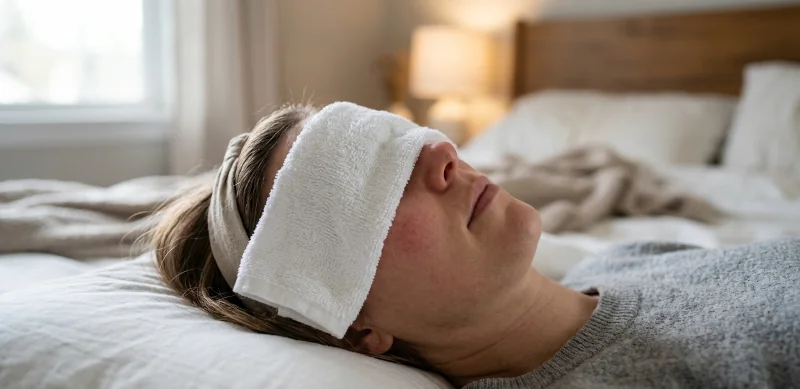
Try preservative-free artificial tears
Lubricating eye drops, often labeled artificial tears, can reduce a gritty or dry feeling. Preservative-free single-use vials are a sensible option if you need drops often or your eyes are sensitive. Wash your hands first, avoid touching the bottle tip to your eye or lashes, and do not share drops. [NEI Dry Eye, 2025] [FDA, 2025]
Remove the trigger and give your eyes a break
Step away from smoke, dust, strong wind, and other irritants. If redness follows screen use, blink more often and take regular visual breaks. The site’s guide to natural remedies for eyestrain has practical ways to reduce screen-related discomfort. Smoke exposure can also keep the eye surface irritated; readers who smoke may find the step-by-step guide to stop smoking useful.
Pause contact lens wear
Take out your contact lenses until the redness has cleared or an eye-care professional says it is safe to restart. Do not wear lenses through pain, discharge, light sensitivity, or worsening redness. If conjunctivitis is possible, throw away disposable lenses and cases used while symptoms were present and follow your eye-care professional’s cleaning advice for reusable items. [CDC, 2024] [CDC Prevention, 2024]
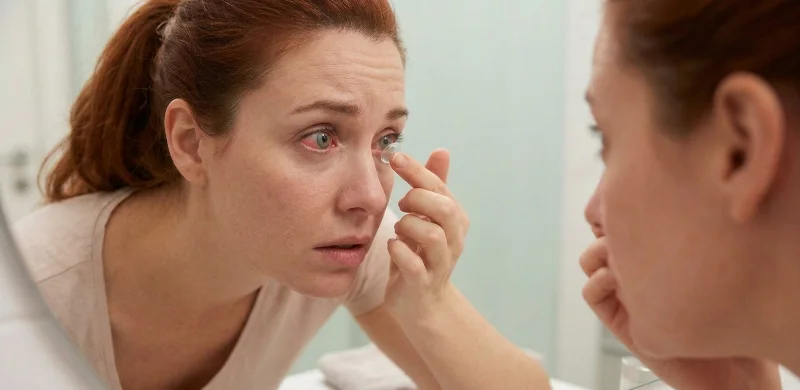
Use warm compresses for crusty eyelids
Redness that comes with flakes, crusting around the lashes, or irritated eyelid edges may be related to blepharitis, which is inflammation of the eyelids. A warm compress over closed eyes can loosen crusts. Gentle eyelid cleaning may help, but avoid scrubbing the eyeball itself. Persistent symptoms deserve an eye exam. [NEI Blepharitis, 2022]
Use careful hygiene if pink eye is possible
Pink eye, also called conjunctivitis, can be caused by viruses, bacteria, allergies, or irritants. Wash your hands often, avoid rubbing your eyes, and do not share towels, pillowcases, eye makeup, drops, or contact-lens supplies. Clean discharge from around the eyelids with a fresh, clean, wet washcloth or cotton ball. For a fuller symptom guide, see natural remedies for conjunctivitis. [CDC Prevention, 2024] [NEI, 2025]
What not to put in your eyes
The eye surface is easy to irritate and vulnerable to contamination. “Natural” does not mean sterile. Skip homemade eye washes made with boric acid, tap water, herbal tea, fennel, cornflower, eyebright, or other plant material. Do not put food, essential oils, colloidal silver, or saliva in your eyes. A mixture can be contaminated even if the ingredients look clean. [FDA, 2025]
Do not use leftover antibiotic or steroid eye drops from an old prescription. Antibiotics do not help viral or allergic conjunctivitis, and steroid eye drops can be risky without an eye exam. A clinician may prescribe treatment after determining the cause. [CDC, 2024]
Be cautious with drops marketed mainly to “get the red out.” Some ocular decongestants shrink surface blood vessels temporarily. Repeated use of older alpha-adrenergic products can lead to reduced effect and rebound redness. If you need redness-relief drops frequently, ask an eye-care professional to help identify the cause instead of masking it. [Hosten & Snyder, 2020]
Routine vitamin or amino-acid megadoses are not a proven remedy for ordinary bloodshot eyes. Vitamin A deficiency can affect eye health, but it is uncommon in the United States and is better known for causing night blindness and dry-eye damage. High-dose supplements can cause harm. Use supplements for a diagnosed deficiency only with professional guidance. [NIH ODS, 2025]
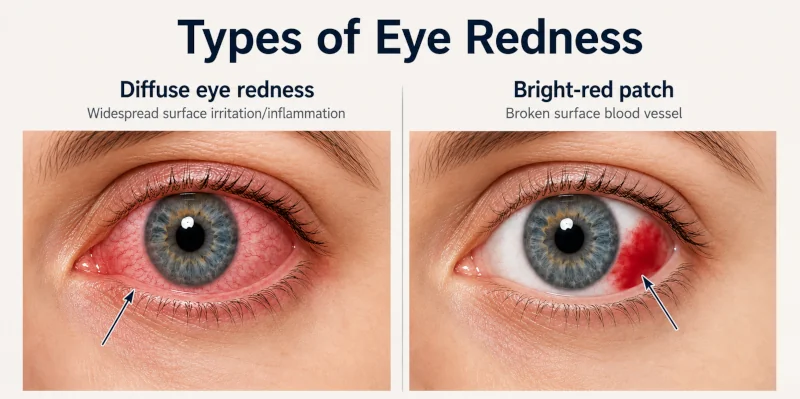
What your red-eye pattern may suggest
Symptoms overlap, so this table cannot diagnose the cause. It can help you decide whether a simple comfort measure is reasonable or whether you should arrange an exam.
| Pattern | What it may suggest | Reasonable next step |
| Itchy, watery eyes, often on both sides | Allergies are possible | Use a cool compress, avoid the trigger, and ask a pharmacist or clinician about allergy treatment if symptoms persist. |
| Gritty, burning, or tired eyes after screens, wind, or dry air | Dry eye or irritation is possible | Use artificial tears, take screen breaks, and reduce exposure to the trigger. |
| Crusting or discharge around the lashes | Conjunctivitis or blepharitis is possible | Use careful hygiene. Arrange medical advice if symptoms worsen, do not improve, or come with pain or vision change. |
| A solid bright-red patch without pain or vision change | A subconjunctival hemorrhage is possible | These patches often clear on their own. Seek care after injury, with recurrent episodes, or if pain or vision change develops. |
| Pain, light sensitivity, vision change, injury, or contact-lens redness | A more serious problem is possible | Seek prompt medical care. Do not rely on home care. |
For more general eye-health information, the site’s natural remedies for eye problems guide can help you compare related topics. A persistent or unexplained red eye still needs individual medical advice.
When self-care is not enough
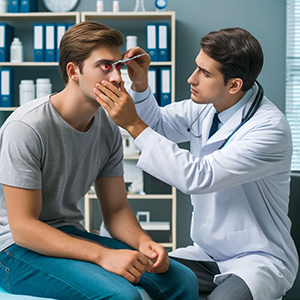
Arrange medical advice if redness is getting worse, does not begin to improve, or keeps returning. The CDC advises care for eye pain, light sensitivity, blurred vision that does not improve after wiping away discharge, intense redness, symptoms that worsen or fail to improve, and symptoms in people with weakened immune systems. A clinician can also help if you are unsure whether the cause is allergy, dry eye, infection, blepharitis, or another condition. [CDC, 2024]
Viral conjunctivitis often clears in 7 to 14 days, although some cases take longer. Mild bacterial conjunctivitis may improve in 2 to 5 days without antibiotics but can take up to 2 weeks to clear fully. The time frame is different for dry eye, allergy, or eyelid inflammation, which may recur unless the trigger or underlying condition is addressed. [CDC, 2024]
| Health Disclaimer: This page is for educational purposes only. It is not a diagnosis and does not replace care from an optometrist, ophthalmologist, pharmacist, or other qualified healthcare professional. Do not put homemade solutions, herbs, supplements, or nonsterile products into your eyes. Seek urgent medical care for pain, light sensitivity, vision change, injury, chemical exposure, contact-lens redness, or rapidly worsening symptoms. |
Frequently Asked Questions
How quickly should mild red eyes improve?
Mild irritation may start to settle after you remove the trigger and use a cool compress or artificial tears. Viral conjunctivitis commonly clears in 7 to 14 days, although some cases take longer. Get medical advice if redness worsens, is intense, or does not begin to improve. [CDC, 2024]
Are artificial tears safe for red eyes?
Lubricating artificial tears can help with mild dryness or irritation. Use a sterile product, wash your hands, and avoid touching the dropper tip to your eye. Ask a pharmacist or eye-care professional for help choosing a product if you need drops often. [FDA, 2025]
Can I use tea, herbs, or boric acid as an eye wash?
No. Homemade eye washes are not reliably sterile and can irritate the eye or introduce infection. Use only sterile products made for use in the eye. [FDA, 2025]
Should I stop wearing contact lenses if my eye is red?
Yes. Remove your lenses and do not restart until the redness has cleared or an eye-care professional says it is safe. Contact a clinician promptly if redness comes with pain, discharge, light sensitivity, or blurred vision. [CDC, 2024]
What does a bright-red patch on the white of the eye mean?
A painless, sharply defined red patch may be a subconjunctival hemorrhage, which is a small broken surface blood vessel. It often clears on its own. Seek care if it follows an injury, keeps recurring, or comes with pain or a change in vision. [Mayo Clinic, 2025]
References
- Centers for Disease Control and Prevention. “How to Treat Pink Eye.” Updated 2024. → View source
- Centers for Disease Control and Prevention. “How to Prevent Pink Eye.” Updated 2024. → View source
- National Eye Institute. “Pink Eye.” → View source
- National Eye Institute. “Dry Eye.” → View source
- National Eye Institute. “Blepharitis.” → View source
- NHS. “Red Eye.” Reviewed October 27, 2025. → View source
- U.S. Food and Drug Administration. “What You Should Know about Eye Drops.” → View source
- Mayo Clinic. “Subconjunctival Hemorrhage: Symptoms and Causes.” → View source
- National Institutes of Health, Office of Dietary Supplements. “Vitamin A and Carotenoids: Fact Sheet for Consumers.” → View source
- Hosten LO, Snyder C. “Over-the-Counter Ocular Decongestants in the United States — Mechanisms of Action and Clinical Utility for Management of Ocular Redness.” Clinical Optometry. 2020;12:95–105. DOI: 10.2147/OPTO.S259398. → View source
