
Acerola cherry is one of the richest natural sources of vitamin C on earth, and vitamin C genuinely does have specific, well-documented jobs inside your immune system. But the popular shorthand — that acerola cherry for immunity will “boost” your defenses or keep colds away — promises more than the evidence supports. The honest version is narrower and more useful: vitamin C is required for immune cells to work normally, regular intake modestly shortens colds, and acerola is a clean, concentrated way to get it. It will not make you cold-proof.
Here’s what the research actually shows, where acerola specifically fits, and what to realistically expect. For the wider picture beyond immunity, see our complete acerola cherry guide and the full range of acerola benefits.
How Vitamin C Actually Supports Your Immune System
The link between vitamin C and immune defense isn’t marketing. It is mapped across hundreds of studies and summarized in a detailed 2017 review by Carr and Maggini in Nutrients [Carr & Maggini, 2017].
Your Immune Cells Stockpile Vitamin C
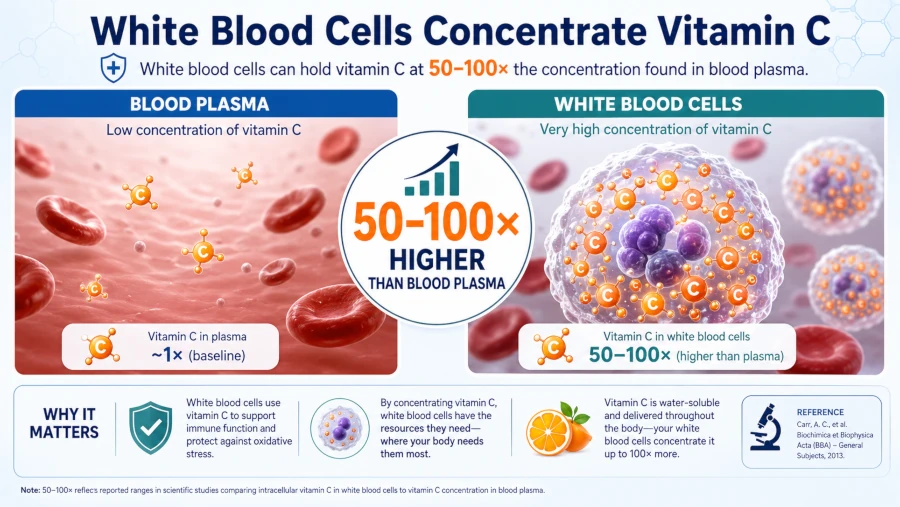
White blood cells — neutrophils, monocytes, and lymphocytes — pull vitamin C in from the blood and hold it at concentrations roughly 50 to 100 times higher than plasma [Carr & Maggini, 2017][Moore & Khanna, 2023]. They don’t do this passively. They spend energy running it inside through dedicated transport proteins. When a cell invests that much effort to hoard a nutrient, that nutrient is doing real work.
Acerola Cherry for Immunity: The First Responders
Your innate immune system is the fast, general-purpose defense that reacts the moment a pathogen shows up. Vitamin C supports several pieces of it:
- Barriers. It helps maintain the skin and the mucosal linings (nose, throat, gut) that physically keep pathogens out, partly by supporting collagen and the protective outer skin layer [Carr & Maggini, 2017].
- Getting to the infection. Vitamin C improves neutrophils’ ability to migrate toward an infection site. In one trial, a whole-food vitamin C source raised neutrophil chemotaxis by about 20% [Bozonet et al., 2015].
- Killing pathogens. It strengthens neutrophils’ ability to engulf and destroy microbes. Cells from vitamin C–deficient animals are noticeably worse at this [Carr & Maggini, 2017].
- Cleaning up afterward. Once neutrophils finish, they need to be cleared so inflammation switches off. Vitamin C supports that orderly cleanup, which limits collateral tissue damage [Carr & Maggini, 2017].
Adaptive Immunity: The Targeted Response
Adaptive immunity is the slower, specific arm — antibodies and memory cells tailored to a particular invader.
- T cells. Vitamin C helps T cells mature and multiply, and may nudge the response toward the type useful against viruses and intracellular pathogens [Cerullo et al., 2020][Sasidharan Nair & Huehn, 2024].
- Antibodies. Effects on antibody-producing B cells are mixed — some studies show a benefit, others don’t [Van Gorkom et al., 2018].
- Natural killer cells. Vitamin C can increase NK cell numbers, though whether it sharpens their killing remains unclear [Van Gorkom et al., 2018].
| Immune function | Vitamin C’s role | How strong is the evidence? |
| Skin & mucosal barriers | Helps keep physical defenses intact | Strong (human + lab) |
| Neutrophil migration | Speeds movement toward infection | Moderate–strong (human) |
| Engulfing & killing microbes | Improves neutrophil killing | Strong (human + animal) |
| Neutrophil cleanup | Reduces leftover inflammation | Moderate (lab + animal) |
| T-cell development | Supports maturation and growth | Moderate (lab + animal) |
| Antibody production | Possible, inconsistent | Mixed |
| NK cell numbers | Can increase counts | Moderate (lab) |
The takeaway: vitamin C is a genuine requirement for normal immune function. That’s different from saying more of it makes a healthy immune system stronger than its baseline.
What the Strongest Cold Research Shows
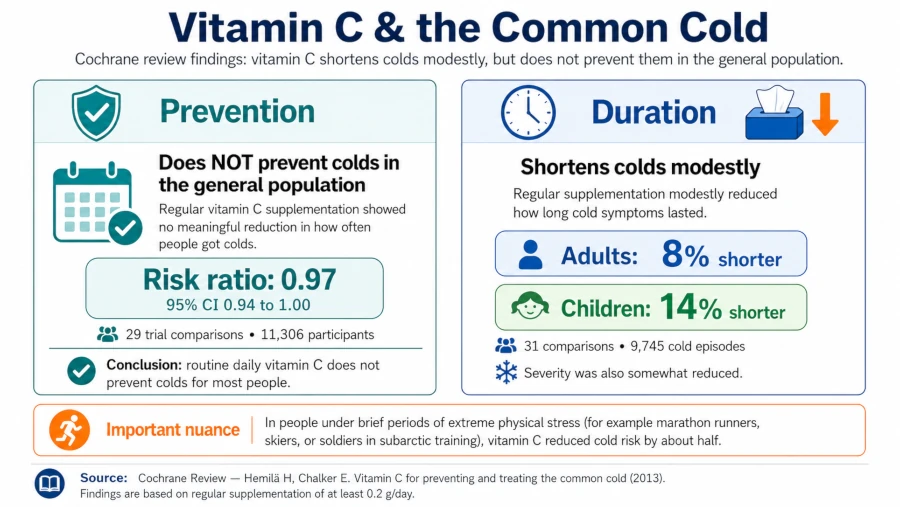
The best evidence on vitamin C and colds is a Cochrane systematic review by Hemilä and Chalker that pooled placebo-controlled trials covering more than 11,000 people [Hemilä & Chalker, 2013]. Cochrane reviews sit at the top of the evidence hierarchy, so this is about as close to a definitive answer as nutrition research gets.
Does Vitamin C Prevent Colds?
For most people, no. Taking vitamin C daily did not reduce how often ordinary people caught colds [Hemilä & Chalker, 2013]. A daily supplement won’t make you immune to the next one going around the office.
There’s one real exception. In six trials covering 642 people under intense short-term physical stress — marathon runners, skiers, and soldiers training in subarctic conditions — regular vitamin C cut cold incidence roughly in half [Hemilä & Chalker, 2013]. If your body is under extreme physical strain, prevention appears possible. For everyday life, it isn’t.
Does Vitamin C Shorten Colds?
Yes — modestly, and only if you were already taking it. Regular supplementation of at least 200 mg/day shortened colds by about 8% in adults and 14% in children [Hemilä & Chalker, 2013]. On a typical 7-day cold, that’s roughly half a day shorter for adults and about a day for kids. Real and statistically solid, but small. Vitamin C trims the edge off a cold; it doesn’t cancel it.
Does Taking Vitamin C After a Cold Starts Help?
Largely no. When people started vitamin C after symptoms appeared, the trials showed no consistent benefit [Hemilä & Chalker, 2013]. The duration benefit comes from steady, ongoing intake — not a reactive megadose at the first sniffle.
| The Cochrane bottom line: Regular vitamin C at 200+ mg/day modestly shortens colds (about 8% in adults, 14% in children) but does not prevent them in the general population. The benefit is preventive and ongoing, not after-the-fact. Only people under extreme physical stress see fewer colds. |
The Linus Pauling Megadose Question
Nobel laureate Linus Pauling popularized vitamin C megadoses (often 1,000+ mg/day) for colds in the 1970s, and the debate has run ever since. He was partly right: vitamin C does support immune function, and the cold-shortening effect is real. But he overstated the size of the benefit and the dose needed.
Two facts settle the dosing argument. Absorption efficiency drops once you go past about 1 gram a day — your gut takes in a smaller fraction of each additional dose [NIH ODS]. And there is no established health benefit for healthy people in exceeding the recommended intake [IOM, 2000]. For immune support, the practical sweet spot is moderate (200–500 mg/day), not heroic.
Where Acerola Cherry Fits In
Everything above applies to vitamin C from any source. So what, if anything, makes acerola worth choosing?
Concentrated Whole-Food Vitamin C
Raw acerola contains roughly 1,678 mg of vitamin C per 100 grams — among the highest of any food and many times that of an orange [USDA FoodData Central]. A small daily serving of acerola powder easily reaches the 200+ mg range the Cochrane data points to, though the exact amount per spoonful varies a lot by product, so check the label rather than assuming. For the full nutrient breakdown, see acerola’s nutrition profile.
The Absorption Question: Promising, Not Proven
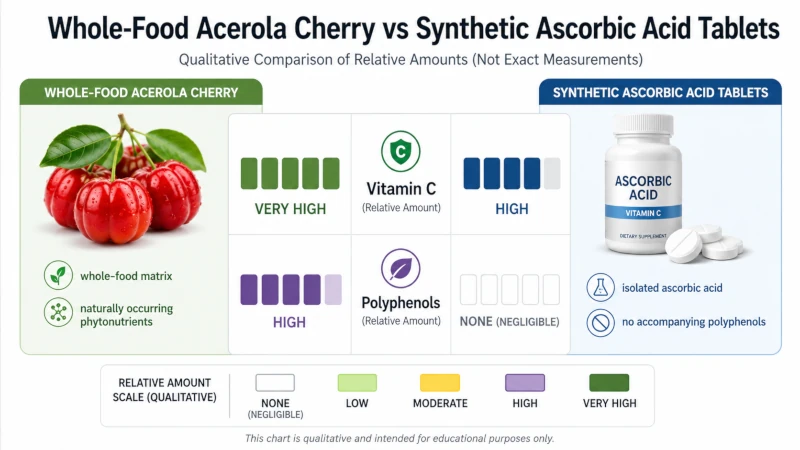
Here’s where acerola’s case gets interesting — and where honesty matters. In a small study of six healthy young men, vitamin C from acerola juice produced higher blood levels and lower urinary loss than the same dose of plain ascorbic acid, meaning more was retained [Uchida et al., 2011]. A later lab study found acerola polyphenols increased the gene for SVCT1, an intestinal vitamin C transporter, offering a plausible mechanism [Takino et al., 2020].
But this should be read as preliminary, not settled. The study was tiny and short. And when researchers look across whole-food vitamin C sources broadly, the flavonoid “absorption advantage” is usually negligible — kiwifruit, blackcurrant, and orange juice studies haven’t reliably shown it, and a steady-state trial found synthetic and kiwifruit-derived vitamin C essentially equivalent [Linus Pauling Institute]. Acerola may be a genuine exception, but “may be” is the accurate phrasing until larger trials confirm it.
The Polyphenol Factor
Acerola delivers vitamin C inside a package of other compounds — flavonoids like quercetin and rutin, anthocyanins, and carotenoids — several of which have their own anti-inflammatory and immune-modulating activity in research [Mezadri et al., 2008][Prakash & Baskaran, 2018].
A 2025 study in cell and zebrafish models reported that acerola concentrate outperformed synthetic vitamin C at calming an inflammatory signaling pathway (NF-κB/TLR4/MyD88), lowered pro-inflammatory signals, and increased immune-cell recruitment — though it noted only limited improvement in one measure of pathogen engulfment [Journal of Functional Foods, 2025]. These are lab and animal findings, not human results, so treat them as a reason for interest, not a health claim.
Realistic Expectations: What Acerola Can and Can’t Do
This is the section the supplement label won’t give you. “Boost” sells, but immunity isn’t a tank you top off. Here’s the honest framework.
| Acerola CAN | Acerola CANNOT |
| Supply concentrated, well-absorbed vitamin C your immune cells need | Stop you from catching colds (no prevention in normal populations) |
| Help correct or prevent low vitamin C status, which impairs immunity | Make a healthy immune system “stronger than normal” |
| Modestly shorten colds when taken regularly, not reactively | Treat an active infection — it isn’t a medication |
| Add polyphenols with their own antioxidant activity | Replace vaccines, sleep, exercise, or hygiene |
| Support barriers, neutrophils, and T-cell development | Make up for an otherwise poor diet or lifestyle |
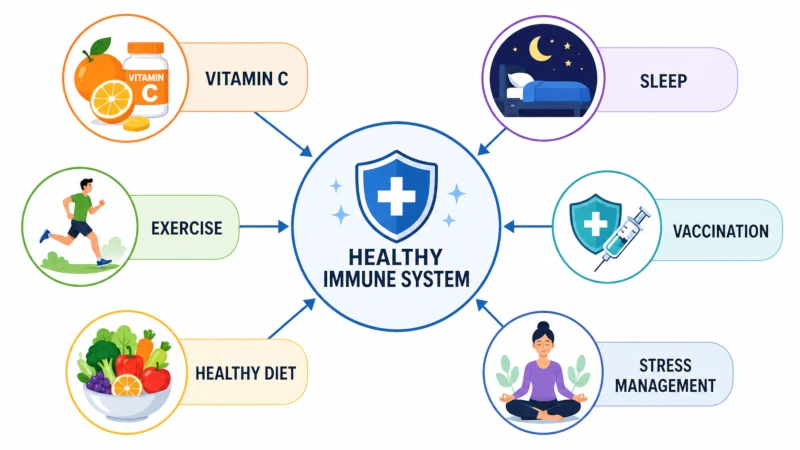
Acerola is a nutritional tool, not a shield. It is one piece of a larger picture that includes sleep, stress management, regular movement, a varied diet, and appropriate vaccination — all of which move immune resilience more than any single supplement.
How to Use Acerola Cherry for Immune Support
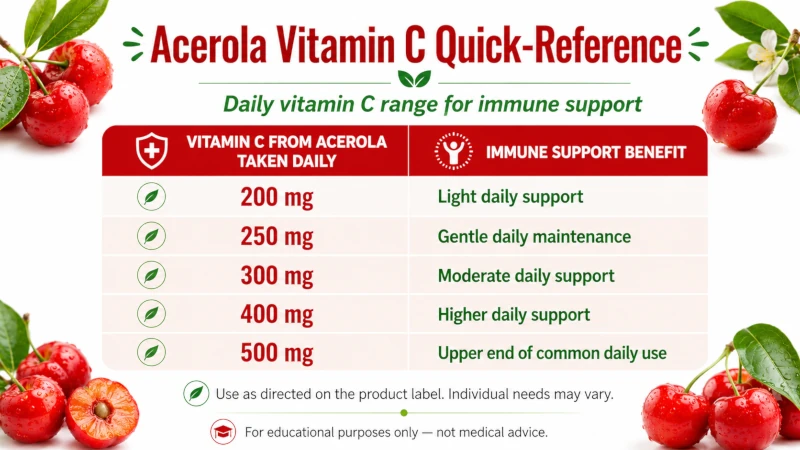
- Daily amount: Aim for 200–500 mg of vitamin C from acerola. This matches the Cochrane cold data and sits in the range where immune-cell vitamin C levels saturate; higher amounts give diminishing returns [Hemilä & Chalker, 2013][NIH ODS].
- Form: Powder stirred into a smoothie or water is the most practical option; capsules work for convenience. See the acerola powder guide for picking a product, and the dosage guide for form-specific amounts.
- Timing: Take it consistently, year-round — not only in cold season. The benefit depends on ongoing intake before a cold, not a scramble once symptoms hit.
- Pair it with the things that matter more: 7–9 hours of sleep, regular exercise, and stress management influence immune resilience more than any supplement. Zinc is another nutrient with reasonable cold evidence.
- If you’re already getting sick: There’s no good evidence that doubling your dose mid-cold speeds recovery if you were supplementing regularly. Keep your usual intake, hydrate, and rest.
Safety, Side Effects, and Who Should Be Cautious
Vitamin C is one of the safer supplements, but “natural” and “high-dose” are not the same as “risk-free.”
Side effects. The most common issues come from large doses: diarrhea, nausea, stomach cramps, and other digestive upset [NIH ODS]. These usually appear well above the immune-support range.
Upper limit. The tolerable upper intake level for adults is 2,000 mg/day of total vitamin C, set because higher amounts can cause osmotic diarrhea and gastrointestinal distress [NIH ODS][IOM, 2000]. The 200–500 mg immune-support range sits comfortably below this — but remember to count vitamin C from all sources, including multivitamins and fortified foods.
Who should check with a clinician first:
- History of kidney stones or kidney disease. High vitamin C intake can raise oxalate and is a noted concern for stone formers [NIH ODS].
- Iron-overload conditions (e.g., hemochromatosis). Vitamin C increases iron absorption, which can be a problem if your body already stores too much [NIH ODS].
- G6PD deficiency. Very high vitamin C doses have been linked to red-blood-cell breakdown in this inherited condition [NIH ODS].
- People taking warfarin. A theoretical interaction exists in which high vitamin C may reduce warfarin absorption; the evidence is weak, but flag it with your prescriber if you take blood thinners.
Pregnancy and breastfeeding. Vitamin C within recommended amounts is appropriate — the RDA is 85 mg in pregnancy and 120 mg while breastfeeding [NIH ODS]. But concentrated acerola supplements specifically haven’t been studied for safety in pregnancy or lactation, so talk to your obstetric provider before using one.
When to see a healthcare professional instead of reaching for a supplement. A cold is self-limiting, but get medical care for a fever above 103°F (39.4°C), symptoms lasting beyond about 10 days or sharply worsening after starting to improve, trouble breathing, chest pain, or a persistent cough with colored mucus. Supplements are not a substitute for evaluation when something feels worse than an ordinary cold.
For a fuller breakdown, see the acerola side effects and interactions guide.
Health Disclaimer: This article is for general educational purposes only and is not medical advice. It is not intended to diagnose, treat, cure, or prevent any disease. Vitamin C and acerola supplements can interact with certain conditions and medications. Always talk with a qualified healthcare professional before starting, stopping, or changing any supplement, especially if you are pregnant, breastfeeding, taking medication, or managing a health condition.
Frequently Asked Questions
Does acerola cherry boost the immune system?
“Boost” overstates it. Vitamin C is required for normal immune function, and acerola is one of the most concentrated natural sources. If your vitamin C status is low, acerola helps restore it, which supports proper immune-cell function — and regular intake modestly shortens colds. But it doesn’t push a healthy immune system above its normal baseline.
Can acerola cherry prevent colds?
For most people, no. The Cochrane review found regular vitamin C didn’t reduce how often ordinary people caught colds. People under extreme physical stress — marathon runners, soldiers in harsh conditions — were the exception, with about half as many colds. For everyday life, acerola shortens colds rather than preventing them.
How much acerola should I take for immune support?
About 200–500 mg of vitamin C from acerola daily, based on the Cochrane evidence — often roughly 1/4 to 1 teaspoon of powder, though this varies by product, so check the label. Taking it regularly beats megadosing during illness.
Is acerola better than a regular vitamin C pill?
Possibly, but it’s not proven. A small study suggested vitamin C from acerola was absorbed and retained better than synthetic ascorbic acid, and acerola adds polyphenols a pill lacks. But across whole-food sources generally, this absorption edge often disappears, so the advantage is plausible rather than established.
Should I take more acerola when I feel a cold coming on?
Probably not worth it. The Cochrane review found that starting or increasing vitamin C after symptoms begin didn’t consistently help if you were already supplementing. Keep your normal intake, hydrate, and rest.
Can acerola replace the flu vaccine?
No. A vaccine creates targeted protection against specific viruses; vitamin C supports general immune-cell function. They’re complementary, not interchangeable. Discuss vaccination with your healthcare provider.
Is acerola cherry safe for daily immune support?
For most healthy adults, yes, when total vitamin C from all sources stays below 2,000 mg/day. At the 200–500 mg range used for immune support, side effects are uncommon.
Key Takeaways
Vitamin C has real, documented roles in immune defense — supporting barriers, neutrophil function, and T-cell development, and concentrating inside immune cells at up to 100 times blood levels [Carr & Maggini, 2017]. The strongest cold evidence shows regular intake of 200+ mg/day modestly shortens colds (about 8% in adults, 14% in children) but doesn’t prevent them in the general population [Hemilä & Chalker, 2013].
Acerola is among the most concentrated natural vitamin C sources [USDA FoodData Central], and early research hints its vitamin C may absorb especially well, though larger studies are needed [Uchida et al., 2011]. Set expectations accordingly: acerola supports normal immune function as one part of a routine built on sleep, exercise, a varied diet, and vaccination. For practical use, 200–500 mg of vitamin C from acerola, taken consistently year-round, fits the evidence.
References
- Carr AC, Maggini S. Vitamin C and immune function. Nutrients. 2017;9(11):1211. View source
- Hemilä H, Chalker E. Vitamin C for preventing and treating the common cold. Cochrane Database Syst Rev. 2013;(1):CD000980. View source
- Bozonet SM, Carr AC, Pullar JM, Vissers MCM. Enhanced human neutrophil vitamin C status, chemotaxis and oxidant generation following dietary supplementation with vitamin C–rich SunGold kiwifruit. Nutrients. 2015;7(4):2574–2588. View source
- Uchida E, Kondo Y, Amano A, et al. Absorption and excretion of ascorbic acid alone and in acerola (Malpighia emarginata) juice: comparison in healthy Japanese subjects. Biol Pharm Bull. 2011;34(11):1744–1747. View source
- Takino Y, et al. Acerola (Malpighia emarginata DC.) promotes ascorbic acid uptake into Caco-2 cells via SVCT1. 2020. View source
- Van Gorkom GNY, et al. Influence of vitamin C on lymphocytes: an overview. Antioxidants. 2018;7(3):41. View source
- Cerullo G, et al. The long history of vitamin C: from prevention of the common cold to potential aid in the treatment of COVID-19. Front Immunol. 2020;11:574029. View source
- Moore A, Khanna D. The role of vitamin C in human immunity and its treatment potential against COVID-19. Cureus. 2023;15(1):e33740. View source
- Sasidharan Nair V, Huehn J. Impact of vitamin C on the development, differentiation and functional properties of T cells. Eur J Microbiol Immunol. 2024;14(2):67–74. View source
- Mezadri T, Villaño D, Fernández-Pachón MS, García-Parrilla MC, Troncoso AM. Antioxidant compounds and antioxidant activity in acerola (Malpighia emarginata DC.) fruits and derivatives. J Food Compos Anal. 2008;21(4):282–290. View source
- Prakash A, Baskaran R. Acerola, an untapped functional superfruit: a review on latest frontiers. J Food Sci Technol. 2018;55(9):3373–3384. View source
- Mechanistic study on the effects of acerola cherry concentrate on LPS-induced IEC-6 cell injury and vinorelbine-induced immune function damage in zebrafish. Journal of Functional Foods. 2025. View source
- NIH Office of Dietary Supplements. Vitamin C: Fact Sheet for Health Professionals. View source
- Institute of Medicine. Dietary Reference Intakes for Vitamin C, Vitamin E, Selenium, and Carotenoids. National Academies Press; 2000. View source
- Linus Pauling Institute. Vitamin C: supplemental forms. Oregon State University. View source
- USDA FoodData Central. Acerola (West Indian cherry), raw. View source
