
Tansy is a herb with a long résumé and a serious problem. For centuries people brewed the tansy plant to drive out intestinal worms, bring on a late period, and settle a sour stomach. It stayed in folk medicine cabinets from the Middle Ages onward. But tansy also carries thujone, a compound toxic enough that doctors were writing up fatal tansy poisonings as far back as the 1830s. So when people look up the benefits of the tansy plant, the truthful answer comes in two parts: yes, it has a real history as a medicinal herb, and no, swallowing it is not something any current health authority considers safe.
This isn’t a fringe warning. U.S. consumer drug references list tansy as unsafe to take by mouth, and herbal-medicine bodies that still describe its traditional uses say plainly it should be used externally only, if at all [RxList, 2021][Herbal Reality, 2026]. Below is what the plant was used for, what the evidence actually supports, where the real dangers lie, and — since most people land here because of worms or a missed period — what to do instead that genuinely works.
What tansy is
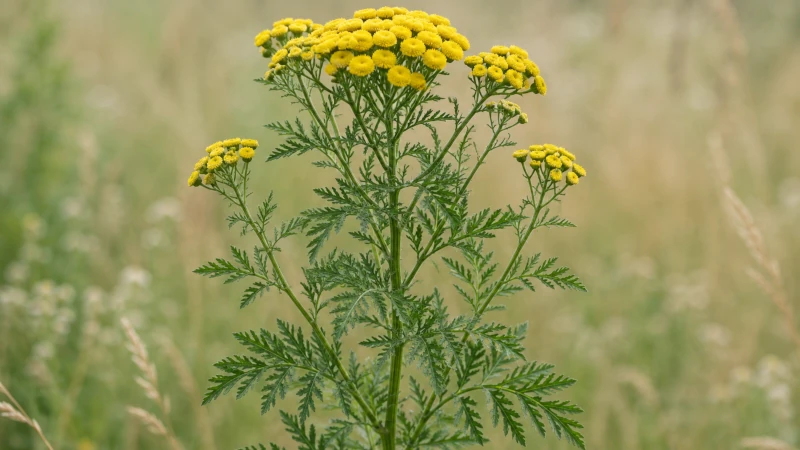
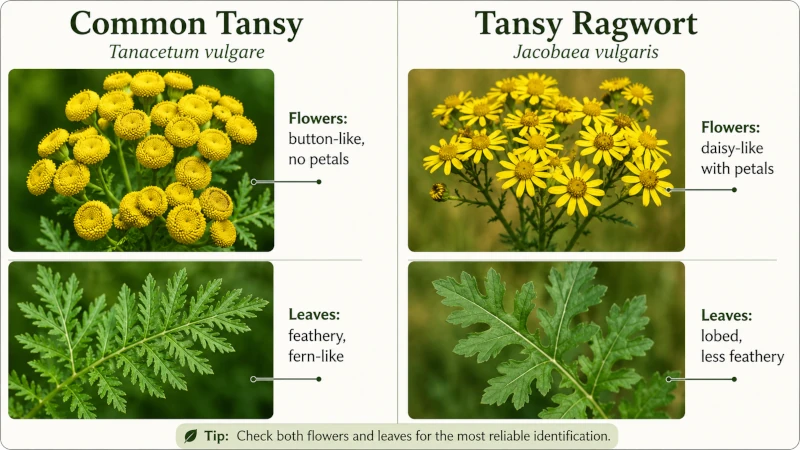
Common tansy (Tanacetum vulgare) is a hardy perennial in the daisy family (Asteraceae, also called Compositae). You’ll recognize it by its flat-topped clusters of yellow, button-like flower heads with no petals, sitting above feathery, fern-like leaves on a stem that can reach about 90 cm. Crush the leaves and you get a sharp, camphor-like smell. Older names — bitter buttons, hindheal, “the worm herb” in several languages — hint at what it was used for. Native to Europe and Asia, it spread to North America, where in many states it’s now treated as an invasive weed rather than a garden herb [Wikipedia, 2026][Montana State University Extension].
What matters medically is what’s inside it. Tansy’s essential oil is rich in thujone, along with camphor and other volatile compounds. Thujone is a neurotoxin — the same compound regulators worried about in absinthe — and its concentration in tansy varies widely from plant to plant and season to season [Tanacetum vulgare essential oil analysis, 2023]. That variability is part of the danger: tea brewed from two different plants can deliver very different doses, and there’s no way to eyeball it.
What tansy was traditionally used for
Most of tansy’s reputation rests on three uses.
As a worm expeller (vermifuge) — the headline use. Tansy tea was given to children and adults to clear roundworms and pinworms. The thujone-rich oil is toxic to the worms; the catch is that it’s toxic to the person too.
As an emmenagogue and abortifacient — tansy was taken to bring on a delayed period or to end an early pregnancy, a use documented in European medicine since at least the medieval era [ScienceDirect, abortifacient overview]. This is the most dangerous traditional use, for reasons covered below.
As a digestive and antispasmodic — the volatile oil can ease intestinal cramping, and tansy was folded into bitters and remedies for upset stomach and “nervous” complaints. Modern herbalists note that gentler, non-toxic herbs do the same job, so tansy is rarely chosen for this now [Herbal Reality, 2026].
It also had non-medicinal lives: as a strewing herb and insect repellent, a meat preservative, and a flavoring in old Easter puddings — uses that have mostly disappeared.
What the evidence actually shows
Tansy’s traditional uses are old and widespread, but they rest mostly on tradition, not on modern clinical trials in people. Laboratory and animal studies have found that tansy extracts have antioxidant, antimicrobial, and insect-repelling activity, and a 2023 analysis of Bulgarian tansy oil confirmed its antioxidant capacity in the lab [Tanacetum vulgare essential oil analysis, 2023]. Those are real findings — but activity in a dish is a long way from a safe, effective treatment you can drink.
One nuance is worth being precise about. A rodent study of a water-based (aqueous) extract of tansy leaves found relatively low toxicity, leading the authors to suggest a margin of safety for that specific preparation at traditional doses [Lahlou et al., 2008]. That’s sometimes quoted as proof tansy is safe. It isn’t. The dangerous part of the plant is concentrated in the essential oil and its thujone — which is what ends up in oils, tinctures, and strong infusions — and home preparations are never standardized. Controlled animal data on a water extract doesn’t make a cup of homemade tansy tea, or a few drops of the oil, predictable or safe.
So the realistic expectation is this: tansy may do some of what folklore claims, but the evidence supporting any specific health benefit in humans is thin, and it sits right next to a well-documented record of harm.
The real risk: thujone toxicity
This is the part that should drive your decision. Tansy’s thujone is potentially neurotoxic, and swallowing the plant or its oil can cause severe gastritis, vomiting, abdominal cramps, a rapid and weak pulse, flushing, violent muscle spasms, and convulsions, along with liver and brain damage [WHO/INCHEM JECFA][Herbal Reality, 2026]. Thujone also lowers the seizure threshold, which makes it especially hazardous for anyone prone to seizures.
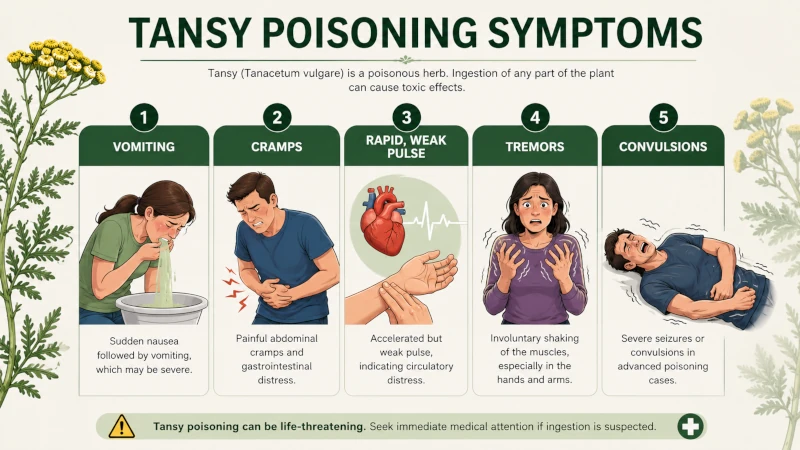
These aren’t theoretical risks. There are documented fatal poisonings from tansy oil, from tansy infusions, and from powdered tansy [Herbal Reality, 2026][Drugs.com, 2025]. Consumer drug references state that as little as about 10 drops of the essential oil can be lethal, and deaths have followed teas and powders as well [RxList, 2021][Drugs.com, 2025]. The medical literature includes cases going back to the 1800s — including a young woman in Boston in 1851 who died within hours of taking the oil [Dalton, 1852]. Because the thujone content is so variable, the line between a “traditional dose” and a poisonous one is unpredictable, and prolonged use carries its own risk of slow poisoning.
This is exactly why this article gives no tansy dosage, even though older versions of pages like this one did. Publishing a teaspoon-by-teaspoon schedule for a substance that has killed people at small doses isn’t responsible — and it isn’t what a careful reader needs. What you need is what works without the risk, which is below.
The pregnancy danger — read this if that’s why you’re here
Tansy’s use to “bring on a period” deserves a blunt warning. Tansy stimulates the uterus, and historically it was used both as an emmenagogue and as an abortifacient — and women died attempting it [RxList, 2021][ScienceDirect, abortifacient overview]. The dose needed to act on the uterus overlaps with the dose that poisons the rest of the body, which is why this use is so dangerous. Tansy is considered unsafe in pregnancy for any reason.
If your period is late and you don’t want to be pregnant, or you think you may be miscarrying, please don’t reach for a toxic herb. Talk to a clinician, a pharmacist, or a reproductive-health service. Safe, effective, monitored options exist for both situations; tansy is not one of them, and the downside is potentially fatal.
Allergies and skin reactions
Tansy can cause allergic contact dermatitis. It belongs to the Asteraceae family, so if you react to ragweed, mugwort, daisies, marigolds, or chrysanthemums, you’re more likely to react to tansy too [Drugs.com, 2025][Asteraceae allergy review, 2024]. Even external use carries some risk — the oil can be absorbed through skin, and undiluted oil can trigger irritation and sensitization.
Who should avoid tansy entirely
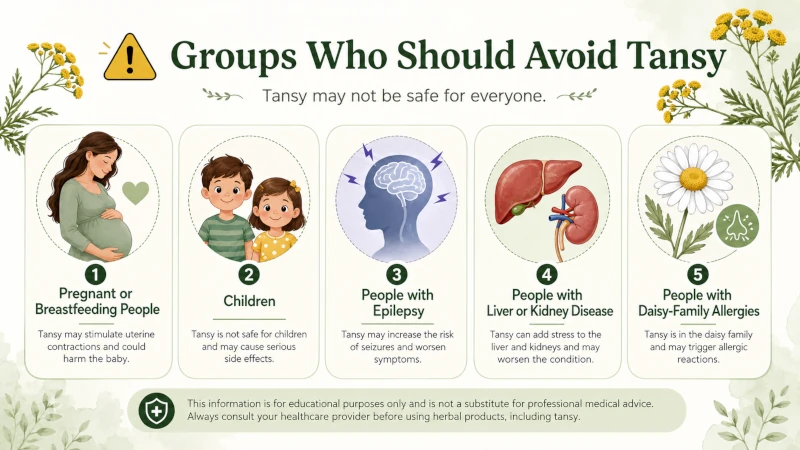
Plainly: no one should take tansy internally. Several groups have extra reason to avoid it in any form, including on the skin:
- Anyone who is pregnant or trying to become pregnant
- Anyone breastfeeding (there’s no safety data)
- Infants and children
- Anyone with epilepsy or a seizure disorder (thujone lowers the seizure threshold)
- Anyone with liver or kidney disease
- Anyone allergic to ragweed, mugwort, daisies, or other Asteraceae plants
- Anyone on medication — especially seizure medication — and never combined with other thujone herbs (wormwood, thuja/white cedar, sage) or with alcohol
Formal drug-interaction studies are limited, but given thujone’s effect on the nervous system, caution with seizure medications and other CNS-active drugs is sensible [Drugs.com, 2025].
What to use instead — for worms
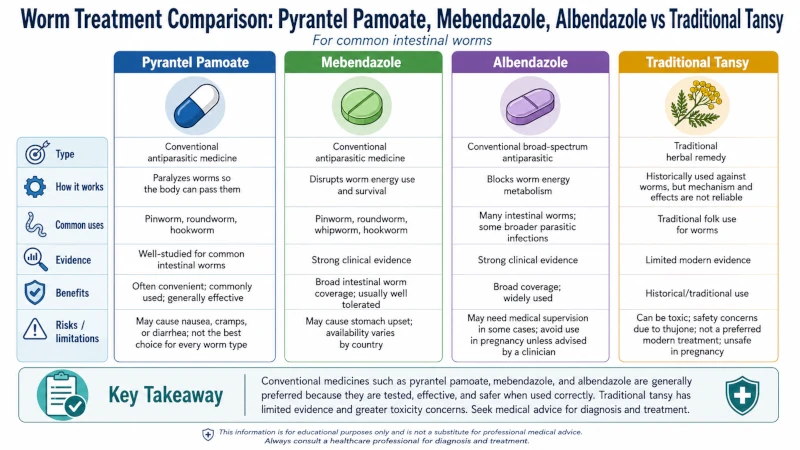
Most people who reach for tansy are dealing with common intestinal worms like pinworms or roundworms, and here the modern answer is easy, cheap, and safe. (Other parasites, such as the ones people can pick up from undercooked pork, are a separate problem with their own treatment.) You don’t need a toxic herb.
For pinworms, an over-the-counter medicine containing pyrantel pamoate works, and prescription mebendazole or albendazole are the other standard options [CDC, 2024][Mayo Clinic, 2025]. Whatever you use, the key details are:
- Take a second dose about two weeks after the first. The medicine kills worms but not eggs, and the follow-up catches worms that hatch afterward [CDC, 2024].
- Treat the whole household at the same time, since pinworm spreads easily and people can carry it without symptoms [CDC, 2024].
- Pair treatment with hand-washing, short fingernails, and washing bedding and underwear in hot water — hygiene is what actually breaks the cycle [CDC, 2024].
For young children, anyone pregnant, or unusual or persistent infections, check with a clinician or pharmacist first to pick the right medicine and dose. Older folk approaches like pumpkin seeds are far gentler than tansy, but they’re not a reliable cure on their own.
Tansy vs. modern worm treatment, at a glance
| Approach | Safety | Evidence in people | Notes |
| Tansy tea, oil, or powder | Unsafe — documented fatal poisonings | No reliable human trials | Thujone content is unpredictable; not recommended internally |
| Pyrantel pamoate | Generally safe; available over the counter | Established for pinworm | Repeat dose in ~2 weeks; check with a pharmacist for young children or pregnancy |
| Mebendazole / albendazole | Prescription; generally safe | Standard, well-studied | Repeat dose in ~2 weeks; clinician chooses the right drug |
The one lower-risk use: external only
If you grow tansy and want to use it the way tradition mostly did, the safer route is topical and non-ingested: as a strewing herb or insect repellent, or in a well-diluted external wash. Even then, dilute generously, do a patch test first, keep it off broken skin, and skip it entirely if you’re pregnant, breastfeeding, or allergic to Asteraceae plants. External use is lower risk than swallowing tansy — but it is not risk-free, and it is not a proven treatment for any condition.
Regulatory status
This isn’t just caution from herbalists. In the United States, thujone is treated as unsafe to add to food, and tansy is permitted only in alcoholic beverages where the finished product is thujone-free [U.S. FDA, 21 CFR 172.510]. The regulatory system already treats tansy’s active compound as something to keep out of what you consume.
When to get medical help
Tansy poisoning is a medical emergency. If someone has swallowed tansy oil, tea, or powder and develops vomiting, severe stomach pain, dizziness, tremors, a racing or weak pulse, confusion, or a seizure, treat it as urgent: in the U.S., call Poison Control at 1-800-222-1222, and call 911 (or your local emergency number) for seizures, trouble breathing, or loss of consciousness. Bring the product or plant with you if you can. For a severe allergic skin reaction — spreading rash, swelling, or trouble breathing — seek emergency care.
A note on costmary
You may see costmary (Tanacetum balsamita), sometimes called Bible leaf, mentioned alongside tansy as a milder relative used for similar purposes. It’s a different species with a gentler reputation, but it’s in the same genus and shares some of the same chemistry, so the same cautions apply: it’s not a safe DIY substitute for proper treatment.
| Health Disclaimer This article is for general education and information only. It is not medical advice and is not a substitute for diagnosis or treatment from a qualified healthcare professional. Tansy is described here largely for historical and safety context; it is not recommended for internal use. Do not use tansy or any herbal product to treat illness, expel parasites, or affect a pregnancy without speaking to a doctor or pharmacist first. If you are pregnant, breastfeeding, give care to a child, or have an existing medical condition or take medication, get personalized advice before using any herbal remedy. If you suspect poisoning, treat it as an emergency (see “When to get medical help”). |
Frequently Asked Questions
Is tansy tea safe to drink?
No. Consumer drug references list tansy as unsafe to take by mouth, and there are documented deaths from tansy tea, oil, and powder [RxList, 2021][Drugs.com, 2025]. The amount of thujone in any given plant is unpredictable, so there is no reliable “safe” home dose.
Does tansy actually get rid of worms?
Tansy’s oil is toxic to intestinal worms, which is why it was used for centuries — but it is also toxic to you, and it is no longer recommended for this [Herbal Reality, 2026]. Safe, effective options exist: over-the-counter pyrantel pamoate, or prescription mebendazole or albendazole, with a repeat dose about two weeks later [CDC, 2024][Mayo Clinic, 2025].
Can I use tansy to bring on a late period?
Please don’t. Tansy stimulates the uterus and was historically used as an abortifacient, and women died attempting it [RxList, 2021][ScienceDirect, abortifacient overview]. If your period is late or you may be pregnant and don’t want to be, talk to a clinician or pharmacist — there are safe, monitored options.
Is tansy essential oil safe to put on skin?
Topical use is lower risk than swallowing it, but not risk-free. Tansy can cause allergic contact dermatitis, the oil can be absorbed through skin, and undiluted oil can irritate [Drugs.com, 2025]. Dilute well, patch-test first, avoid broken skin, and skip it entirely if you’re pregnant, breastfeeding, or allergic to ragweed, mugwort, or daisies.
What should I do if someone swallowed tansy oil or tea?
Treat it as an emergency. In the U.S., call Poison Control at 1-800-222-1222, and call 911 for seizures, trouble breathing, or loss of consciousness. Bring the product or plant with you if you can.
Is tansy the same as tansy ragwort?
No. Tansy ragwort (Senecio jacobaea) is a different, also-toxic plant that damages the liver. They’re sometimes confused because of the shared name, but they are not the same herb.
References
- RxList. Tansy: Health Benefits, Side Effects, Uses, Dose & Precautions. 2021. View source
- Drugs.com. Tansy: Uses, Benefits & Dosage (natural products monograph). 2025. View source
- Herbal Reality. Tansy (Tanacetum vulgare): Benefits, Safety, Uses. 2026. View source
- Centers for Disease Control and Prevention. Clinical Overview of Pinworm Infection. 2024. View source
- Mayo Clinic. Pinworm infection — Diagnosis & treatment. 2025. View source
- World Health Organization / IPCS INCHEM (JECFA). Thujone — WHO Food Additives Series 16 (oil of tansy constituents and toxicity). View source
- Bulgarian Tanacetum vulgare essential oil: chemical composition, antioxidant potential, and acute toxicity (PMC). 2023. View source
- Lahlou S, et al. Acute and chronic toxicity of a lyophilised aqueous extract of Tanacetum vulgare leaves in rodents. 2008. View source
- Dalton JC. A Case of Poisoning with Oil of Tansy (historical case report, reproduced via PMC). 1852. View source
- ScienceDirect Topics. Abortifacient — overview (folk emmenagogue/abortifacient status of tansy). View source
- Diagnostic Workup in IgE-Mediated Allergy to Asteraceae Weed Pollen and Herbal Medicine Products in Europe (PMC). 2024. View source
- Wikipedia. Tansy (botany; FDA limitation of tansy to thujone-free alcoholic beverages). 2026. View source
- Montana State University Extension. Common tansy (Tanacetum vulgare) — invasive plant and livestock toxicity. View source
- U.S. FDA. 21 CFR 172.510 — natural flavoring substances; thujone restriction (eCFR). View source
