
There are many different types of sugar, but they fall into two groups that actually matter for your health: the sugars that occur naturally in whole foods, and the sugars added to food during processing or cooking. The chemistry is nearly identical. What differs is the company the sugar keeps — whether it arrives wrapped in fiber, vitamins, and water, or stripped down to pure sweetness with nothing else attached.
That single distinction explains most of the confusion around sugar. The sugar in an apple and the sugar in a cola are broken down by your body in similar ways, yet their effect on your diet is not the same. This guide walks through each common type of sugar, how it behaves in the body, and how much is reasonable to eat — using the numbers that public health agencies actually publish.
Natural sugar vs added sugar: the distinction that matters
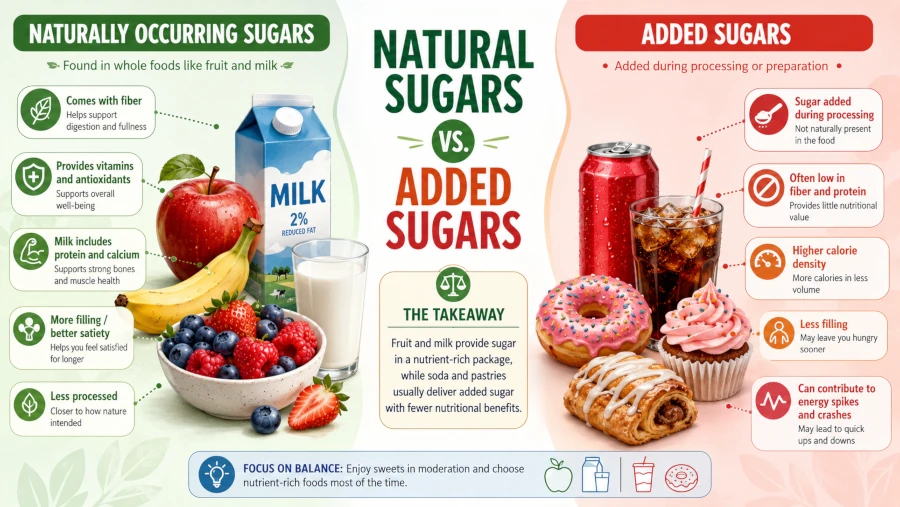
Naturally occurring sugars are built into foods: fructose in fruit, lactose in milk, and small amounts of sucrose in vegetables. They come packaged with fiber, water, vitamins, and antioxidants that slow digestion and add real nutritional value. [AHA, 2024]
Added sugars are put into food and drinks during manufacturing, cooking, or at the table. White sugar, brown sugar, honey, maple syrup, and high-fructose corn syrup all count once they’re added to something. These are the ones nutritionists describe as “empty calories”: they deliver energy but no vitamins, minerals, or fiber. [Harvard T.H. Chan, 2025]
The problem usually isn’t sugar’s chemistry. It’s three things stacked together: added sugar brings calories without nutrients; most people eat far more than guidelines suggest; and added sugar tends to ride along with refined foods — sodas, pastries, candy — that aren’t doing your health any favors on their own.
One practical takeaway: you don’t need to fear the sugar in whole fruit or plain milk. The sugar worth limiting is the added kind, and the Nutrition Facts label now lists it on its own line, under “Total Sugars,” so you can see exactly how much a product contains. [FDA, 2023]
Simple and compound sugars, briefly
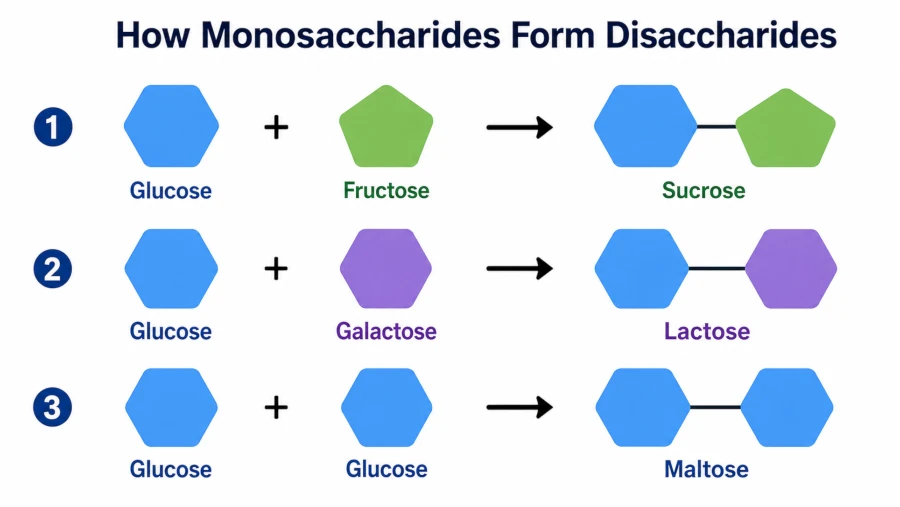
All sugars are carbohydrates, and each gram supplies about four calories. [FDA, 2023] They come in two structural forms.
Monosaccharides are single-unit sugars — glucose, fructose, and galactose. They’re the simplest form and the building blocks of everything else.
Disaccharides are two monosaccharides joined together. Sucrose (table sugar) is glucose plus fructose. Lactose (milk sugar) is glucose plus galactose. Maltose is two glucose units. [IFIC, 2025] Before your body can absorb a disaccharide, enzymes in the small intestine have to split it back into single units — which is why a missing enzyme, as in lactose intolerance, causes trouble.
A guide to the different types of sugar
Here’s how the sugars you’ll actually run into — on labels, in recipes, and in your kitchen — differ from one another.
Table sugar (sucrose)
Also sold as white, granulated, or refined sugar. It’s extracted from sugarcane or sugar beets and is about 99.8% sucrose. Because sucrose is a disaccharide, an intestinal enzyme splits it into glucose and fructose before the two are absorbed. It’s the most widely used sweetener in the world and the reference point most other sugars get compared against.
Powdered sugar
Confectioners’ or icing sugar is just table sugar ground to a fine powder, usually with a small amount of cornstarch (around 3%) mixed in to stop it clumping. Same sugar, different texture — handy for icings and dusting because it dissolves almost instantly.
Brown sugar, raw sugar, and turbinado
Most supermarket brown sugar is white sugar with molasses added back for color and flavor. That molasses brings a trace of minerals such as iron and calcium, but the amount is small — brown sugar is nutritionally close to white sugar, not a meaningful upgrade.
Raw and turbinado sugars are minimally processed: they come from partially refined cane juice and keep a little more of the molasses and minerals naturally present. They’re marginally less processed, but they’re still sugar and still count as added sugar. Don’t let “raw” or “natural” on the label talk you into treating them as health food.
Invert sugar
When sucrose is heated with a little acid or an enzyme, it splits into equal parts glucose and fructose — a syrup called invert sugar. It’s sweeter than regular sugar and holds onto moisture well, which is why bakeries use it to keep cookies and cakes soft and slow to go stale.
Maple sugar
Boil maple sap long enough — past the syrup stage and through crystallization — and you get maple sugar. It’s mostly sucrose with some glucose and fructose, plus small amounts of minerals; maple is a genuine source of manganese and zinc, though the quantities are modest next to the sugar it delivers. It can replace table sugar more or less spoon for spoon and carries a distinctive flavor. Nutritionally, it’s still an added sugar.
Glucose (dextrose)
Glucose is a monosaccharide and your body’s preferred fuel. On labels it often appears as dextrose. It’s found in many fruits, especially grapes, and is produced industrially from starch. Unlike sucrose, glucose needs no digesting — it passes straight into the bloodstream — but cells need the hormone insulin to take it up and burn it for energy. Whatever the body can’t use right away is stored as glycogen or converted to fat in the liver. It’s slightly less sweet than table sugar and common in processed foods.
Fructose
Fructose is the sugar that gives fruit its sweetness, and it’s the sweetest of the common sugars. Its molecule contains the same atoms as glucose arranged differently, which makes the two isomers.
A few things set fructose apart. It dissolves easily, and because it doesn’t raise blood glucose as sharply as glucose does, it was once promoted for people with diabetes. But that’s not the full picture. Fructose is processed almost entirely in the liver, and in large amounts — particularly the concentrated fructose in sugary drinks and high-fructose corn syrup, stripped of fiber — it drives the liver to make fat, which can raise blood triglycerides and contribute to fatty liver disease. [Baharuddin, 2024] Heavy fructose intake also pushes up uric acid, which raises the risk of gout. [Baharuddin, 2024]
The key word is proportion. In fruit, honey, and ordinary table sugar, fructose comes paired with roughly equal glucose — and, in fruit, with fiber — and at those proportions the body handles it without trouble. The concern is concentrated fructose eaten well above what whole foods provide.
Lactose
Lactose is the sugar in milk — a disaccharide of glucose and galactose. Digesting it requires the enzyme lactase, which splits it into its two parts for absorption.
Most of the world’s adults make less lactase after early childhood. About 65% of people have a reduced ability to digest lactose after infancy, and the trait tracks with ancestry rather than being universal. [MedlinePlus, 2024] Reduced lactase is most common in people of East Asian descent (an estimated 70–100%), and also common among those of West African, Arab, Jewish, Greek, and Italian heritage; it’s least common — around 5% — in people of Northern European descent. [MedlinePlus, 2024] People who don’t make enough lactase can get gas, bloating, and diarrhea after dairy. As a food additive, lactose is much less sweet than table sugar and is used in small amounts in some foods and medicines.
Maltose
Maltose is two glucose units joined together, produced when starch breaks down — during the malting of grains, for example. It’s noticeably less sweet than table sugar and shows up mainly in the baking and brewing industries.
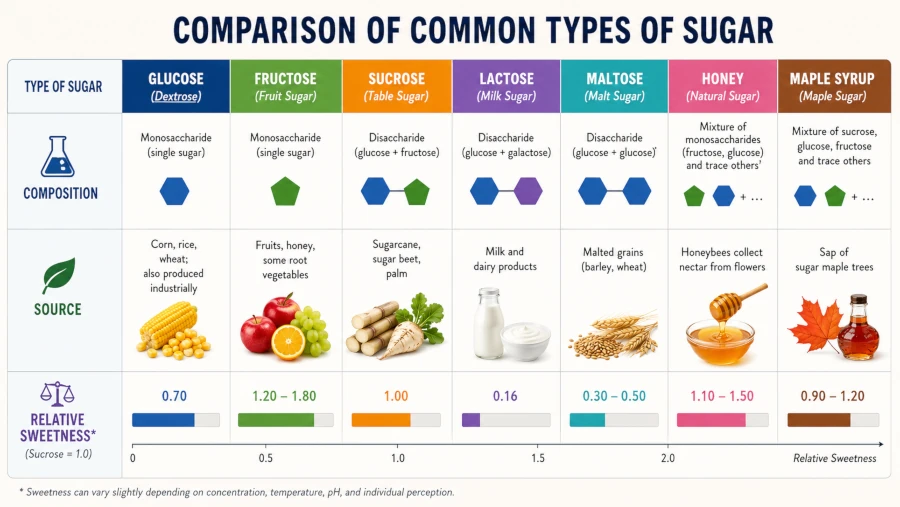
At a glance, here is how the main sugars compare:
| Sugar | Type | Made of | Source | Sweetness |
| Table sugar (sucrose) | Disaccharide | Glucose + fructose | Cane, beet | Reference |
| Glucose (dextrose) | Monosaccharide | Glucose | Fruit, starch | Less sweet |
| Fructose | Monosaccharide | Fructose | Fruit, honey | Sweeter |
| Lactose | Disaccharide | Glucose + galactose | Milk | Much less sweet |
| Maltose | Disaccharide | Glucose + glucose | Malted grain, starch | Much less sweet |
| Maple sugar | Mostly sucrose | Sucrose + glucose/fructose | Maple sap | Similar |
| Brown sugar | Sucrose + molasses | Glucose + fructose | Cane/beet + molasses | Similar |
| Invert sugar | Monosaccharide mix | Glucose + fructose | Hydrolyzed sucrose | Sweeter |
*Based on a 2,000-calorie diet. Sweetness is relative to table sugar.
Is sugar fattening?
Sugar isn’t uniquely fattening, but it’s easy to overeat. Each gram supplies about four calories. Eat more than your body needs for energy, and the liver converts the surplus to fat. [Baharuddin, 2024] The effect is larger when sugar comes with fat — pastries, chocolate, ice cream — because you’re stacking two dense calorie sources at once. Sugary drinks make it worse still, since liquid calories don’t fill you up the way solid food does. [Harvard T.H. Chan, 2025]
The reverse is also true: sugar your body actually uses for activity is simply fuel. The trouble starts with the steady daily excess most modern diets deliver, which is where cutting back and choosing foods that support weight loss makes a difference.
How much sugar is safe?
You don’t need any added sugar to be healthy. The natural sugars in fruit, vegetables, and dairy cover what the body needs, even for intense activity. The real question is how much added sugar is reasonable — and here the major guidelines line up closely.
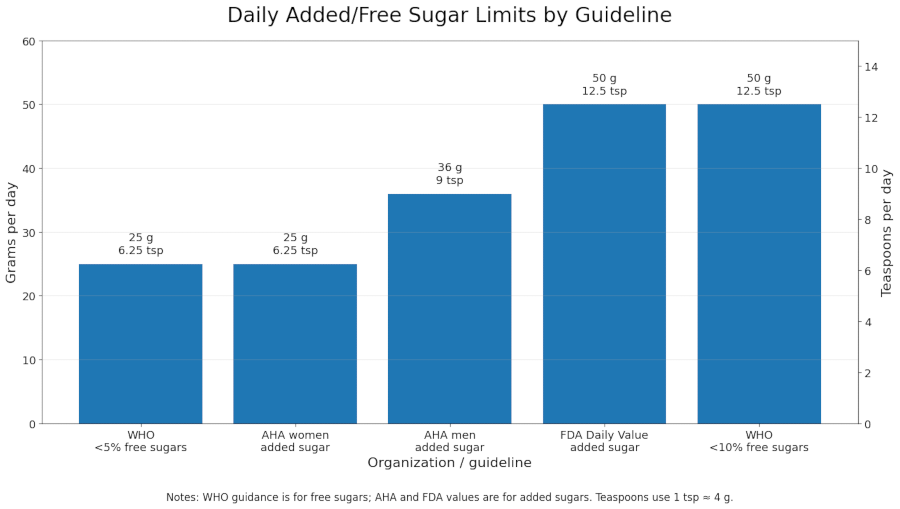
The World Health Organization recommends keeping free sugars — added sugars plus the sugars in honey, syrups, and fruit juice — below 10% of your daily calories, and suggests that dropping below 5% (roughly 25 grams, or 6 teaspoons, for an average adult) brings extra benefit. [WHO, 2015] Note this applies to free sugars — not the sugar naturally present in whole fruit, vegetables, or milk.
In the United States, the Dietary Guidelines and the FDA set the Daily Value for added sugars at 50 grams on a 2,000-calorie diet — the same as keeping added sugars under 10% of calories. [FDA, 2023] The American Heart Association goes further, recommending a daily cap of about 36 grams (9 teaspoons) for most men and 25 grams (6 teaspoons) for most women; children aged 2 to 18 should stay under about 25 grams, and children under 2 should have no added sugar at all. [AHA, 2024]
| Guideline | Added-sugar limit | In teaspoons |
| WHO — strong recommendation | Under 10% of calories | ~12 tsp* |
| WHO — for added benefit | Under 5% of calories (~25 g) | ~6 tsp |
| US Dietary Guidelines / FDA Daily Value | 50 g (under 10% of calories) | ~12 tsp |
| AHA — most men | 36 g | 9 tsp |
| AHA — most women | 25 g | 6 tsp |
| AHA — children 2–18 | Under 25 g | Under 6 tsp |
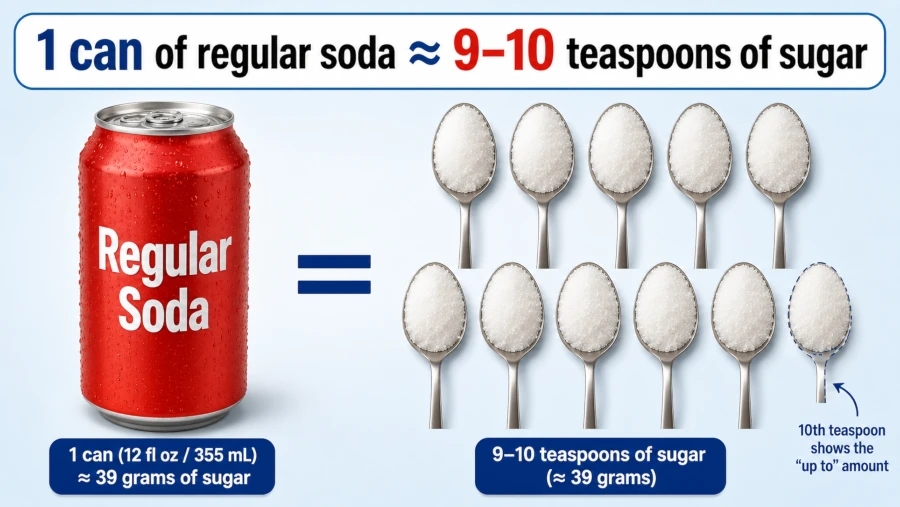
For context, a single 12-ounce can of regular soda can hold around 9 to 10 teaspoons of added sugar — at or above a full day’s recommended limit for many adults. [AHA, 2024] If that’s a regular habit, a structured approach to cutting back on sugar can help.
Side effects, safety, and who should be cautious
For most people, sugar in normal amounts is a source of calories, not a danger. The cautions below matter mainly at high intakes or for specific groups.
Too much fructose
Concentrated fructose — mostly from sugary drinks and foods made with high-fructose corn syrup — is the form to watch. In excess it can raise triglycerides, promote fat buildup in the liver, and increase uric acid, which can trigger gout in susceptible people. [Baharuddin, 2024] Fructose from whole fruit, buffered by fiber and eaten in normal amounts, doesn’t carry the same risk.
Lactose intolerance
If dairy reliably brings on bloating, gas, or diarrhea, low lactase activity is a likely reason, and it’s very common worldwide. [MedlinePlus, 2024] Lactose-free milk, hard cheeses (which are naturally lower in lactose), and lactase supplements are usually well tolerated. This is a digestive issue, not a dairy allergy — a milk allergy is a separate, immune-based condition that needs different management.
Diabetes, pregnancy, and children
People with diabetes shouldn’t treat fructose as a free pass; some of it converts to glucose in the liver and still needs managing, and large amounts carry the metabolic downsides above. Anyone managing blood sugar should fit added sugars into an overall plan built with their care team — the same principle behind choosing diabetic-friendly foods. For children under 2, health authorities advise no added sugar at all. [AHA, 2024] If you’re pregnant or breastfeeding, there’s no need to avoid normal dietary sugar, but the same “keep added sugar modest” advice applies; check with your clinician about your overall diet.
When to talk to a healthcare professional
Sugar itself rarely causes an emergency, but some symptoms shouldn’t be brushed off. See a professional if you have ongoing excessive thirst, frequent urination, unexplained weight loss, or persistent fatigue — possible signs of high blood sugar or diabetes that warrant testing. Get prompt care for symptoms of very low blood sugar — shakiness, confusion, sweating, or fainting — especially if you take diabetes medication. And if cutting back on sugar feels impossible despite real effort, a doctor or registered dietitian can help you build a workable plan.
| Health Disclaimer This article is for general educational and informational purposes only. It is not a substitute for professional medical advice, diagnosis, or treatment. If you have diabetes, prediabetes, fatty liver disease, or any other medical condition — or if you are pregnant or breastfeeding — talk to your doctor or a registered dietitian before making significant changes to your diet. Individual responses to sugar and carbohydrates vary, and the guidance here is general rather than personal. Always seek the advice of a qualified health professional with any questions about your health. |
Frequently asked questions
Is brown sugar healthier than white sugar?
Barely. Most brown sugar is white sugar with molasses added back, which contributes only trace minerals. Treat the two as interchangeable and focus on the total amount rather than the color.
Is fruit sugar bad for you?
Not in whole fruit. The fructose in fruit comes with fiber, water, and nutrients that slow its absorption. The concern is concentrated fructose from sugary drinks and high-fructose corn syrup — not an apple or a handful of berries. [Baharuddin, 2024]
Which sugar is the healthiest?
No added sugar is a health food. Less-refined options like maple sugar or raw sugar carry slightly more minerals than white sugar, but the difference is small and your body handles them all in much the same way. The healthiest “sugar” is the kind that comes built into whole fruit and vegetables.
How much added sugar per day is okay?
Public health guidance lands around 25 grams (6 teaspoons) a day for most women and 36 grams (9 teaspoons) for most men, with less for children. [AHA, 2024] WHO frames the same idea as under 10% of daily calories, ideally under 5%. [WHO, 2015]
Does the body process natural and added sugar differently?
Chemically, your body breaks both down into the same simple sugars. The difference is what comes with them: whole foods deliver sugar alongside fiber and nutrients that blunt its impact, while added sugar arrives without them. [AHA, 2024]
Is honey or maple syrup better than table sugar?
They bring trace nutrients and a distinctive flavor, but they’re still added sugars and still count toward your daily limit. Use them for taste, not as a health upgrade. [Harvard T.H. Chan, 2025]
References
- World Health Organization. (2015). Guideline: Sugars Intake for Adults and Children. WHO, Geneva. → View source
- American Heart Association. (2024). How Much Sugar Is Too Much? heart.org. → View source
- American Heart Association. (2024). Sugar 101. heart.org. → View source
- Harvard T.H. Chan School of Public Health, The Nutrition Source. (2025). Added Sugar in the Diet. → View source
- U.S. Food and Drug Administration. (2023). Added Sugars on the Nutrition Facts Label. → View source
- MedlinePlus Genetics, U.S. National Library of Medicine. (2024). Lactose Intolerance. → View source
- Baharuddin, B. (2024). The Impact of Fructose Consumption on Human Health. Cureus, 16(9):e70095. → View source
- International Food Information Council (IFIC). (2025). What Is Lactose? → View source
