
There is no clinically established dose for acerola cherry. No human trial has ever tested a specific amount of the fruit against a health outcome, so there is no FDA-approved dose, no standardized clinical protocol, and no published dose-response study to point to. That sounds like a dead end, but it isn’t. Because nearly all of acerola’s documented effect comes from one ingredient — vitamin C — the right way to think about acerola cherry dosage is to dose by its vitamin C content, using the well-established intake levels that nutrition scientists have set for vitamin C over decades of research [Institute of Medicine, 2000].
This guide turns that idea into practical numbers: how much to take by form (powder, capsule, juice, fresh fruit), how to adjust for your goal and situation, and how to read any product label so you know your real intake. For background on the fruit itself, see our complete acerola cherry guide.
Is There an Official Acerola Cherry Dosage?
No. Major drug-information references make this plain: WebMD notes there isn’t enough reliable evidence to set an appropriate dose for acerola, and Drugs.com states that clinical data to guide acerola dosing are lacking [WebMD; Drugs.com]. Neither source is hiding anything — the studies simply haven’t been done.
What does exist is a large, mature body of research on vitamin C requirements. The U.S. Institute of Medicine set formal Dietary Reference Intakes for vitamin C in 2000, based on its physiological and antioxidant roles in the body [Institute of Medicine, 2000]. Since vitamin C is acerola’s primary active component, those numbers give you a defensible, evidence-based proxy for how much acerola to take. The rest of this guide builds on them.
Vitamin C Guidelines as Your Dosage Framework
Recommended Dietary Allowance (RDA)
The RDA is the daily amount that meets the needs of about 97–98% of healthy people in a given group [NIH ODS]. For vitamin C, the figures are modest:
| Population group | Vitamin C RDA |
| Adult men (19+) | 90 mg/day |
| Adult women (19+) | 75 mg/day |
| Pregnancy | 85 mg/day |
| Breastfeeding | 120 mg/day |
| Smokers | +35 mg/day above baseline (≈125 mg men / 110 mg women) |
| Boys 14–18 | 75 mg/day |
| Girls 14–18 | 65 mg/day |
| Children 9–13 | 45 mg/day |
| Children 4–8 | 25 mg/day |
| Children 1–3 | 15 mg/day |
Source: Institute of Medicine (2000); NIH Office of Dietary Supplements.
These numbers are lower than most people expect. According to USDA data, a single acerola cherry weighing about 4.8 grams holds roughly 80 mg of vitamin C — enough on its own to meet the adult RDA [USDA FoodData Central]. That single fact reframes the whole question: with acerola, the risk is rarely taking too little.
Tolerable Upper Intake Level (UL)
The UL is the highest daily intake unlikely to cause harm in the general population [NIH ODS]:
| Age group | Vitamin C upper limit |
| Adults 19+ | 2,000 mg/day |
| Adolescents 14–18 | 1,800 mg/day |
| Children 9–13 | 1,200 mg/day |
| Children 4–8 | 650 mg/day |
| Children 1–3 | 400 mg/day |
Going over the UL doesn’t guarantee a problem, but it raises the odds of gastrointestinal effects — nausea, cramps, diarrhea — which are the very effects the 2,000 mg limit is built around [Institute of Medicine, 2000]. With chronic high intake, vitamin C supplements may also raise kidney-stone risk in susceptible people, a point covered in the safety section below. For a fuller breakdown, see our acerola side effects and safety guide.
What These Numbers Mean in Practice
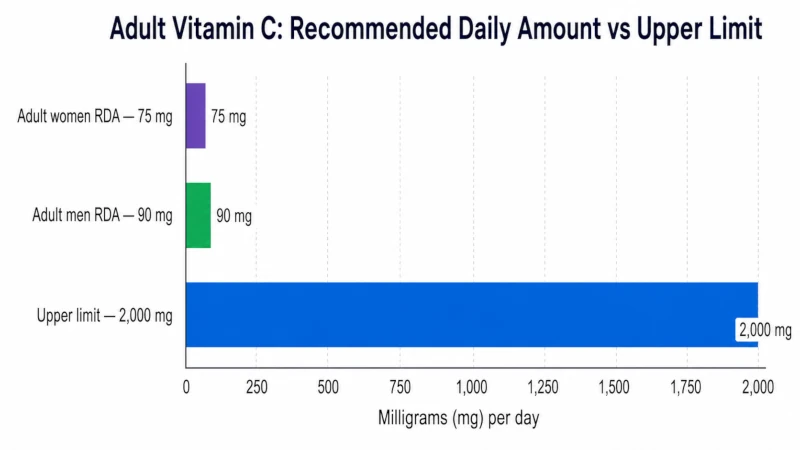
The space between the RDA (75–90 mg) and the UL (2,000 mg) is wide, which gives you a comfortable working range. For general wellness, an intake in the low hundreds of milligrams of vitamin C per day — meaningfully above the RDA, well under the UL — is a reasonable target and is where most of vitamin C’s documented benefits sit.
There’s also a biological reason not to chase huge doses. Vitamin C absorption is efficient at moderate intakes and tapers off as the dose climbs: the body absorbs roughly 70–90% of vitamin C at intakes of 30–180 mg/day, but absorption falls to about 50% or less once single doses exceed 1 gram [NIH ODS; Institute of Medicine, 2000]. Past a point, a bigger dose mostly ends up in your urine, not your tissues.
Acerola Cherry Dosage by Form
How much acerola to measure out depends heavily on the form, because vitamin C concentration varies enormously between products.
Powder
Powder is the most common supplement form and the one where precision matters most, since concentration differs by how the powder was made.
| Powder type | ~Vitamin C per ¼ tsp (~1 g) | ~Vitamin C per 1 tsp (~4 g) | Suggested starting dose |
| Freeze-dried (25–30%) | 250–300 mg | 1,000–1,200 mg | ¼ tsp |
| Spray-dried (≈17%) | ~170 mg | ~680 mg | ¼–½ tsp |
| High-potency extract (≈35%) | ~350 mg | ~1,400 mg | ¼ tsp or less |
These are estimates only. Every product is different, so treat the figure on your label as the real number and use the calculation method below. For help choosing between types, see our acerola cherry powder guide.
Capsules and Tablets
Capsules and tablets are the easiest form to dose because the vitamin C per serving is pre-measured and printed on the label. Most acerola capsules supply 200–500 mg of vitamin C per serving, usually in one or two capsules. Use the manufacturer’s serving size as your starting point; there’s no reason to exceed it unless a clinician advises otherwise.
Juice
Juice is the least predictable form, because vitamin C depends on whether the juice is fresh, frozen, or pasteurized, how much it’s been diluted, and whether it’s pure or blended. As a rough guide, 100 ml of pure juice from ripe acerola can contain on the order of several hundred to over a thousand milligrams of vitamin C. One small study in healthy adults found vitamin C from acerola juice was absorbed comparably to plain ascorbic acid, so the juice is a legitimate source — just a concentrated one [Uchida et al., 2011]. Start small, around 30–50 ml (1–2 ounces) diluted in water, and adjust to tolerance. Our acerola cherry juice guide covers preparation.
Fresh Fruit
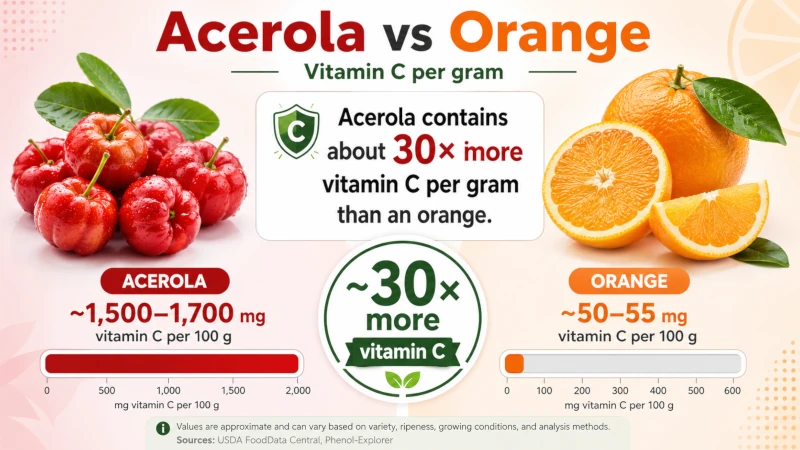
Fresh acerola is the simplest case. Each cherry (~4.8 g) holds roughly 80 mg of vitamin C, so two to three cherries a day supply about 160–240 mg — already well above the adult RDA [USDA FoodData Central]. One quirk worth knowing: slightly underripe, green-tinged fruit tends to carry more vitamin C than fully ripe red fruit [Delva & Schneider, 2013]. For the complete breakdown, see acerola’s full nutritional profile.
How to Calculate Your Vitamin C Intake from Any Acerola Product
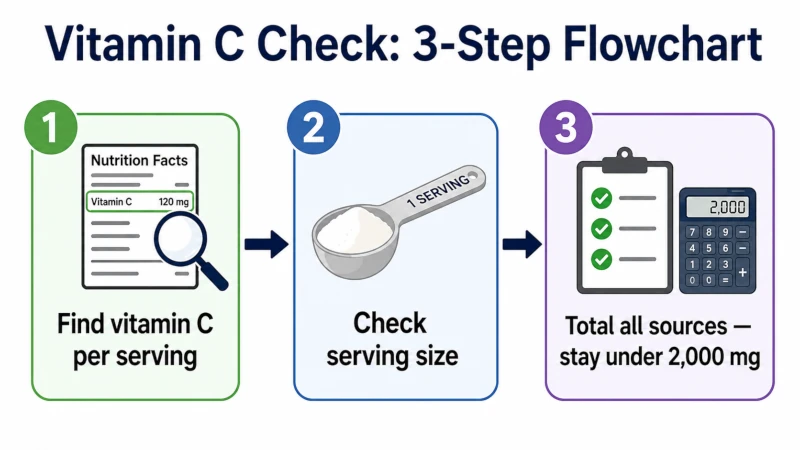
Whichever product you own, three steps tell you your real intake.
Step 1 — Find the vitamin C per serving on the label. Look for a line such as “Vitamin C 500 mg per serving” or “Ascorbic acid (from acerola) 250 mg.” If that number isn’t printed anywhere, treat it as a quality red flag and consider a different product.
Step 2 — Check the serving size. The vitamin C figure is tied to a specific serving — grams, teaspoons, or a number of capsules. If the label reads “500 mg per 2 capsules,” then one capsule gives you 250 mg.
Step 3 — Add up every vitamin C source. Your daily total isn’t just acerola. Combine your acerola product, any standalone vitamin C, the vitamin C in a multivitamin, and vitamin C from food (oranges, strawberries, bell peppers, kiwi, broccoli). Keep the all-sources total under 2,000 mg/day.
| Worked example: ½ tsp of a freeze-dried acerola powder (300 mg) + a multivitamin (90 mg) + one orange (~53 mg) = about 443 mg of vitamin C. That’s comfortably above the RDA and well within the safe range. |
Dosage by Goal
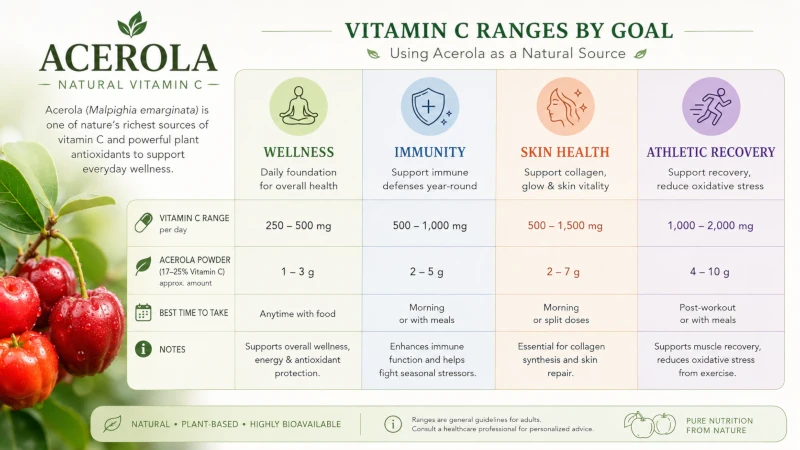
There are no acerola-specific trials for particular health goals, so the ranges below are drawn from general vitamin C research. Read them as practical targets, not prescriptions.
General Wellness
Suggested range: 100–250 mg of vitamin C from acerola per day. This clears the RDA with margin and delivers a useful amount of acerola’s accompanying plant compounds (flavonoids, anthocyanins, carotenoids) without crowding the upper limit. For most healthy adults, this is the practical sweet spot.
Immune Support
Suggested range: 200–500 mg of vitamin C from acerola per day. A Cochrane review of 31 trial comparisons found that taking vitamin C regularly (at least 200 mg/day) modestly shortened colds — by about 8% in adults and 14% in children [Hemilä & Chalker, 2013]. Two honest caveats: regular vitamin C did not reduce how often people caught colds in the general population, and starting vitamin C after symptoms began showed no consistent benefit. So acerola is reasonable as a steady daily habit for immune support, not as a remedy you reach for once you feel a cold coming on. Our article on acerola cherry health benefits digs deeper into this evidence.
Skin Health and Collagen
Suggested range: 250–500 mg of vitamin C from acerola per day. Vitamin C is a required cofactor for collagen synthesis, and a 2017 review concluded that skin benefits are best supported at intakes above the RDA without needing megadoses [Pullar et al., 2017]. This is a mechanistic and observational case rather than proof that acerola visibly improves skin, so set expectations accordingly.
Athletic Recovery
Suggested range: 200–500 mg of vitamin C from acerola per day. Exercise generates oxidative stress, and moderate vitamin C may help manage it. There’s a meaningful catch: some controlled trials suggest that very high doses (roughly 1,000 mg/day or more) can blunt certain beneficial adaptations to endurance training. A moderate intake is the safer bet for active people.
| Goal | Vitamin C from acerola | Approx. freeze-dried powder (25–30%) |
| General wellness | 100–250 mg/day | ~¼–½ tsp |
| Immune support | 200–500 mg/day | ~½–1 tsp |
| Skin / collagen | 250–500 mg/day | ~½–1 tsp |
| Athletic recovery | 200–500 mg/day | ~½–1 tsp |
These are general suggestions based on vitamin C research, not acerola-specific data. Adjust for your total intake from all sources.
Dosage Adjustments for Specific Populations
Children
Acerola in food amounts is generally fine for children, but supplements need care because children’s upper limits are much lower than adults’ (400 mg/day at ages 1–3, 650 mg at 4–8, 1,200 mg at 9–13). Acerola powder is potent enough that even a small scoop delivers a lot of vitamin C relative to a child’s size. A conservative starting point is about ⅛ teaspoon (roughly 85–150 mg, depending on the powder) stirred into yogurt or a smoothie — and talk to a pediatrician before giving acerola supplements regularly.
Pregnancy and Breastfeeding
The vitamin C RDA rises to 85 mg/day in pregnancy and 120 mg/day while breastfeeding; the 2,000 mg/day upper limit still applies. Acerola-specific safety data for these stages are insufficient [WebMD; Drugs.com]. Food amounts are generally considered safe. If you want to supplement, stay conservative — roughly 100–200 mg of vitamin C from acerola — and clear it with your obstetrician or midwife first.
Smokers
Smoking speeds up vitamin C turnover and lowers blood levels, which is why the Institute of Medicine adds 35 mg/day to the smoker RDA (125 mg for men, 110 mg for women) [Institute of Medicine, 2000]. A slightly higher acerola intake, around 200–300 mg of vitamin C, is reasonable for regular smokers.
People with Kidney Concerns
If you have a history of kidney stones, kidney disease, or hyperoxaluria, be cautious with any concentrated vitamin C source, acerola included. The body converts some vitamin C into oxalate, a building block of the most common type of kidney stone. A 2019 systematic review and meta-analysis found that vitamin C supplements were associated with a higher rate of kidney stones in men, though not clearly in women [Jiang et al., 2019].
An earlier prospective study of more than 23,000 men found that those taking vitamin C supplements (typically around 1,000 mg) had roughly double the stone risk of non-users [Thomas et al., 2013]. The signal is tied to supplements, not food. If this applies to you, stay well under the upper limit, avoid stacking acerola with other vitamin C products, and talk to your nephrologist or urologist first. More detail is in our acerola side effects and safety guide.
Signs You May Be Taking Too Much
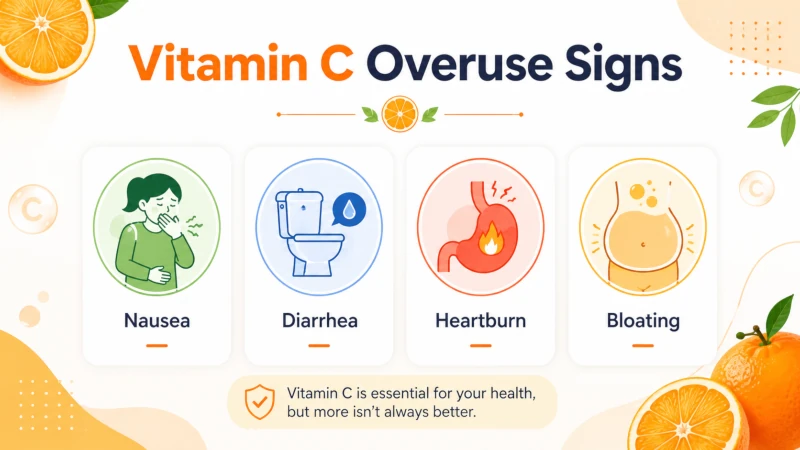
Your body tends to signal an excessive dose before any real harm occurs. Watch for:
- Nausea or stomach cramps — often the first sign; concentrated ascorbic acid can irritate the stomach.
- Diarrhea or loose stools — unabsorbed vitamin C pulls water into the gut. This osmotic effect is the basis of the 2,000 mg limit.
- Heartburn or acid reflux — high-dose vitamin C can worsen reflux in people already prone to it.
- Bloating or gas — gut bacteria ferment the vitamin C that isn’t absorbed.
If any of these appear, cut your dose back. Symptoms usually settle within a day or two. If they don’t, stop and check with your healthcare provider.
When to Take Acerola
Because vitamin C is water-soluble and isn’t stored in large amounts, consistency matters more than timing. A few practical points still help:
- Take it with food to limit stomach irritation — the acidity is gentler with a meal.
- Morning or early afternoon suits most people. A few report mild restlessness with late-day doses, though that effect isn’t well documented.
- Pair it with iron-rich plant foods if you want to boost iron absorption. Vitamin C markedly improves uptake of non-heme iron from foods like spinach, lentils, and fortified cereals.
- Split doses above ~500 mg/day into a morning and afternoon serving, since absorption efficiency drops at higher single doses.
| Health Disclaimer This content is for general education only and is not intended to diagnose, treat, cure, or prevent any disease. It is not a substitute for advice from a qualified clinician. Acerola has no clinically established dose, and the guidance here is derived from vitamin C intake levels. Talk to your doctor, pharmacist, or a registered dietitian before starting any supplement — especially if you are pregnant or breastfeeding, give supplements to a child, take prescription medications, or have kidney disease or a history of kidney stones. Stop and seek medical advice if you have an unexpected reaction. |
Frequently Asked Questions
How much acerola cherry powder should I take daily?
For most adults, ¼ to 1 teaspoon supplies roughly 170–500 mg of vitamin C, depending on concentration — within the safe, useful range. Always confirm the vitamin C per serving on your label and account for other sources.
Can I take too much acerola?
Yes. Going over 2,000 mg of vitamin C per day from all sources raises the risk of nausea, diarrhea, and cramps, and supplements have been linked to higher kidney-stone risk in some people. Acerola is concentrated, so it’s easier to overshoot than you’d think.
Is there a clinical dose for acerola?
No. No trial has set an acerola-specific dose. All guidance comes from vitamin C intake recommendations, which are well established.
Should I take acerola every day?
Daily use fits how water-soluble vitamins work — the body doesn’t store much vitamin C, so steady intake beats occasional large doses. There’s no evidence that normal daily amounts harm healthy adults.
How much acerola equals one orange’s worth of vitamin C?
An orange has about 53 mg of vitamin C. Matching that takes only a fraction of a gram of acerola powder — less than ⅛ teaspoon — since acerola holds roughly 1,677 mg of vitamin C per 100 g, around 30 times an orange gram-for-gram.
Can I take acerola and a separate vitamin C supplement together?
You can, but add the totals. 300 mg from acerola plus 500 mg from a supplement is 800 mg — still safe. Problems start when people stack sources without counting.
Key Takeaways
No official acerola cherry dosage exists. Every practical recommendation traces back to the vitamin C reference intakes: an RDA of 75–90 mg/day for adults and an upper limit of 2,000 mg/day [Institute of Medicine, 2000].
For most healthy adults, 100–500 mg of vitamin C from acerola per day is a sensible target — above the RDA, below the upper limit, and within the range where vitamin C’s benefits are best supported. That’s roughly ¼ to 1 teaspoon of typical powder, or one to two capsules.
The most important habit is simple: read your product label for vitamin C per serving, and count your total from all sources. Acerola is concentrated enough that small amounts add up fast — that’s its strength and the reason precision pays off. Start low, take it with food, stay hydrated, and check with a clinician first if you’re pregnant, have kidney issues, or take prescription medications.
References
- Institute of Medicine. (2000). Dietary Reference Intakes for Vitamin C, Vitamin E, Selenium, and Carotenoids. National Academies Press. View source
- NIH Office of Dietary Supplements. Vitamin C: Fact Sheet for Health Professionals. View source
- Hemilä, H., & Chalker, E. (2013). Vitamin C for preventing and treating the common cold. Cochrane Database of Systematic Reviews, (1), CD000980. View source
- Jiang, K., et al. (2019). Ascorbic acid supplements and kidney stones incidence among men and women: a systematic review and meta-analysis. Urology Journal, 16(2), 115–120. View source
- Thomas, L. D. K., et al. (2013). Ascorbic acid supplements and kidney stone incidence among men: a prospective study. JAMA Internal Medicine, 173(5), 386–388. View source
- Pullar, J. M., Carr, A. C., & Vissers, M. C. M. (2017). The roles of vitamin C in skin health. Nutrients, 9(8), 866. View source
- USDA FoodData Central. Acerola, (west indian cherry), raw. View source
- Delva, L., & Schneider, R. G. (2013). Acerola (Malpighia emarginata DC): production, postharvest handling, nutrition, and biological activity. Food Reviews International, 29(2), 107–126. View source
- Uchida, E., et al. (2011). Absorption and excretion of ascorbic acid alone and in acerola juice. Biological & Pharmaceutical Bulletin, 34(11), 1744–1747. View source
