
Most herbal remedies for the urinary system do one thing: they make you produce more urine. That is the entire mechanism behind the old idea of “flushing” the kidneys and bladder, and it is why nearly every traditional urinary herb is taken as a tea. The honest news is that a few of these plants have been tested in people and show modest, specific benefits. Most have not been tested at all. And none of them treats an active urinary tract infection or dissolves a kidney stone.
That gap between tradition and tested benefit matters more here than in most areas of herbal medicine, because a bladder infection left alone can climb to the kidneys. Time is not neutral.
How herbal remedies for the urinary system are supposed to work
Diuretic herbs increase urine volume. More dilute urine, moving through more often, plausibly gives bacteria less opportunity to establish themselves and gives dissolved minerals less chance to crystallize. It is a reasonable mechanism.
The strongest evidence for that mechanism, though, comes from plain water. In a 12-month randomized trial of premenopausal women with recurrent cystitis, adding 1.5 liters of water a day to usual intake cut the mean number of infections from 3.2 to 1.7 Hooton et al., JAMA Internal Medicine, 2018. A halving, from something that costs nothing.
Which creates a problem for interpreting herbal teas. Almost none have been compared against an equal volume of plain water, so it is genuinely unclear how much of any benefit belongs to the plant and how much to the cup of hot liquid it arrived in. European regulators are explicit about this: goldenrod, java tea, and birch leaf are all approved as “traditional use” products, meaning their acceptance rests on a long history of use rather than on clinical trials European Medicines Agency assessment of Solidago virgaurea, 2018.
That is not a reason to dismiss them. It is a reason to keep expectations proportionate.
Herbs and supplements with real human evidence
Cranberry: prevention in specific groups, never treatment
Cranberry is the most-studied plant in this entire category, and the picture is now reasonably clear. A 2023 Cochrane review pooling 50 randomized trials and 8,857 participants found cranberry products reduced the risk of symptomatic, culture-confirmed UTIs overall (RR 0.70, 95% CI 0.58–0.84, moderate-certainty evidence) Cochrane review of cranberries for preventing urinary tract infections, 2023.
The benefit was concentrated in three groups: women with recurrent UTIs (RR 0.74), children (RR 0.46), and people undergoing bladder procedures (RR 0.47). It was absent in older adults in institutional care, in pregnant women, and in people with neurogenic bladder.
The American Urological Association’s 2025 guideline reflects this, stating that clinicians “should offer cranberry as an option for prophylaxis for women with rUTIs” AUA/CUA/SUFU recurrent UTI guideline, 2025.
What cranberry does not do is treat an infection you already have. The National Center for Complementary and Integrative Health is direct on this point: cranberry is not recommended for treating UTIs and should not replace proven treatment NCCIH on cranberry, reviewed 2024. Processing matters too — the proanthocyanidins thought to be responsible can be degraded when cranberry is turned into tablets or capsules.
Side effects are mild, mostly stomach upset. The interaction question that comes up most often is warfarin, and here sources genuinely disagree: some report a meaningful effect on bleeding risk, others find it negligible. NCCIH describes the evidence as conflicting. If you take warfarin, that disagreement is reason enough to check with your doctor or pharmacist before starting cranberry supplements rather than juice.
Bearberry (uva ursi): mixed results, strict time limits
Bearberry leaf contains arbutin, which the body converts to hydroquinone — a compound with antiseptic activity that is excreted in urine. The theory is sound. The trial results are not consistent.
One small double-blind study found women taking uva ursi prophylactically had no cystitis episodes over 12 months, compared with 23% in the placebo group. But a far larger 2019 UK trial in 382 women with suspected uncomplicated UTI found no difference in symptom severity or antibiotic use between uva ursi and placebo Moore et al., Clinical Microbiology and Infection, 2019. Two trials, opposite answers — and the larger, better-powered one was negative.
Safety is where uva ursi demands attention. NIH’s LiverTox database notes that hydroquinone is potentially carcinogenic and that uva ursi “is recommended in short courses only and not to be taken chronically” LiverTox: Uva Ursi, NIH. That is why the EU herbal monograph caps use at one week per course and advises seeing a doctor if symptoms last beyond four days EMA monograph on Arctostaphylos uva-ursi folium, 2018. Kidney disorders are a listed contraindication. It is contraindicated in pregnancy and breastfeeding, and not recommended under 18. Long-term use has been linked to bull’s-eye maculopathy, a retinal problem Drugs.com professional monograph on uva ursi, reviewed 2025. Urine may turn greenish-brown, which is harmless.
If you use it at all, use it briefly and not repeatedly.
Horsetail: a genuine diuretic signal
Horsetail is one of the few traditional urinary herbs with a controlled human diuretic trial behind it. In a randomized, double-blind study in 36 healthy male volunteers, 900 mg per day of Equisetum arvense produced diuretic effects comparable to hydrochlorothiazide 25 mg and superior to placebo, with no changes in electrolytes or kidney, liver, or blood counts Drugs.com professional monograph on horsetail, reviewed 2025.
Read that carefully, though. Thirty-six healthy men, dosed once — evidence of a diuretic effect, not evidence that horsetail treats any urinary condition. And a diuretic effect on par with a prescription thiazide is a reason for caution, not enthusiasm, if you already take a diuretic or a blood pressure medication.
Raw horsetail contains thiaminase, which destroys vitamin B1; reputable supplement manufacturers are expected to document its removal. The National Kidney Foundation lists horsetail among herbs people with chronic kidney disease should avoid National Kidney Foundation on herbal supplements and kidney disease. LiverTox rates it a probable rare cause of liver injury and discourages high long-term doses in anyone with existing liver disease LiverTox: Horsetail, NIH.
Saw palmetto: the evidence went the other way
Saw palmetto is the most popular supplement for the urinary symptoms of an enlarged prostate, and it is the clearest example in this article of good research overturning a confident claim.
A 2023 Cochrane review of 27 studies in 4,656 men concluded that Serenoa repens alone “provides little to no benefits” for lower urinary tract symptoms from benign prostatic enlargement — a mean difference of just −0.90 points on the IPSS symptom scale at 3–6 months, rated high-certainty evidence Cochrane review of Serenoa repens for benign prostatic hyperplasia, 2023. NCCIH notes that two NIH-funded trials tested standard and high doses, and neither improved symptoms NCCIH on saw palmetto, reviewed 2020.
It is well tolerated, and it does not appear to distort PSA readings. It also does not appear to work. If nocturia and weak stream are affecting your life, that is a conversation to have with a doctor rather than a supplement to keep buying.
Nettle root and pumpkin seed: promising, unproven
Nettle root is a different preparation from nettle leaf and is the one studied for prostate-related urinary symptoms. Several trials report modest benefits, but the active constituent has not been identified and standardization across trials is poor. NIH’s LiverTox summarizes it fairly: “clinical evidence of efficacy is promising yet unproven” LiverTox: Stinging Nettle, NIH.
Pumpkin seed oil was compared head-to-head with tamsulosin in a small single-blind trial of 73 men. Both groups improved; pumpkin seed oil reduced IPSS scores by 3.19 points versus 5.33 for tamsulosin, and the drug worked faster. The pumpkin group reported no side effects at all, while the tamsulosin group reported dizziness, headache, and retrograde ejaculation. The authors’ own conclusion was that pumpkin seed oil “relieved BPH symptoms with no side effects, but was not as effective as tamsulosin” Zerafatjou et al., BMC Urology, 2021. Seventy-three men over three months is a starting point, not a verdict.
D-mannose: the answer changed
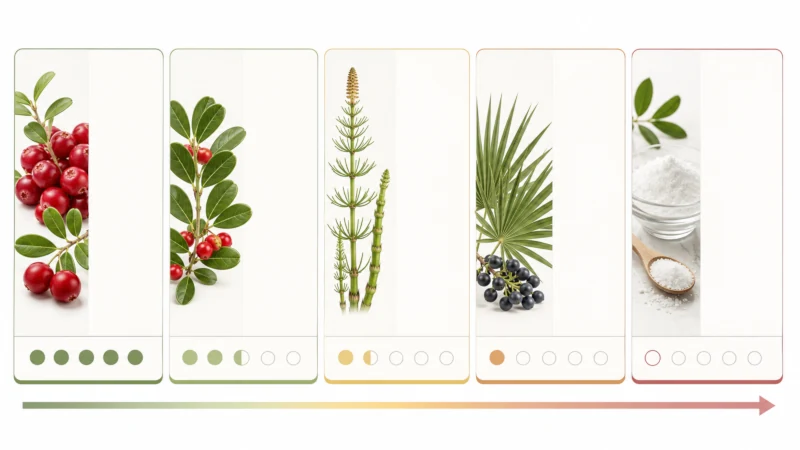
D-mannose is a sugar rather than an herb, but it comes up in every conversation about natural UTI prevention, and the evidence shifted recently. The MERIT trial randomized 598 women with recurrent UTI across 99 UK primary care practices to 2 g of D-mannose daily or placebo for six months. Recurrence occurred in 51.0% of the D-mannose group and 55.7% of the placebo group — a difference that did not reach significance Hayward et al., JAMA Internal Medicine, 2024. The AUA guideline now advises clinicians to tell patients that D-mannose alone “may not be effective in UTI prevention.”
Traditional urinary herbs: long use, thin evidence
These plants appear in every classical herbal for urinary complaints. European regulators accept several of them as traditional-use products, which is a real regulatory category — but it certifies a history of safe use, not demonstrated efficacy.
| Herb | Traditional urinary use | Evidence level | Key safety note |
| Goldenrod | Increase urine flow in minor complaints | EU traditional-use monograph; controlled trials lacking | Avoid with daisy-family allergy; not for edema from heart or kidney failure |
| Java tea (orthosiphon) | Flushing the urinary tract | EU traditional-use monograph | Contraindicated when fluid intake must be restricted |
| White birch leaf | Mild diuretic | EU traditional-use monograph | No evidence it dissolves existing stones |
| Corn silk | Increase urine flow | EU monograph still in draft; human trials minimal | Little safety data in pregnancy or kidney disease |
| Couch grass | Irrigation for cystitis | Traditional use only | Not studied in pregnancy |
| Restharrow | Diuretic for cystitis | Traditional use only | Not studied in pregnancy |
| Pellitory of the wall | Diuretic | Traditional use only | Among the strongest airborne pollen allergens; avoid with hay fever |
| Heather | Urinary antiseptic (arbutin) | Traditional use only | Same hydroquinone questions as uva ursi |
| Cherry stalks | Diuretic tea | Traditional use only | High potassium; caution in kidney disease |
| Wild celery | Diuretic, gout | Traditional use only | Photosensitivity; celery allergy is common |
| Dandelion | Diuretic | Traditional; German approval covers dyspepsia, not urinary use | High potassium; caution in kidney disease |
| Wild strawberry leaf | Diuretic | Traditional use only | Little safety data |
| Parsley | Diuretic | One small study (n=20) found no change in urine volume | Avoid medicinal doses in pregnancy; the oil is toxic |
| Juniper | Diuretic | No clinical data for any indication | Avoid in pregnancy and in kidney impairment |
| Buchu | Urinary antiseptic | Claims not substantiated | Contains pulegone; contraindicated in pregnancy and breastfeeding |
| Asparagus | Diuretic | Human diuretic effect not demonstrated | Vitamin K content matters if you take warfarin |
Sources for the regulatory column: EMA assessment of Solidago virgaurea, 2018, EMA assessment of Orthosiphon aristatus folium, 2021, EMA monograph page for Maydis stigma, draft 2025, Drugs.com professional monographs on parsley, juniper, and buchu, reviewed 2025.
Kidney stones: what herbs cannot do
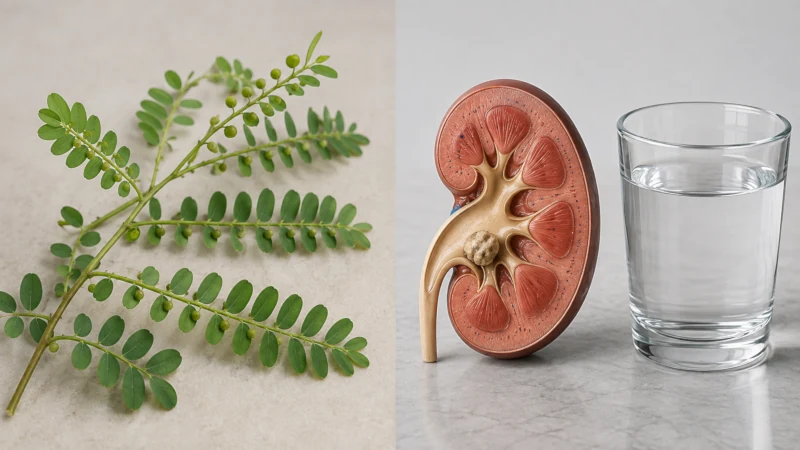
The claim that certain plants dissolve kidney stones is one of the most persistent in herbal writing, and it does not survive contact with the evidence.
NIDDK’s treatment guidance describes shock wave lithotripsy, ureteroscopy, and percutaneous nephrolithotomy for stones that need removing. For uric acid stones specifically, allopurinol and potassium citrate address the underlying chemistry rather than dissolving stones directly. The prevention advice is unglamorous: “drinking enough liquids each day is the best way to help prevent most types of kidney stones” NIDDK on kidney stone treatment.
The one plant with any supporting data is Phyllanthus niruri, sold as chanca piedra or “stone breaker.” A 2020 systematic review and meta-analysis found reductions in stone size and number versus control — but it pooled only two controlled studies totaling 181 patients, with high statistical heterogeneity, and the stone outcomes were not the primary endpoints of the original studies Dhawan & Olweny, Canadian Journal of Urology, 2020. The authors called for larger trials. That is a signal worth watching, not a treatment.
And madder root, which appears in older herbals precisely as a stone remedy, should not be taken internally at all. It contains lucidin, a genotoxin that produced liver and kidney tumors in animal studies; Germany withdrew madder-based herbal medicines from the market over these concerns.
Safety: who should be careful, and who should not use these at all
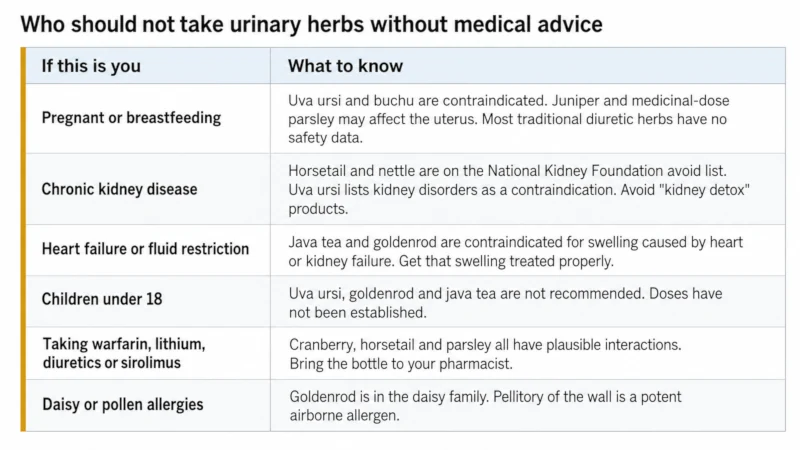
Do not use diuretic herbs to manage swelling from heart or kidney failure
This is the most important safety line in the whole category, and it is easy to miss because it sounds counterintuitive — swelling seems like exactly what a diuretic herb is for. It isn’t. The EU monographs for goldenrod and java tea both carry an explicit contraindication for edema caused by impaired heart or kidney function, and java tea is contraindicated outright in any condition where fluid intake must be restricted EMA assessment of Orthosiphon aristatus folium, 2021. Self-managing that swelling delays treatment that actually works.
Chronic kidney disease
If your kidney function is reduced, herbal products are riskier for you than for most people, because compounds that would normally be cleared can accumulate. The National Kidney Foundation names horsetail and nettle among herbs to avoid in CKD, along with alfalfa, ginseng, and turmeric for potassium load, and warns specifically against “kidney detox” and “cleanse” products National Kidney Foundation on herbal supplements and kidney disease. Uva ursi lists kidney disorders as a formal contraindication, and juniper should be avoided in kidney impairment.
Pregnancy and breastfeeding
Treat this as the default answer: no. Uva ursi and buchu are formally contraindicated. Juniper has suspected anti-implantation and abortifacient activity. Parsley in medicinal amounts — particularly the seed and oil, which contain apiol and myristicin — may have uterotonic effects, though culinary amounts are fine. Goldenrod, java tea, and corn silk are simply not recommended because safety data do not exist. Saw palmetto may be unsafe in pregnancy. Cranberry in food amounts appears safe; larger supplemental doses have not been established as safe, and the Cochrane data found no UTI-prevention benefit in pregnancy anyway.
Medication interactions worth raising with a pharmacist
- Diuretics and blood pressure medications — adding a herb with a real diuretic effect, like horsetail, can compound fluid and electrolyte loss.
- Warfarin — cranberry evidence is conflicting; asparagus and other high-vitamin-K foods require consistent, not zero, intake.
- Lithium — any diuretic effect can change lithium levels.
- Urine acidifiers — these reduce uva ursi’s activity, since it depends on alkaline urine.
- Sirolimus — parsley may raise serum concentrations, which matters for transplant recipients.
- Efavirenz — horsetail may reduce its effect.
Product quality is not guaranteed
The FDA does not approve dietary supplements before they are sold. Manufacturers carry initial responsibility for safety and for substantiating their claims, and a product marketed as treating or curing a disease is legally being sold as a drug FDA questions and answers on dietary supplements. In practice this means the label is a claim, not a certification. Third-party verification marks from USP, NSF, or ConsumerLab are the most practical filter available to a shopper.
Red flags: stop self-treating and get medical care
Urinary symptoms are one of the situations where herbal self-care has a hard stop. Contact a doctor promptly if you have symptoms of a bladder infection at all — burning with urination, urgency, lower abdominal discomfort, or cloudy, bloody, or strong-smelling urine.
Seek care the same day, at urgent care or an emergency room, if you have any of the following, which suggest the infection has reached a kidney:
- Fever and chills
- Nausea or vomiting
- Pain in your back, side, or groin
NIDDK is blunt about why timing matters: kidney infections “may cause severe pain and serious health problems if not treated early” NIDDK on bladder infection symptoms and causes.
Call 911 or go to an emergency room if you cannot urinate at all, if you have severe flank pain with vomiting, or if you develop confusion, a rapid heartbeat, or difficulty breathing alongside urinary symptoms — those can signal a bloodstream infection.
Some people should skip the self-care stage entirely and be evaluated from the start: men with UTI symptoms, pregnant women, anyone with a urinary catheter, people with diabetes or a suppressed immune system, and anyone with a history of kidney stones or kidney disease.
If you and your doctor decide an herbal tea makes sense
A few practical points, once serious causes have been ruled out:
Start with the parts that are free: fluid intake, and a diet that supports the foods that are genuinely good for the bladder and kidneys. Then use one herb at a time, so you can tell what is doing what. Keep courses short — a week for uva ursi, and a reassessment at two weeks for the milder traditional herbs. Drink the tea alongside adequate water rather than instead of it, since the fluid is doing real work. Bring the actual bottle or package to your appointments; pharmacists can only check for interactions with a product they can see. And stop and get evaluated if symptoms are no better after three days, or worse at any point.
| Health Disclaimer: This article is for general education and is not medical advice. Herbal products can interact with prescription medications and are not appropriate for everyone, particularly during pregnancy or breastfeeding, in children, or in people with kidney disease, liver disease, or heart failure. Nothing here is a substitute for diagnosis and treatment from a doctor, and urinary symptoms in particular can indicate infections that need prompt antibiotic treatment. Talk to your doctor, pharmacist, or registered dietitian before starting any herbal remedy, and seek care promptly if your symptoms worsen or do not improve. |
Frequently Asked Questions
Can herbal tea cure a urinary tract infection?
No. No herbal preparation has been shown to clear an established UTI, and cranberry — the best-studied option — is explicitly not recommended as a treatment. Untreated bladder infections can spread to the kidneys, so a suspected UTI needs a doctor’s assessment rather than a tea.
Does cranberry juice work as well as cranberry supplements?
The evidence base includes both, and the Cochrane review found benefit across cranberry products generally. There is a mechanistic argument for juice and whole-fruit preparations, since the proanthocyanidins thought to be responsible can degrade when cranberry is processed into tablets or capsules. Juice adds sugar and calories, which matters if you are managing blood glucose.
Is it safe to drink diuretic herbal teas every day?
For most of these plants, nobody knows, because they have not been studied at that duration. Two exceptions are clear: uva ursi should be limited to about a week at a time because of hydroquinone exposure, and anyone with reduced kidney function, heart failure, or fluid restriction should not take diuretic herbs at all without medical supervision.
Will any herb dissolve my kidney stones?
No herb has been shown to reliably dissolve stones. The chanca piedra data are limited to two small controlled studies with inconsistent results. Stones that need removing are treated with procedures, and the best-supported prevention strategy remains drinking enough fluid every day.
The current evidence says it offers little to no benefit, from a Cochrane review of 27 trials rated high-certainty. It is generally safe, so the cost is mostly financial and the delay in getting effective treatment. Worsening nighttime urination, a weak stream, or incomplete emptying deserve a medical evaluation.
Are herbal remedies for the urinary system safe during pregnancy?
Assume not, unless your doctor says otherwise. Uva ursi and buchu are contraindicated, juniper and medicinal-dose parsley may affect the uterus, and most of the traditional diuretic herbs simply have no pregnancy safety data. Cranberry in normal food amounts is considered safe, though trials found no UTI-prevention benefit in pregnancy.
References
- Williams G, Stothart CI, Hahn D, Stephens JH, Craig JC, Hodson EM. Cranberries for preventing urinary tract infections. Cochrane Database of Systematic Reviews, 10 November 2023. DOI 10.1002/14651858.CD001321.pub7. View source
- National Center for Complementary and Integrative Health. Cranberry. NCCIH, U.S. National Institutes of Health. View source
- American Urological Association / Canadian Urological Association / Society of Urodynamics, Female Pelvic Medicine & Urogenital Reconstruction. Recurrent Uncomplicated Urinary Tract Infections in Women: AUA/CUA/SUFU Guideline (2025). View source
- Hooton TM, Vecchio M, Iroz A, et al. Effect of Increased Daily Water Intake in Premenopausal Women With Recurrent Urinary Tract Infections: A Randomized Clinical Trial. JAMA Internal Medicine. 2018;178(11):1509–1515. PMID 30285042. DOI 10.1001/jamainternmed.2018.4204. View source
- Hayward G, Mort S, Hay AD, et al. d-Mannose for Prevention of Recurrent Urinary Tract Infection Among Women: A Randomized Clinical Trial. JAMA Internal Medicine. 2024;184(6):619–628. PMID 38587819. DOI 10.1001/jamainternmed.2024.0264. View source
- Moore M, Trill J, Simpson C, et al. Uva-ursi extract and ibuprofen as alternative treatments for uncomplicated urinary tract infection in women (ATAFUTI): a factorial randomized trial. Clinical Microbiology and Infection. 2019;25(8):973–980. PMID 30685500. DOI 10.1016/j.cmi.2019.01.011. View source
- European Medicines Agency, Committee on Herbal Medicinal Products. European Union herbal monograph on Arctostaphylos uva-ursi (L.) Spreng., folium (Revision 2). View source
- Drugs.com. Uva Ursi — professional natural products monograph. View source
- National Institutes of Health. Uva Ursi. LiverTox: Clinical and Research Information on Drug-Induced Liver Injury. View source
- Drugs.com. Horsetail — professional natural products monograph. View source
- National Institutes of Health. Horsetail. LiverTox. View source
- Franco JVA, et al. Serenoa repens for the treatment of lower urinary tract symptoms due to benign prostatic enlargement. Cochrane Database of Systematic Reviews, 2023. DOI 10.1002/14651858.CD001423.pub4. View source
- National Center for Complementary and Integrative Health. Saw Palmetto: Usefulness and Safety. View source
- National Institutes of Health. Stinging Nettle. LiverTox. View source
- Zerafatjou N, Amirzargar M, Biglarkhani M, Shobeirian F, Zoghi G. Pumpkin seed oil (Cucurbita pepo) versus tamsulosin for benign prostatic hyperplasia symptom relief: a single-blind randomized clinical trial. BMC Urology. 2021;21(1):147. DOI 10.1186/s12894-021-00910-8. View source
- European Medicines Agency. Assessment report on Solidago virgaurea L., herba. View source
- European Medicines Agency. Assessment report on Orthosiphon aristatus (Blume) Miq. var. aristatus, folium (Revision 1). View source
- European Medicines Agency. Maydis stigma (corn silk) — herbal medicine overview. Draft monograph under discussion, public consultation October 2025 – January 2026. View source
- Drugs.com. Parsley — professional natural products monograph. View source
- Drugs.com. Juniper — professional natural products monograph. View source
- Drugs.com. Buchu — professional natural products monograph. View source
- National Institute of Diabetes and Digestive and Kidney Diseases. Symptoms & Causes of Bladder Infection in Adults. View source
- National Institute of Diabetes and Digestive and Kidney Diseases. Treatment for Kidney Stones. View source
- Dhawan S, Olweny EO. Phyllanthus niruri (stone breaker) herbal therapy for kidney stones: a systematic review and meta-analysis of clinical efficacy, and Google Trends analysis of public interest. Canadian Journal of Urology. 2020;27(2):10162–10166. View source
- National Kidney Foundation. “Kidney Detox” and Herbal Supplements: What’s Safe and What’s Not. View source
- U.S. Food and Drug Administration. Questions and Answers on Dietary Supplements. View source
