Abelmosk is a musk-scented plant best known for its fragrant seeds, which perfume makers distill into ambrette oil and some cooks add to coffee and spice blends. It also carries a long history in traditional medicine across India, the Caribbean, and Southeast Asia.
The honest picture of abelmosk benefits is straightforward: people have used the seeds for generations to ease cramps, calm the nerves, and as a reputed aphrodisiac, but nearly all of that rests on tradition and early lab or animal research rather than human studies [Drugs.com, 2025]. The plant is generally considered safe in the small amounts found in food, while larger medicinal doses and use during pregnancy come with real cautions.
What is abelmosk?
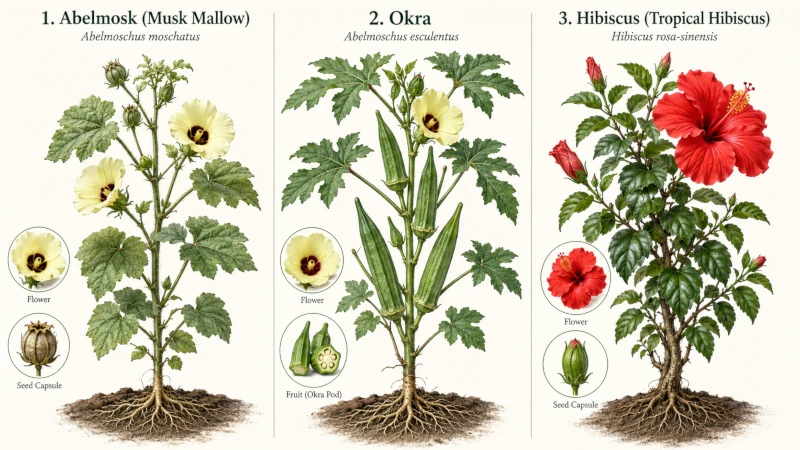
Abelmosk (Abelmoschus moschatus, formerly Hibiscus abelmoschus) is a small flowering shrub in the mallow family, Malvaceae — the same family as okra and garden hibiscus. You may see it called ambrette, musk okra, musk mallow, muskdana, or kasturi bhindi. It is native to India, southern China, and tropical Asia, and is now grown across the tropics [Drugs.com, 2025].
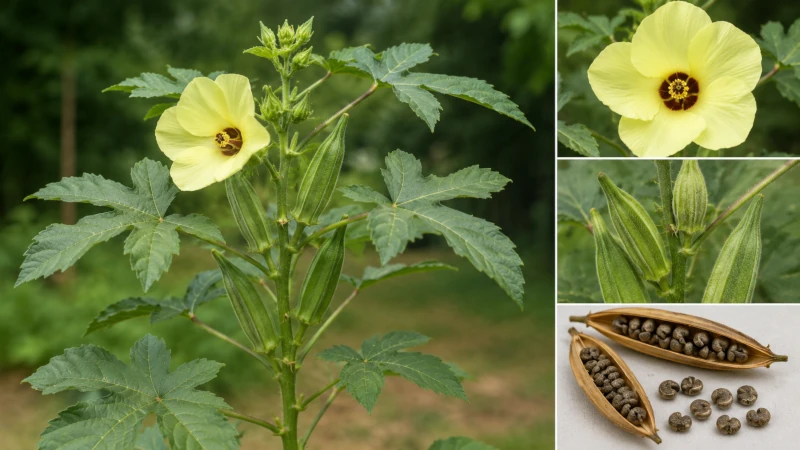
The plant grows to roughly a meter tall, with yellow flowers that have crimson or purple centers and seed capsules full of small, kidney-shaped seeds. Those seeds carry a warm, musky scent — the source of the Latin name moschatus, meaning “musk.” When the seeds are rubbed or warmed, that aroma deepens into something close to amber and natural musk, which is exactly why the perfume trade values them. In parts of Central America the seeds are dropped into coffee for fragrance, and the young pods and leaves are eaten as a vegetable.
What’s in the seeds
The musky smell comes mainly from a compound called ambrettolide, alongside farnesol and farnesol acetate [Drugs.com, 2025]. The seeds also contain fatty acids and a flavonoid called myricetin, which is the single ingredient most studied for a possible health effect [Liu, 2005]. Knowing which compound is responsible matters, because the evidence below is really about these isolated molecules, not the whole seed as people typically use it.
Abelmosk benefits: what the evidence actually shows
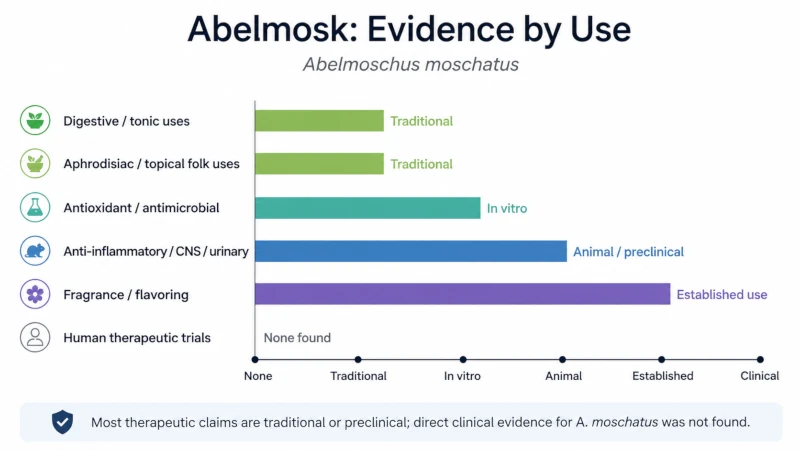
Here is the key point a careful reader needs: the major drug-information references state that the plant has been used traditionally for many purposes, but no clinical (human) trials support any of them [Drugs.com, 2025]. What exists is folk history plus laboratory and animal studies.
Traditional uses
In Ayurvedic and other folk systems, abelmosk seeds have been used as a calming agent and as a remedy for headaches, cramps, muscle aches, and nervous complaints, and as a reputed aphrodisiac and digestive aid [Drugs.com, 2025]. The seed oil contains compounds with an antispasmodic reputation, which is the traditional basis for using it to ease cramping pain, and it has long been linked with a soothing effect on the nervous system. These are long-standing customs worth describing accurately, but they have not been tested in controlled human studies, so they should be read as tradition rather than proof.
Blood sugar — early animal research
The most promising thread is myricetin, a flavonoid in the seeds. In diabetic and obese rats, myricetin from abelmosk lowered blood glucose and reduced insulin resistance, with an effect size researchers compared to a standard diabetes drug [Liu, 2005; Liu, 2010]. This is genuinely interesting, but it is animal data using an isolated compound. It does not show that eating the seeds or drinking a seed tea helps blood sugar in people, and it is not a reason to replace diabetes treatment.
Antioxidant, antimicrobial, and other lab findings
In test-tube and animal studies, abelmosk extracts have shown antioxidant activity, modest activity against some bacteria and fungi, and the ability to slow the growth of certain cancer cell lines in a dish [Gul, 2011; Arokiyaraj, 2015]. Animal studies have also suggested a protective effect on the kidneys against a chemotherapy drug’s toxicity [Amarasiri, 2020]. None of these has been confirmed in humans, and laboratory activity often does not translate into a real effect in the body.
The table sums up where each claim stands.
| Claimed use | Strength of evidence | What the research actually is |
|---|---|---|
| Eases cramps / colic (antispasmodic) | Traditional only | Centuries of folk use; no human trials |
| Aphrodisiac | Traditional only | Folk use; no human data |
| Calming / nervous-system support | Traditional only | Folk use; no human data |
| Lowers blood sugar | Early animal research | Myricetin lowered glucose in diabetic rats |
| Antioxidant | Lab and animal | Compounds scavenged free radicals in assays and mice |
| Antibacterial / antifungal | Lab (in vitro) only | Seed oil inhibited some microbes in dishes |
| Anticancer | Lab (cell lines) only | Slowed growth of some cancer cells in vitro |
| Kidney protection | Animal only | Reduced drug-induced kidney injury in rats |
How abelmosk is used
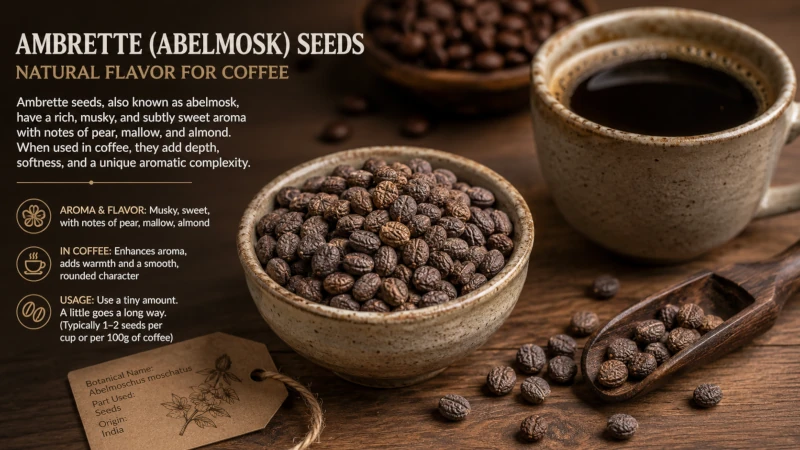
The plant’s clearest, best-documented role is in fragrance and food. Ambrette oil from the seeds is a prized natural musk in perfumery, and the seeds flavor some coffees, bitters, and dishes [Drugs.com, 2025]. Used this way — as a flavoring or scent — abelmosk has a long, uneventful track record.
Traditional medicine also uses a seed infusion (an older preparation steeps roughly 50 grams of seed per liter of water). It’s worth being clear about this: there is no clinically established safe or effective dose for abelmosk, and reference sources note that taking more than about 2¼ teaspoons of seed has been linked to dizziness and headache [Drugs.com, 2025]. If you choose to try a culinary amount, treat it as a flavoring, keep the quantity small, and don’t assume a stronger brew is more beneficial.
Safety, side effects, and who should avoid abelmosk
Abelmosk is regarded as possibly safe in the small amounts used to flavor food. Beyond that, a few cautions are well worth knowing:
- Pregnancy and breastfeeding: Avoid. A closely related hibiscus species has shown an anti-implantation effect, abelmosk is used in some cultures as a traditional remedy around fertility and childbirth, and musk compounds from the plant can persist in breast milk [Drugs.com, 2025; Lans, 2007]. There isn’t enough safety data to use it medicinally while pregnant or nursing.
- Skin and sun sensitivity: Ambrette and musk compounds, especially in cosmetics, can cause skin irritation and photosensitivity (a stronger-than-normal reaction to sunlight) in sensitive people [Drugs.com, 2025]. Patch-test any product containing ambrette oil before broad use.
- Larger seed doses: Dizziness and headache have been reported with more than about 2¼ teaspoons of seed [Drugs.com, 2025].
- Diabetes medication: Because animal research shows blood-sugar lowering, anyone taking glucose-lowering medication should be cautious about combining it with concentrated seed products and should monitor levels with their clinician’s guidance. No specific drug interactions are well documented, but this one is worth flagging.
- Children: There is no safety data for medicinal use in children, so it’s best avoided.
The broader caution is the most important one: abelmosk has not been shown to treat, cure, or prevent any disease. It should never replace proven treatment for conditions like diabetes, infections, or painful periods.
When to talk to a healthcare professional
Speak with a doctor, pharmacist, or qualified herbal practitioner before using abelmosk medicinally if you are pregnant or breastfeeding, take prescription medication (especially for diabetes), have a chronic condition, or plan to give it to a child.
Do not use abelmosk to self-treat symptoms that need real medical attention. Get prompt care for severe or worsening abdominal pain, a high fever, fainting, a severe allergic reaction (swelling of the face or throat, trouble breathing), or any symptom that is severe, unusual for you, or not improving — these are not problems for a home remedy to solve.
Health Disclaimer: This article is for general educational purposes only and is not medical advice. It is not a substitute for diagnosis or treatment from a qualified healthcare professional. Abelmosk (ambrette) has not been proven to treat, cure, or prevent any disease, and the research described here is largely traditional, laboratory-based, or from animal studies. If you are pregnant, breastfeeding, taking medication, or managing a health condition, talk with your doctor or pharmacist before using any herb or supplement. Seek prompt medical care for severe or worsening symptoms.
Frequently Asked Questions
Is abelmosk safe to consume?
In the small amounts used to flavor food, it is generally considered safe. There is no established safe medicinal dose, and larger amounts of seed (more than about 2¼ teaspoons) have been linked to dizziness and headache [Drugs.com, 2025].
Does abelmosk lower blood sugar?
Only animal research supports this, and it involves an isolated compound (myricetin), not the seeds as people normally use them [Liu, 2010]. It hasn’t been tested in humans, so it shouldn’t be used to manage diabetes.
Is abelmosk the same as okra?
They’re relatives, not the same plant. Both belong to the mallow family (Malvaceae), but abelmosk (Abelmoschus moschatus) is grown for its musky, fragrant seeds, while common okra (Abelmoschus esculentus) is grown as a vegetable.
Can I use abelmosk during pregnancy?
No. Reference sources advise avoiding medicinal use during pregnancy and breastfeeding because of possible effects on implantation and limited safety data [Drugs.com, 2025; Lans, 2007].
What is ambrette oil used for?
It’s a natural musk used widely in perfumery, and it has been used to scent cosmetics and flavor some foods and drinks [Drugs.com, 2025]. That fragrance and flavoring role is the plant’s best-documented use.
REFERENCES
- Drugs.com (Wolters Kluwer). Musk Okra (Abelmoschus moschatus): Uses, Benefits & Dosage. Medically reviewed; updated Oct 16, 2025. View source
- Liu IM, Liou SS, Lan TW, Hsu FL, Cheng JT. Myricetin as the active principle of Abelmoschus moschatus to lower plasma glucose in streptozotocin-induced diabetic rats. Planta Med. 2005;71(7):617–621. View source
- Liu IM, Tzeng TF, Liou SS. Abelmoschus moschatus (Malvaceae), an aromatic plant, suitable for medical or food uses to improve insulin sensitivity. Phytother Res. 2010;24(2):233–239. View source
- Gul MZ, Bhakshu LM, Ahmad F, et al. Evaluation of Abelmoschus moschatus extracts for antioxidant, free radical scavenging, antimicrobial and antiproliferative activities using in vitro assays. BMC Complement Altern Med. 2011;11:64. View source
- Arokiyaraj S, Choi SH, Lee Y, et al. Characterization of ambrette seed oil and its mode of action in bacteria. Molecules. 2015;20(1):384–395. View source
- Lans C. Ethnomedicines used in Trinidad and Tobago for reproductive problems. J Ethnobiol Ethnomed. 2007;3:13. View source
- Amarasiri SS, Attanayake AP, Arawwawala LDAM, et al. Acute and 28-day repeated-dose oral toxicity assessment of Abelmoschus moschatus Medik. in healthy Wistar rats. Evid Based Complement Alternat Med. 2020;2020:1359050. View source
- Pamplona-Roger GD. Encyclopedia of Medicinal Plants. Editorial Safeliz; 2000:363. Print.
