
If you have come across a plant labelled allgood and wondered whether it is food, medicine, or just a weed, the honest answer is: mostly food. Good King Henry, the plant behind that old name, is a leafy perennial that European cottage gardeners grew and ate for centuries, long before spinach pushed it off the plate. The allgood plant also carries a long folk reputation as a healing herb — some of which is worth taking seriously, while a good deal of it is tradition rather than tested fact. Here is what the plant is, how people eat it, what is genuinely known about its nutrition and safety, and where the health claims run ahead of the evidence.
What the allgood plant actually is
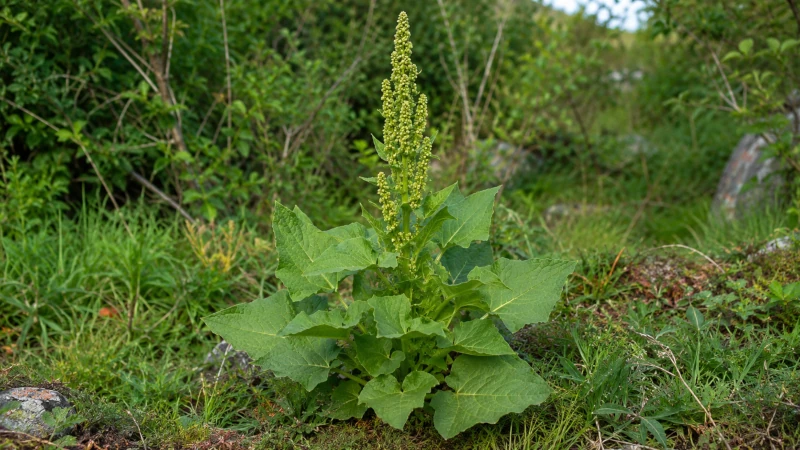
Good King Henry answers to a startling number of names: allgood, poor man’s asparagus, perennial goosefoot, Lincolnshire spinach, English mercury, mercury goosefoot, and markery among them. Botanists now call it Blitum bonus-henricus. For most of the last 250 years it sat under Chenopodium bonus-henricus, and you will still see that name on seed packets and in older herbals. Molecular work around 2012 moved it into the genus Blitum, closer to true spinach than to the goosefoots it had been grouped with. Its family is the Amaranthaceae, which absorbed the old Chenopodiaceae — so the older description of it as a “Chenopodiaceae” plant is not so much wrong as out of date.
It is a hardy perennial reaching roughly 40–80 cm, with broad, arrow- or triangle-shaped leaves that feel slightly waxy and succulent, and tall spikes of tiny greenish flowers. Native to central and southern Europe, it spread across the continent and crossed the Atlantic with settlers, and it still turns up around old homesteads in parts of North America.
The name is more folklore than history. “Good King Henry” seems to come from the German Guter Heinrich (Good Henry), used to tell the edible plant apart from Böser Heinrich (Bad Henry), a name for poisonous dog’s mercury. The “Henry” there is the sort of name old European folklore handed to household elves, not to any real monarch — the regal “King” was added later in English. “Allgood” simply meant the whole plant was useful. If you like reviving forgotten kitchen-garden greens, it sits alongside another old leafy potherb, patience dock.
What it tastes like and how people eat it
This is where the plant earns its place. All the tender parts are edible, and each was traditionally cooked a little differently:
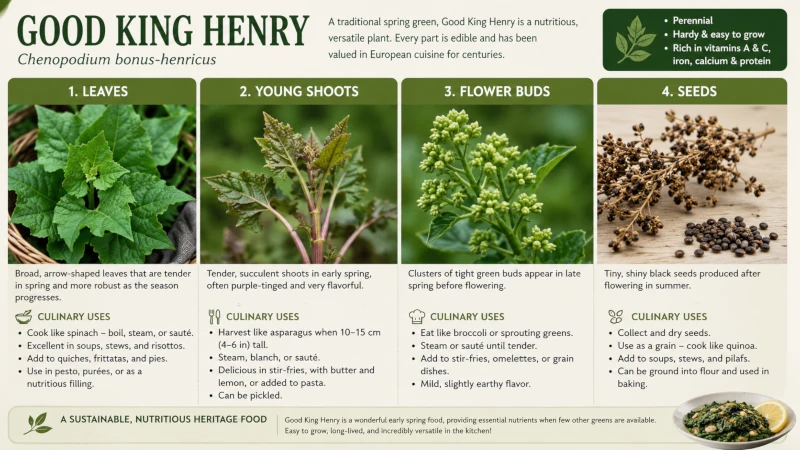
- Leaves — cooked like spinach: boiled, steamed, or sautéed, and added to soups and stews. They are milder in early spring and turn more bitter as the season wears on.
- Young shoots — cut at around 12 cm and cooked like asparagus, which is exactly where “poor man’s asparagus” comes from.
- Flower buds — steamed or sautéed like a small broccoli.
- Seeds — ground into a flour and mixed with grain flour for bread, but only after soaking and rinsing to remove their saponins (more on those below).
Most growers steer you toward cooking rather than eating large amounts raw, both because heat softens the slightly mealy, bitter texture and because it lowers the oxalate content. If the leaves taste sharply bitter, soaking them in salted water for about half an hour and rinsing before cooking takes the edge off.
What’s actually in it (and what we don’t know)
Good King Henry is routinely described as rich in iron, a source of vitamin C, and calcium, with some sources adding vitamin A, B vitamins, and potassium. As a dark leafy green related to spinach, that profile is entirely plausible, and historically these greens were prized precisely as an early-spring source of vitamins after a long winter of stored food.
One honest caveat: most of those nutrition claims come from gardening write-ups and seed catalogues, not from a measured laboratory nutrient panel of the kind spinach has in national food databases. Reliable per-gram figures for this particular species are thin on the ground. So it is fair to treat Good King Henry as a healthy leafy green of the spinach type — not as a precisely quantified “superfood,” and not as a substitute for a varied diet or a supplement when one is actually needed.
The oxalate question — the part that actually matters
Like spinach, chard, rhubarb, and beet greens, Good King Henry contains oxalic acid (oxalates). Oxalates are natural plant compounds. In the body they bind to calcium, and in people who are prone to them they can contribute to calcium-oxalate kidney stones; they can also modestly reduce how much of certain minerals you absorb from a meal. For most people eating normal amounts, oxalate-rich greens are healthy and not a problem.
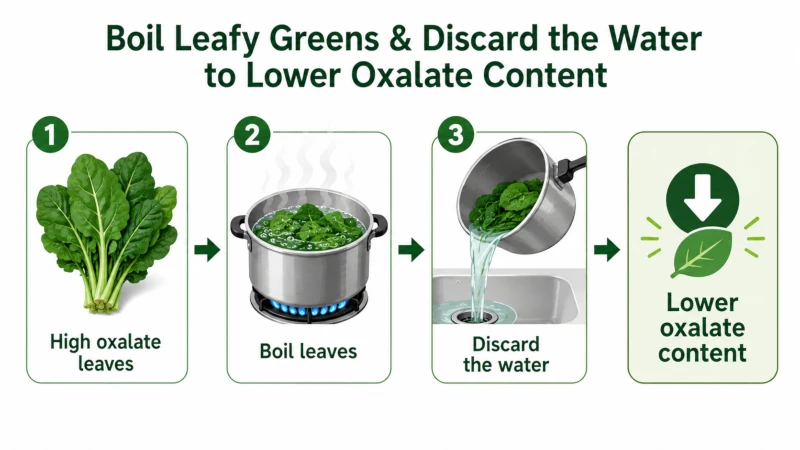
There is real, plant-specific data here, not just guesswork. A 2017 analysis of Good King Henry measured its oxalate content and found that boiling the mixed leaves, stems, and buds for two minutes significantly cut the total oxalate compared with the raw plant, and that larger mature leaves carried noticeably more oxalate than small young ones. The practical lesson is simple: pick young leaves, cook them, and tip away the cooking water, because much of the oxalate leaches out into it.
Who should be cautious
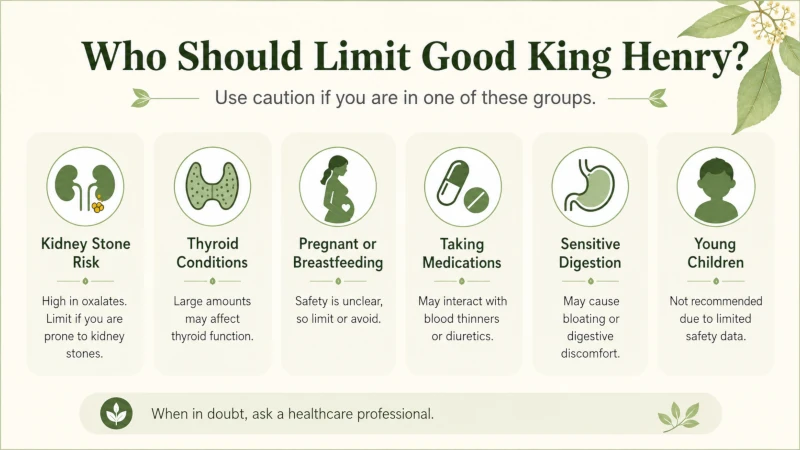
If you have had calcium-oxalate kidney stones, have kidney disease, or have been advised to follow a low-oxalate diet, treat Good King Henry the way you would treat spinach: limit it, or check with your doctor or dietitian before making it a regular part of meals. People with gout are sometimes advised to be careful with high-oxalate foods as well. A few habits lower the risk for everyone: cook the greens, pair high-oxalate foods with a source of calcium (the calcium binds oxalate in the gut so less is absorbed), and stay well hydrated.
Its traditional medicinal reputation — and how seriously to take it
For centuries Good King Henry was a folk remedy as well as a vegetable. The seeds were used as a gentle laxative; mashed leaves were laid on chronic sores, boils, and abscesses as a poultice; and the plant was reputed to help with anaemia. In Bulgarian folk medicine the roots were used for complaints ranging from bronchitis and laryngitis to rheumatism, gout, constipation, and skin inflammation. The seventeenth-century herbalist Nicholas Culpeper recommended it for cleansing stubborn sores.
Here is the part to be clear about: these are traditional uses, recorded in herbals and handed down — not conclusions from modern clinical trials. There is no good human-trial evidence that eating Good King Henry treats anaemia, clears intestinal parasites, or heals wounds. Its folk reputation as a mild laxative and “blood cleanser” is at least consistent with its being a fibre- and mineral-containing green, but that is a long way from a tested medicine. Treat the medicinal history as cultural background, not a treatment plan.
Two of the old uses deserve a specific word of caution:
- Parasite “cleanses.” Good King Henry was once grouped with the “wormseed” plants used to expel intestinal worms. Its better-known relative for that job, wormseed (now Dysphania ambrosioides), is genuinely toxic at the doses once used. Self-treating a suspected parasite with folk “parasite” herbs is unreliable and can be dangerous; if you think you have an infection, get tested and treated properly.
- Poultices on abscesses. An abscess is a walled-off pocket of infection that often needs to be drained, and sometimes treated with antibiotics. Packing it with plant material can delay proper care and introduce contamination. For general interest in herbs traditionally used on the skin, that is one thing; treating a real abscess at home is another, and worth avoiding.
What the modern research actually shows
In the last few years, chemists — largely a Bulgarian research group — have isolated specific flavonoids from the plant’s above-ground parts (glycosides of patuletin, 6-methoxykaempferol, and spinacetin) and tested them in the laboratory. In test-tube models — isolated rat-brain particles and human nerve-cell lines placed under chemically induced stress — these purified compounds showed antioxidant and so-called neuroprotective effects, and a few weakly nudged enzymes tied to blood sugar and fat digestion.
That sounds impressive, so here is the necessary brake on it. This is early, in-vitro work on purified molecules at fixed concentrations — not studies of people, or even animals, eating the plant. It tells us Good King Henry contains some interesting antioxidant compounds, which is true of a great many leafy greens. It does not show that adding it to dinner protects your brain, lowers blood sugar, or does anything measurable for your health. Reading these results as “brain superfood” would badly overstate what was found.
How to use the allgood plant safely
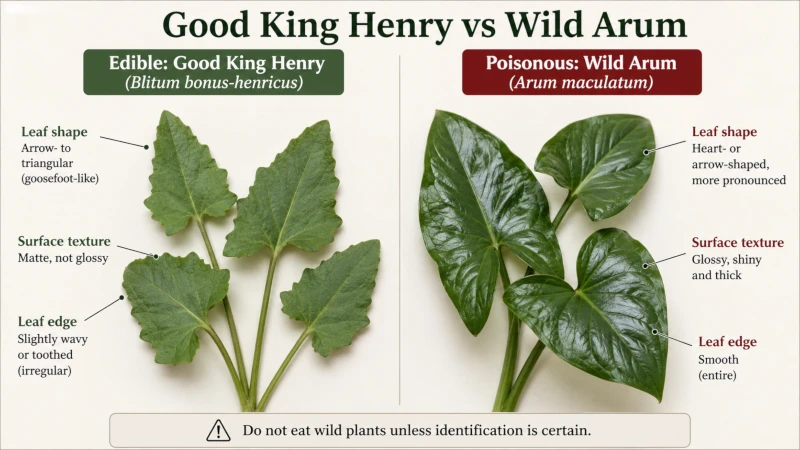
- Identify it correctly. In its leafy stage Good King Henry can be confused with wild arum (Arum maculatum), which is poisonous. Arum leaves are smoother and glossier, and its flower is a single hooded spathe, nothing like Good King Henry’s slim greenish flower spikes. If you are not sure, do not eat it.
- Cook the leaves and discard the water. This softens the texture and leaches out much of the oxalate.
- Harvest young. Older leaves are more bitter and higher in oxalate.
- Process the seeds. Soak and rinse them before use because of their saponins. For the same reason, do not dump quantities of the plant into a fish pond — the saponins are why people once used it to stun fish.
- Keep it in proportion. Treat it like spinach: a wholesome green in ordinary amounts, not a daily megadose.
Who should avoid it or check first
- Anyone with a history of calcium-oxalate kidney stones, kidney disease, or who has been told to limit oxalate.
- People with gout, who are often advised to watch high-oxalate foods.
- During pregnancy or breastfeeding: as an occasional cooked vegetable in normal food amounts it sits in the same bracket as other leafy greens, but there is no safety data for medicinal or concentrated preparations, so skip any “herbal remedy” use and ask your doctor.
- For children: the old idea of the seeds as a children’s laxative is not a reason to use them that way. Do not give plant remedies to a child for constipation without paediatric advice.
When to see a professional
Food is food, but some situations call for a clinician rather than a garden remedy. Seek proper medical care for:
- An abscess or boil that is enlarging, spreading redness or red streaks, or accompanied by fever.
- A suspected intestinal parasite — this needs testing and targeted treatment, not foraged greens.
- Signs of a kidney stone, such as severe one-sided back or flank pain, or blood in the urine — this can be urgent.
- Symptoms of anaemia such as persistent fatigue, paleness, or breathlessness — get a blood test rather than self-treating with greens.
| Health Disclaimer This article is for general education only and is not medical advice. Good King Henry is described here mainly as a traditional food plant. Nothing in it is intended to diagnose, treat, cure, or prevent any disease, and the historical medicinal uses mentioned are not endorsements. Do not use this plant — or any herb, foraged green, or home remedy — to self-treat a medical condition without first speaking to a qualified healthcare professional. If you are pregnant or breastfeeding, take prescription medication, have kidney disease or a history of kidney stones, or are considering giving any plant remedy to a child, talk to your doctor or pharmacist first. If you forage, be certain of your identification: when in doubt, do not eat it. |
Frequently Asked Questions
Is the allgood plant the same as Good King Henry?
Yes. “Allgood” is one of many old common names for Good King Henry (Blitum bonus-henricus, formerly Chenopodium bonus-henricus). Other names include poor man’s asparagus, Lincolnshire spinach, perennial goosefoot, and English mercury.
Can you eat Good King Henry raw?
A few young leaves in a salad are fine, but it is usually cooked. Cooking improves the slightly mealy texture and lowers its oxalate content, so boiling or steaming and discarding the water is the better default.
Is Good King Henry poisonous?
The tender, correctly identified, cooked parts are not. The real cautions are its oxalate content (relevant mainly for people prone to kidney stones), the saponins in raw seeds, and the risk of confusing it in leaf with poisonous lookalikes such as wild arum.
Does Good King Henry have proven health benefits?
It is a nutritious leafy green, and that is the honest headline. The claims that it treats anaemia, clears parasites, or heals wounds come from folk tradition, not clinical trials. Recent laboratory work on isolated compounds from the plant is interesting but does not show health benefits from eating it.
Who should avoid it?
People with a history of calcium-oxalate kidney stones, kidney disease, or gout should limit it or ask a professional. Avoid medicinal or concentrated preparations during pregnancy and breastfeeding, and don’t use it as a remedy for children without medical advice.
Is it the same plant as wormseed or epazote?
No. They are relatives within the same broad family, but wormseed/epazote (Dysphania ambrosioides) is a different, more pungent plant that was used as a worm treatment and can be toxic. Good King Henry is the mild, spinach-like potherb.
References
Medical and safety claims are anchored to peer-reviewed studies and established health sources. Botanical, culinary, and historical details draw on horticultural and reference sources, which are appropriate for that material but not for medical claims.
- “Oxalate Content of the Herb Good-King-Henry (Blitum Bonus-Henricus).” Foods, 2017 (peer-reviewed; plant-specific oxalate measurement and the effect of cooking). PubMed ID 28231194. View source
- Kokanova-Nedialkova Z., Nedialkov P.T., et al. “Neuroprotective, anti-α-glucosidase and prolipase active flavonoids from Good King Henry (Chenopodium bonus-henricus L.).” Natural Product Research, 2021 (in-vitro study of isolated flavonoids). PubMed ID 32597284. View source
- Kondeva-Burdina M., Panayotova D., Nedialkov P.T., Kokanova-Nedialkova Z. “Flavonoids and Saponins from Two Chenopodium Species — Preliminary Evaluation for hMAO-A/B, Neuroprotective Activity.” Molecules, 2025 (in-vitro; documents traditional Bulgarian root uses). View source
- Medical News Today. “Oxalic acid (oxalate): What it is, uses, and risks.” Reviewed health reference on oxalates and kidney-stone risk. View source
- WebMD. “Foods High in Oxalates.” Consumer-health reference on dietary oxalate and who may need to limit it. View source
- Royal Horticultural Society (RHS). “Blitum bonus-henricus (good King Henry).” Botanical and culinary profile. View source
- “Blitum bonus-henricus.” Wikipedia (tertiary source, used for naming history, description, and reclassification background). View source
- Backyard Larder. “Good King Henry.” Horticultural reference on taxonomy history, etymology, and cultivation. View source
- Plantura. “Good King Henry: growing, location & use.” Note on oxalic acid caution and confusion with poisonous wild arum (Arum maculatum). View source
- Mother Earth Living. “An Herb to Know: Good-King-Henry.” Historical and folk-use background. View source
- Pamplona-Roger G.D., M.D. Encyclopedia of Medicinal Plants, Editorial Safeliz, 2000 (print; original source for traditional-use descriptions).
