People have trusted the cornflower plant for centuries — brewing the petals into a pale herbal tea, dabbing cooled “cornflower water” on tired eyes, folding the blue flowers into skin lotions. Before you try any of that, here’s the honest version: the cornflower plant (Centaurea cyanus) has a rich folk history, but modern research has not shown that it treats any medical condition, and the old eye remedies deserve a genuine safety warning rather than a recommendation. Where cornflower shines is as a garden flower, a food-safe way to add color to tea, and a gentle cosmetic ingredient. Where it falls short is anywhere it’s asked to stand in for real medical care — especially for your eyes.
What the cornflower plant actually is
Cornflower is an annual in the daisy family (Asteraceae/Compositae), the same big plant family as ragweed, chrysanthemums, marigolds, and daisies. That family tie matters later for allergies. It grew wild for generations in European grain fields — so much so that farmers cursed it for blunting their sickles, which is where the old English name hurtsickle comes from. Today it’s mostly a cultivated ornamental and a wildflower-mix staple, and it grows readily across North America.
How to recognize it
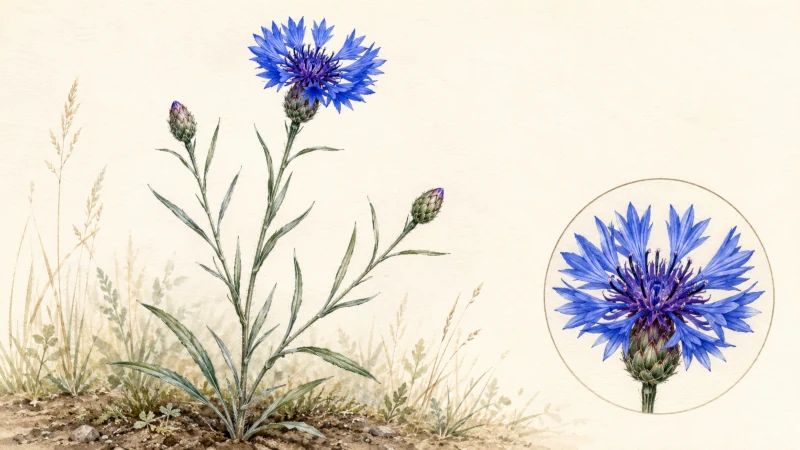
A thin, wiry stem rises up to roughly half a meter, topped by a vivid blue flower head with a slightly ragged, fringed edge. The narrow gray-green leaves have a soft, downy surface. The intense blue is the plant’s signature, though garden varieties also come in pink, purple, and white.
Names you’ll see it under
Cornflower travels under a lot of aliases: bachelor’s button, bluebottle, bluebonnet, blue centaury, cyani flos, and hurtsickle, plus bleuet in French and azulejo in Spanish [WebMD, 2026]. The French also nicknamed it casse-lunettes — “glasses-breaker” — from an old belief that it sharpened eyesight enough to retire your spectacles. That one is folklore, not fact.
What’s inside the flowers
The blue petals owe their color to anthocyanins, the same class of pigments found in blueberries and red cabbage. The flowers also contain flavonoids, coumarins, and other polyphenols, along with polysaccharides and bitter compounds [Centaurea phytochemistry review, 2021]. Several of these have measurable antioxidant activity in the lab. That’s a fair reason to find the plant interesting — but a compound behaving well in a test tube is a long way from a benefit you’d notice, and it’s worth keeping those two things separate.
Traditional uses vs. what the evidence shows
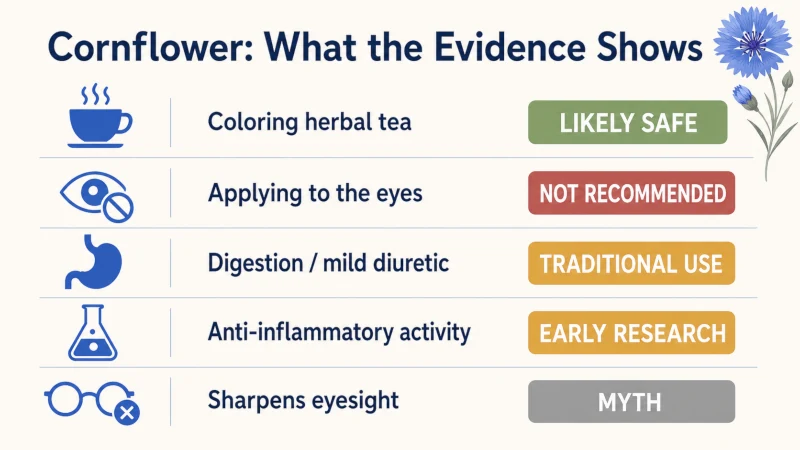
Cornflower’s reputation rests almost entirely on tradition. In European folk medicine the flower heads were used for minor eye irritation, and the bitter infusion was taken to nudge along digestion and as a mild diuretic [Garbacki et al., 1999]. Modern testing hasn’t caught up to the folklore. Health-reference databases that grade herbs against clinical evidence rate cornflower as having insufficient evidence for every medicinal use on record — including eye irritation, fever, constipation, and menstrual complaints [RxList, 2026]. There’s simply no good human research showing it treats a condition [WebMD, 2026].
Evidence at a glance
| Use | Evidence grade | What’s actually known |
| Coloring / flavoring herbal tea | Generally safe | Considered likely safe when used to color herbal teas. |
| Eye irritation (applied to the eye) | Insufficient / not recommended | Traditional use only; no clinical support, and a real safety concern. |
| Digestion, appetite, mild diuretic | Traditional use only | Long folk history; no reliable human trials. |
| Anti-inflammatory activity | Early lab / animal findings | Flower-head polysaccharides reduced induced swelling in animal and test-tube models — not tested as a human treatment. |
| “Sharpens vision” / breaks need for glasses | Myth | Historical folklore with no basis. |
The eye tradition — and where it goes wrong
The eye connection is cornflower’s most famous claim, and it’s the one to be most careful with. The tradition is real: flower heads were used in European folk practice for minor eye inflammation, and a 1999 laboratory study did find that polysaccharides from the flowers reduced inflammation in animal and test-tube models [Garbacki et al., 1999]. But that research tells you about isolated compounds under controlled conditions — not about squeezing homemade flower water into a human eye. No clinical trial has shown cornflower helps conjunctivitis, blepharitis, styes, or any eye condition.
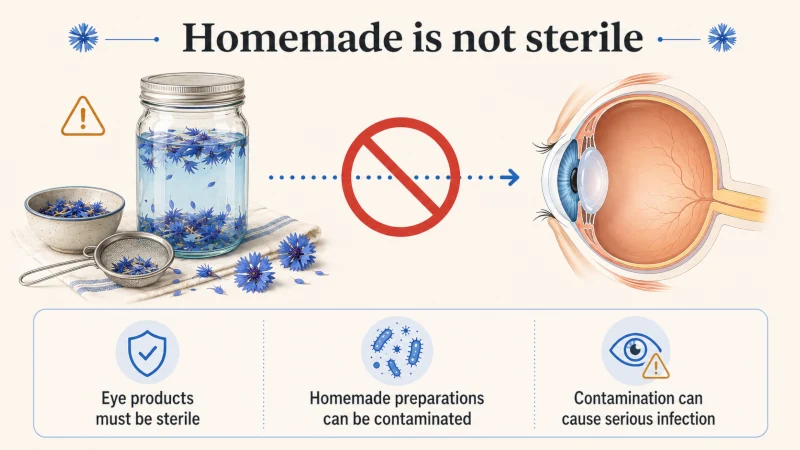
Here’s the part the old recipes leave out. Anything you put in your eye needs to be sterile, because the eye bypasses many of the body’s normal defenses — the FDA is blunt that contaminated eye products have caused infections, vision loss, and blindness, which is why even commercial eye drops get recalled over sterility failures [FDA guidance on eye drops, 2026].
A kitchen infusion strained through a cloth is not sterile, even if you boiled the water. Cornflower is also a daisy-family plant, so it can provoke allergy or irritation on the delicate eye surface. The red, itchy eye you’re trying to soothe could be allergy, dry eye, an infection, or something more serious — and a homemade remedy can delay the right diagnosis while quietly making things worse. For a fuller look at how these conditions get confused, see what can be mistaken for pink eye, and for how cornflower stacks up against other traditional eye herbs, what the evidence says about herbs for eye health.
The practical takeaway: enjoy cornflower elsewhere, and keep it away from your eyes.
Digestive bitter and mild diuretic
The other traditional uses are gentler and lower-stakes. The bitter infusion was sipped before meals as a digestive “appetizer,” and the flowers have a mild diuretic reputation — cornflower is even listed in some national herbal pharmacopeias as a diuretic [Centaurea phytochemistry review, 2021]. These are traditions, not proven effects, and there’s no established medicinal dose. If you like a bitter herbal tea, cornflower is a reasonable thing to enjoy — just hold your expectations at “pleasant beverage,” not “treatment.”
Safe, sensible ways to enjoy cornflower
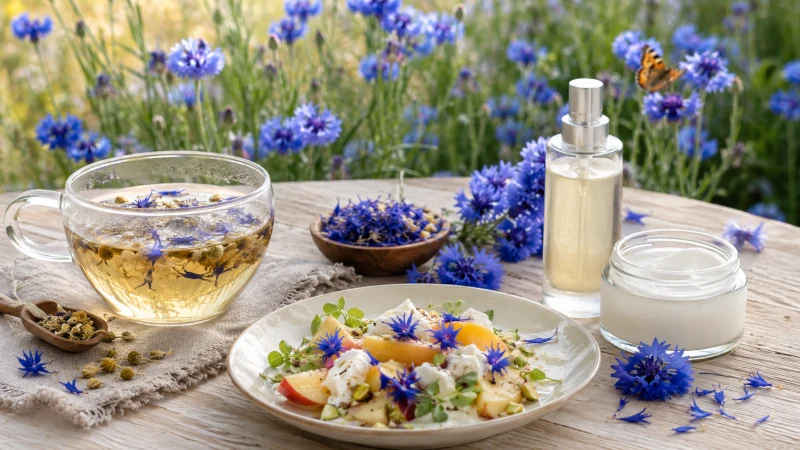
Cornflower earns its keep best when you stop asking it to be medicine:
- In tea, for color and a light bitter note. Dried cornflower petals are a common, food-safe addition to loose-leaf blends, prized mostly for those bright blue flecks. Coloring herbal tea this way is considered a likely-safe use [RxList, 2026].
- As an edible garnish. The petals are edible and look striking scattered over salads, cakes, or cocktails.
- In cosmetics and skincare. Cornflower extract and cornflower water appear in toners and eye-area creams as a soothing, antioxidant-rich ingredient. Used as a labeled cosmetic on intact skin, that’s a low-risk way to enjoy the plant — a very different thing from dripping a homemade version onto your eyeball.
- In the garden. Bees and butterflies love it, and it’s one of the easier annuals to grow from seed.
For eyes specifically, the more reliable move is food and routine care rather than folk drops. The site’s guide to the best foods for eye health covers what genuinely supports vision over the long run.
Safety: side effects, allergies, and who should skip it
Cornflower is considered likely safe as a tea colorant, but there isn’t enough information to call it safe in larger, medicinal amounts, and its side-effect profile in those doses simply hasn’t been mapped [WebMD, 2026].
The clearest risk is allergy. Because cornflower belongs to the Asteraceae/Compositae family, people sensitive to ragweed, daisies, marigolds, or chrysanthemums can react to it [RxList, 2026]. If you have hay fever or known plant allergies, treat cornflower with caution and stop at any sign of a rash, swelling, or itching.
Pregnancy, breastfeeding, and medication cautions
There isn’t reliable safety information on cornflower during pregnancy or breastfeeding, so the standard advice is to avoid it in medicinal amounts during those times [WebMD, 2026]. And because “natural” doesn’t mean “no interactions,” it’s worth running any regular herbal use past a doctor or pharmacist if you take prescription medication, have a chronic condition, or are heading into surgery. The honest reason to be careful here isn’t a documented danger — it’s the absence of data, which is its own reason not to overdo it.
Your eyes: when to skip the folk remedy and see a doctor
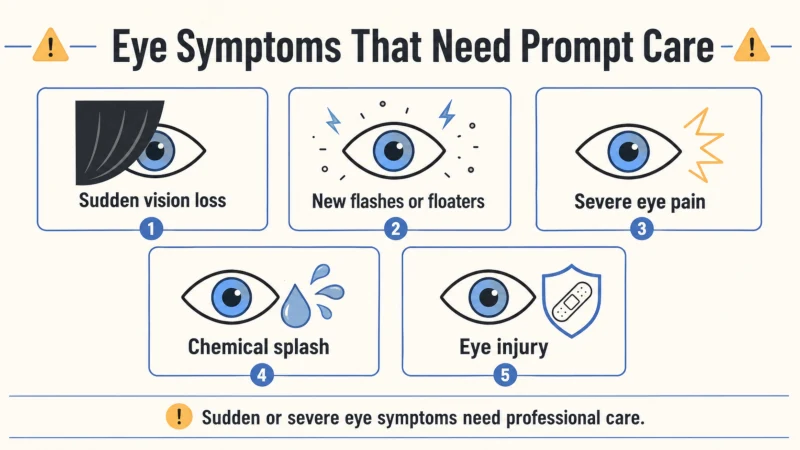
Red, irritated eyes are common and often minor, but some signs mean it’s time for a professional rather than a home remedy. Seek prompt or urgent eye care — primary care, urgent care, or an eye doctor, and the ER for anything sudden and severe — if you have:
- Sudden vision loss, or a shadow or curtain moving across your sight
- A sudden burst of new floaters or flashing lights
- Eye pain, marked light sensitivity, or a painful red eye
- A chemical splash (flush immediately with clean water for at least 15 minutes and get help)
- An eye injury, or discharge and redness that worsens or won’t settle
Everyday redness that lingers, recurring styes, or persistent irritation also deserve a real exam rather than another round of DIY drops. You can browse more symptom-focused Eye & Vision guides to prepare good questions before that visit. Cornflower’s place is in your teacup or your flowerbed — not in your first-aid plan for your eyes.
| Health Disclaimer: This article is for education only and is not medical advice, diagnosis, or treatment. Cornflower has not been proven to treat, cure, or prevent any condition, and there is no established medicinal dose. Do not place homemade cornflower tea, water, or any non-sterile herbal preparation in your eyes. Talk with your doctor or pharmacist before using cornflower or any herbal product if you are pregnant or breastfeeding, take medication, have allergies to plants in the daisy family, or have a diagnosed health condition. Sudden vision changes, severe eye pain, eye injury, chemical exposure, flashes, or new floaters require urgent medical care. |
Frequently Asked Questions
Is the cornflower plant safe to use?
As a colorant or flavor note in herbal tea, cornflower is considered likely safe. There isn’t enough information to know whether it’s safe in larger, medicinal amounts, and people allergic to ragweed, daisies, or related plants can react to it [WebMD, 2026].
Can I use cornflower water for my eyes?
It’s not recommended. There’s no clinical evidence it helps any eye condition, and homemade preparations aren’t sterile — the FDA warns that non-sterile products in the eye can cause infection and even vision loss [FDA guidance on eye drops, 2026]. Use only products made and labeled for the eyes, and see an eye doctor for persistent redness or irritation.
Does cornflower actually improve eyesight?
No. The old idea that it “breaks the need for glasses” is folklore. Cornflower has never been shown to sharpen normal vision.
What is cornflower good for, then?
Realistically: as an ornamental garden flower, an edible petal garnish, a food-safe tea color, and a gentle cosmetic ingredient on the skin. Its centuries-old medicinal reputation isn’t backed by human research [RxList, 2026].
Can I drink cornflower tea while pregnant?
Skip it in medicinal amounts. There isn’t reliable safety data for cornflower during pregnancy or breastfeeding, so avoiding it is the cautious choice [WebMD, 2026]. Ask your doctor if you’re unsure.
Are cornflower petals edible?
Yes. The petals are edible and are used as a colorful garnish and in tea blends. As with any new food, go easy if you have plant allergies.
References
- WebMD. “Cornflower — Uses, Side Effects, and More.” 2026. View source
- RxList. “Cornflower: Health Benefits, Side Effects, Uses, Dose & Precautions.” 2026. View source
- Garbacki N, Gloaguen V, Damas J, Bodart P, Tits M, Angenot L. “Anti-inflammatory and immunological effects of Centaurea cyanus flower-heads.” Journal of Ethnopharmacology. 1999;68(1–3):235–241. View source
- Comparative Assessment of the Phytochemical Composition and Biological Activity of Extracts of Centaurea cyanus L., Centaurea jacea L. and Centaurea scabiosa L. 2021. View source
- U.S. Food and Drug Administration. “What You Should Know about Eye Drops.” Content current June 15, 2026. View source
