
The black pepper plant, Piper nigrum, is a tropical climbing vine, and every black, white and green peppercorn in your kitchen comes from its small, round fruit. As a seasoning, pepper is safe for almost everyone, and it’s one of the easiest ways to cook with less salt. The bigger health claims are thinner than most websites suggest. The best human research on pepper isn’t about curing anything. It’s about how piperine, the compound behind pepper’s bite, changes the way your body absorbs other substances. That explains why pepper gets paired with turmeric, and why it can matter if you take certain medicines.
What is the black pepper plant?
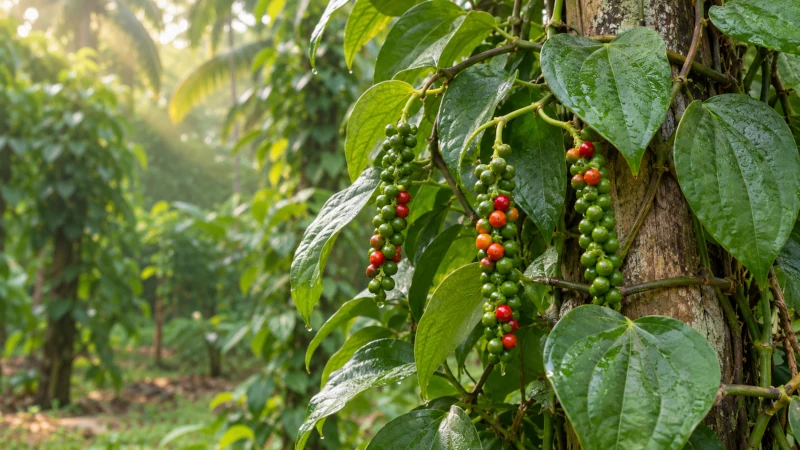
Black pepper is a woody vine in the Piperaceae family. Left to climb, it reaches about 10 meters (33 feet), gripping trees or poles with short aerial roots [Britannica, n.d.]. The leaves are glossy, dark green and pointed. Tiny flowers hang in slender spikes, roughly 50 to 150 to a spike, and ripen into single-seeded fruits about 5 to 6 mm across that turn from green to red [Kew POWO, n.d.; Britannica, n.d.].
The plant is native to southwestern India, including the Western Ghats of Kerala on the Malabar Coast, and possibly Sri Lanka. It’s now grown throughout the tropics, and Vietnam, Indonesia, Brazil and India are the major producers [Kew POWO, n.d.]. People have traded it for a very long time. Pepper moved overland between India and Europe, and the ancient Greeks and Romans sometimes paid tributes in it [Britannica, n.d.].
| Black pepper at a glance | |
| Scientific name | Piper nigrum L. |
| Family | Piperaceae (the pepper family) |
| Native range | Southwestern India; possibly Sri Lanka |
| Growth habit | Perennial, evergreen climbing vine |
| Part used | The fruit (peppercorns), whole or ground, and its essential oil |
| Pungent compound | Piperine |
| Productive life | Starts bearing in 2–5 years; can produce for up to 40 years [Britannica, n.d.] |
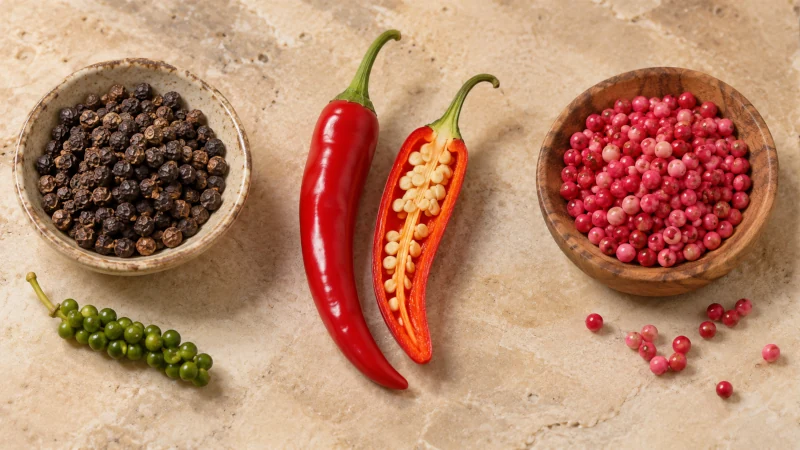
Despite the shared name, black pepper has nothing to do with chili or bell peppers. Those belong to Capsicum, in the potato family [Kew POWO, n.d.], and we cover them in our guide to Capsicum pepper plant benefits. Pink peppercorns aren’t true pepper either. They come from the Brazilian pepper tree, a relative of cashews. Sichuan pepper comes from Zanthoxylum species in the citrus family. Long pepper (Piper longum) is a genuine cousin with a milder flavor [Kew POWO, n.d.].
How one plant gives you black, white and green pepper
All three colors come from the same vine. What differs is when the fruit is picked and what happens to it next [Kew POWO, n.d.].
| Type | When it’s picked | What happens next |
| Green pepper | While the fruit is still immature [Kew POWO, n.d.] | Picked once the spike has filled out [NParks, 2023] |
| Black pepper | Full-size but still green, as the first berries begin to redden | Dipped in boiling water for about 10 minutes, left to darken, then sun-dried for 3–4 days [Britannica, n.d.] |
| White pepper | Slightly riper [Kew POWO, n.d.] | Kept in moist heaps or soaked in running water until the outer layer softens, then rubbed clean and dried [Britannica, n.d.] |
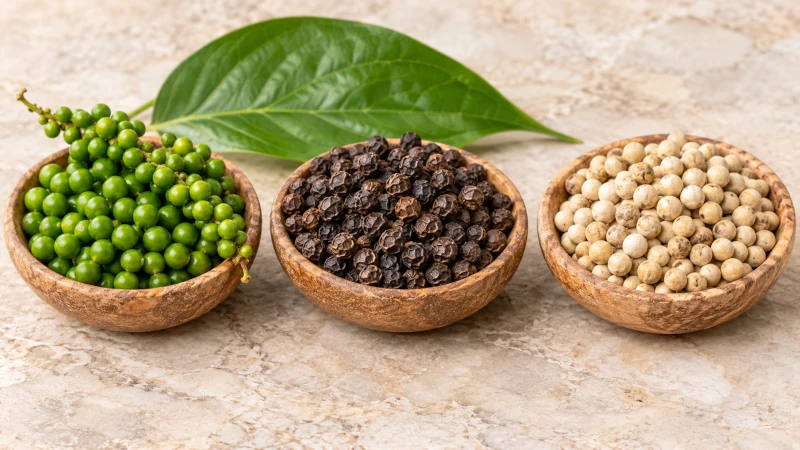
Pepper’s heat comes mainly from piperine. White pepper, with its outer layer removed, is less pungent than black [Britannica, n.d.].
Can you grow a black pepper plant at home?
Yes, if you can give it tropical conditions and some patience. In the field the vine wants a long rainy season, fairly high temperatures and partial shade [Britannica, n.d.]. Growers aim for about 23–32 °C (73–90 °F) [PlantVillage, n.d.]. Outside the tropics, that makes it a container plant that comes indoors well before cold weather.
- Light. Give it bright, indirect or dappled light. More than about six hours of direct sun can scorch it [NParks, 2023].
- Soil and water. Use well-draining soil rich in organic matter, slightly acidic at around pH 5.5 to 6.5, and keep it moist but never waterlogged [PlantVillage, n.d.].
- Pot and support. Choose a pot at least 30 cm (12 inches) deep and give the vine a tall, sturdy trellis or pole to climb [NParks, 2023].
- Starting a plant. Stem cuttings are the usual method [Britannica, n.d.]. Seeds also work and typically sprout within about 10 days [NParks, 2023].
- Waiting. From seed, expect 3 to 4 years before it flowers, and up to a year for each flower spike to ripen [NParks, 2023].

Pick spikes green once they fill out, or let the fruit redden and dry it for black pepper [NParks, 2023]. One potted vine won’t stock your kitchen. It does make an unusual houseplant, and few things explain a spice better than watching it ripen.
Black pepper benefits: what the evidence shows
Black pepper has a long history in Ayurveda, Siddha and Unani medicine, mostly as an appetite stimulant and digestive aid, and also for coughs, colds and expelling intestinal worms [Kew POWO, n.d.]. Only a few of those ideas have been tested in people. Here’s how the main claims hold up.
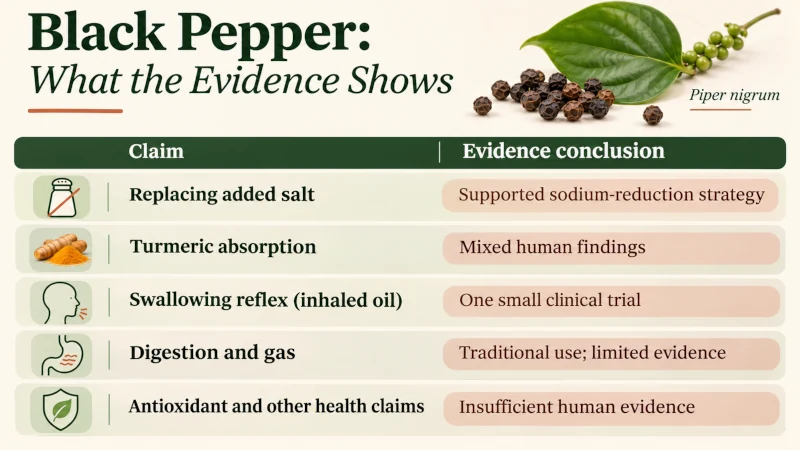
| Claim | What the research looked at | Strength of evidence |
| Helps you eat less salt | Heart-health guidance to season with spices and black pepper instead of salt [American Heart Association, 2025] | Strong as a strategy. The benefit comes from less sodium, not from the pepper. |
| Boosts turmeric (curcumin) absorption | One 1998 study in 8 volunteers; a later 30-person study found no significant effect [Shoba et al., 1998; UK Committee on Toxicity, 2024] | Mixed. Probably some effect; the famous “2,000%” is overstated. |
| Improves swallowing reflex in older adults (inhaled oil) | One 1-month randomized trial in 105 nursing-home residents in Japan [Ebihara et al., 2006] | Early. Promising, in a narrow clinical group. |
| Aids digestion, eases gas | Traditional use; no good human trials [Kew POWO, n.d.; Natural Medicines via WebMD, n.d.] | Traditional only. |
| Antioxidant, anti-inflammatory, blood sugar, weight loss | Mostly lab and animal research; insufficient human evidence [Natural Medicines via RxList, n.d.] | Insufficient. |
| Kills intestinal parasites | Traditional use [Kew POWO, n.d.] | Insufficient. Get tested and treated. |
Seasoning instead of salt
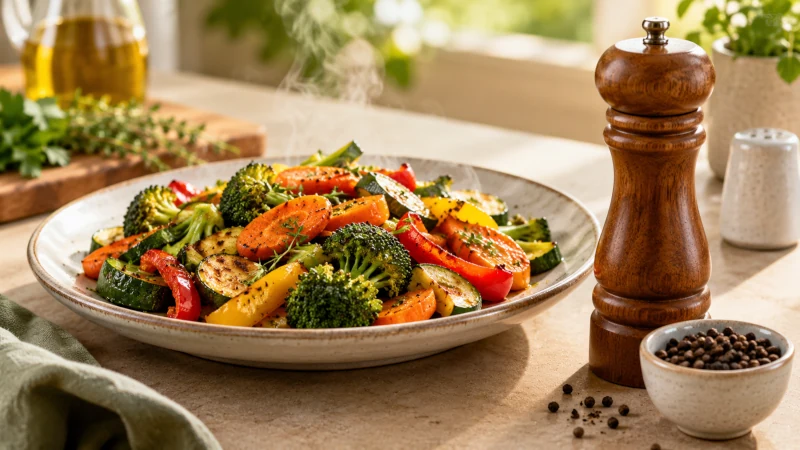
This is the least exotic benefit and the one most likely to help you. The American Heart Association’s tips for cutting sodium include cooking with herbs and spices, following the DASH eating plan, and, when eating out, skipping the salt shaker and adding black pepper instead [American Heart Association, 2025]. The gain comes from the sodium you skip, not from anything in the pepper. If blood pressure is your concern, our guide to foods that lower blood pressure explains which foods have the strongest evidence and how much difference to expect.
Black pepper and turmeric
Curcumin, the main active compound in turmeric, is poorly absorbed. Piperine slows one of the routes the liver and gut use to break it down [UK Committee on Toxicity, 2024]. In a widely cited 1998 study, healthy volunteers who took 2 g of curcumin with 20 mg of piperine had much higher blood levels than with curcumin alone, and the authors reported a 2,000% increase in bioavailability [Shoba et al., 1998].
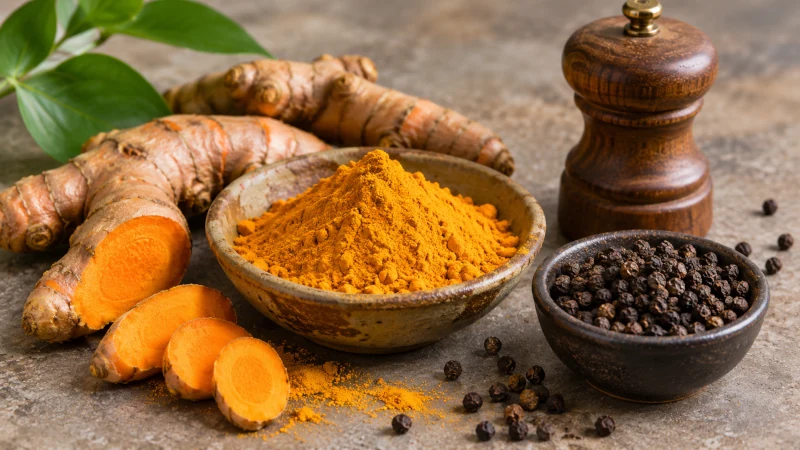
That number gets repeated everywhere, so its limits matter. The UK Committee on Toxicity points out that the study had only eight participants and sampled blood for six hours. Curcumin was mostly undetectable without piperine, which makes any percentage increase hard to pin down. A later study in 30 people found no significant difference when piperine was added [UK Committee on Toxicity, 2024].
Piperine probably helps somewhat, but “2,000%” overstates what’s known. The same effect that raises curcumin levels can also raise levels of some medicines (more on that below). A grind of pepper over food cooked with turmeric is a sensible kitchen habit. A turmeric-and-piperine capsule is a different product with different risks.
Black pepper oil and swallowing
One of the more interesting human trials didn’t involve eating pepper at all. Japanese researchers randomized 105 nursing-home residents with swallowing problems, most of them after a stroke. One minute of breathing in black pepper oil shortened the delay before the swallowing reflex kicked in, compared with lavender oil or plain water. After a month of the inhalations, reflex measures had improved [Ebihara et al., 2006].
It’s a single study in a specific group of patients. Swallowing problems can lead to food entering the airway and to pneumonia, so they need assessment by a doctor or swallowing specialist rather than an essential oil at home.
Digestion and gas
Pepper’s reputation as a digestive aid is centuries old [Kew POWO, n.d.], and there is a measurable effect behind it. In a small 1987 experiment, 1.5 g of black pepper delivered directly into healthy volunteers’ stomachs increased acid and pepsin secretion [Myers et al., 1987]. More stomach acid isn’t the same thing as better digestion, though, and there’s no good human evidence that pepper relieves upset stomach or gas [Natural Medicines via WebMD, n.d.].
If bloating is your main complaint, fennel for gas and bloating has a better-recognized traditional record, and our overview of herbs for the digestive system covers other options.
Antioxidants, inflammation and parasites
Piperine shows antioxidant and antimicrobial activity in laboratory research [Kew POWO, n.d.; Natural Medicines via WebMD, n.d.], and that work is the source of most “benefit” lists online. It hasn’t turned into proven benefits in people. Natural Medicines, a database that grades herbal evidence, rates black pepper as having insufficient evidence for arthritis, asthma, cancer, weight loss, low libido and many other uses [Natural Medicines via RxList, n.d.].
Pepper’s traditional use against intestinal worms [Kew POWO, n.d.] falls in the same category. If you think you have a parasite, get tested and treated. Our guide to herbs promoted for killing parasites explains which remedies have any human evidence and which ones are dangerous.
Black pepper side effects, interactions and safety
Pepper in ordinary food amounts is likely safe for adults, children, and people who are pregnant or breastfeeding [Natural Medicines via WebMD, n.d.]. The cautions below apply mainly to large amounts, concentrated extracts and piperine supplements.
Stomach irritation
In the same 1987 experiment, pepper also increased shedding of stomach-lining cells and caused tiny areas of bleeding, and one volunteer had visible bleeding [Myers et al., 1987]. That was a 1.5 g dose delivered straight into the stomach, not pepper sprinkled on a meal.
Pepper isn’t among the main causes of ulcers. NIDDK names H. pylori infection and NSAID pain relievers such as aspirin and ibuprofen as the most common ones [NIDDK, n.d.]. Still, if you have gastritis, an ulcer or reflux and pepper makes your symptoms worse, use less. The same goes for other pungent spices, including ginger in large amounts.
Medication interactions
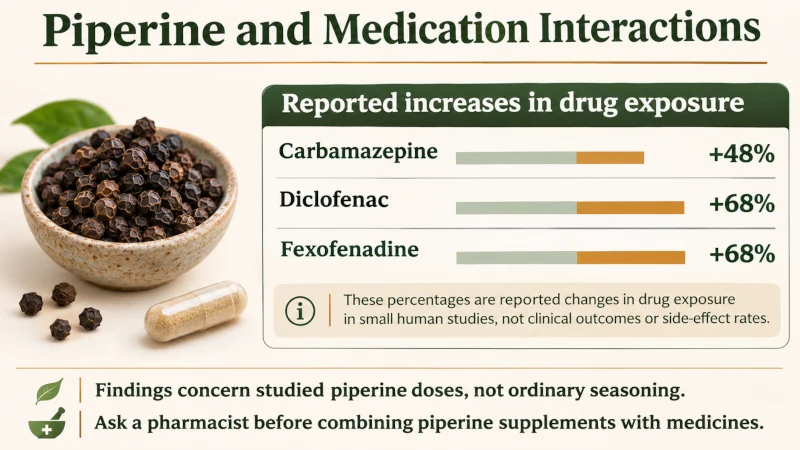
This is the risk that matters most, and it mostly concerns supplements. In lab experiments, piperine blocks CYP3A4, a liver enzyme that breaks down many drugs, and P-glycoprotein, a pump that moves drugs out of cells [Bhardwaj et al., 2002].
Human studies show the effect is real. Healthy volunteers who took 20 mg of piperine a day for 10 days had 48% more of the seizure drug carbamazepine in their blood, and 68% more of both the pain reliever diclofenac and the allergy drug fexofenadine. Piperine at 15 mg a day for 3 days made the sedative midazolam last longer [Horn & Hansten, 2017]. Most of these studies were small and not double-blind.
It isn’t clear whether pepper in food causes meaningful interactions. Pharmacists John Horn and Philip Hansten note that heavy pepper users may take in piperine amounts similar to those in the studies [Horn & Hansten, 2017]. Natural Medicines lists moderate interactions with lithium, phenytoin, propranolol, theophylline, rifampin, cyclosporine, blood thinners and antiplatelet drugs, diabetes medicines, and many drugs processed by CYP3A4 [Natural Medicines via WebMD, n.d.].
What to do: if you take any of these, or any medicine where small changes in blood levels matter, ask your pharmacist before taking piperine or a turmeric product that contains it. Check the label: piperine is often listed as “black pepper extract.”
Pregnancy, breastfeeding and children
Food amounts are fine. Large medicinal amounts during pregnancy are considered likely unsafe [Natural Medicines via WebMD, n.d.], and animal studies using high doses of isolated piperine have found effects on sperm production and on pregnancy and embryo development [Ziegenhagen et al., 2021]. Skip piperine supplements while pregnant or breastfeeding unless your doctor recommends them, and consider skipping them while trying to conceive.
For children, pepper in food is safe. There are reports of children dying after large amounts of pepper got into their lungs [Natural Medicines via WebMD, n.d.], so keep bulk pepper out of small children’s reach.
Bleeding, surgery, skin and eyes
Piperine may slow blood clotting and affect blood sugar. Natural Medicines advises against amounts above food levels if you have a bleeding disorder, and stopping them at least 2 weeks before scheduled surgery. If you have diabetes, larger amounts may change how your medicine works [Natural Medicines via WebMD, n.d.; Natural Medicines via RxList, n.d.]. Black pepper essential oil can burn if it gets in your eyes, and allergic reactions are possible [Natural Medicines via WebMD, n.d.].
Who should limit or avoid it
| If you… | What to do |
| Take carbamazepine, phenytoin, lithium, cyclosporine, a blood thinner, diabetes medicine, or another drug processed by CYP3A4 | Avoid piperine and turmeric-with-piperine supplements unless your doctor or pharmacist approves. Mention it if you eat a lot of pepper. |
| Are pregnant, breastfeeding or trying to conceive | Stick to food amounts. |
| Have gastritis, an ulcer or reflux | Cut back if pepper worsens your symptoms. |
| Have a bleeding disorder or upcoming surgery | No more than food amounts; stop supplements at least 2 weeks before surgery. |
| Care for young children | Food amounts only; store bulk pepper out of reach. |
When to see a doctor
Talk to a doctor or pharmacist before starting a piperine or turmeric-with-piperine supplement if you take any prescription medicine. See your doctor if pepper or spicy food regularly brings on stomach pain or heartburn, if indigestion keeps coming back, or if you cough or choke when you eat or drink.
Get medical help right away if you have any of these signs, which can point to a bleeding ulcer or another emergency [NIDDK, n.d.]:
- Black or tarry stools, or red or maroon blood in your stool
- Red blood in your vomit, or vomit that looks like coffee grounds
- Sudden, sharp or severe stomach pain that doesn’t go away
- Dizziness or fainting
- A rapid pulse or other signs of shock
| HEALTH DISCLAIMER: This article is for general education. It isn’t a substitute for advice, diagnosis or treatment from your doctor, pharmacist or another qualified health professional. Black pepper in normal food amounts is safe for most people. Before taking piperine, black pepper extracts, or turmeric supplements that contain piperine, talk to a healthcare professional, especially if you’re pregnant, breastfeeding, have a medical condition, or take prescription medicine. |
Frequently Asked Questions
No. Black pepper is Piper nigrum, a vine in the pepper family. Chili and bell peppers are Capsicum species in the potato family [Kew POWO, n.d.]. The shared name comes from both being used to add heat.
How long does a black pepper plant take to produce peppercorns?
Cultivated vines usually start bearing in 2 to 5 years and can keep producing for up to 40 years [Britannica, n.d.]. From seed, expect 3 to 4 years before flowering, and up to a year for each flower spike to ripen [NParks, 2023].
Are pink peppercorns real pepper?
No. They come from the Brazilian pepper tree, a member of the cashew family native to South and Central America [Kew POWO, n.d.]. Sichuan pepper isn’t true pepper either.
Does black pepper really help your body absorb turmeric?
Probably somewhat. Piperine slows the breakdown of curcumin, but the often-quoted 2,000% boost comes from one small study, and a larger later study found no significant difference [Shoba et al., 1998; UK Committee on Toxicity, 2024].
Can black pepper cause stomach ulcers?
Pepper isn’t a main cause of ulcers; H. pylori infection and NSAIDs are [NIDDK, n.d.]. Large amounts can irritate the stomach lining [Myers et al., 1987], so if you already have an ulcer, gastritis or reflux, use pepper in moderation.
Are piperine supplements safe?
Human studies of isolated piperine rarely report side effects, but they weren’t designed to assess safety well. Animal studies at high doses raise reproductive concerns, and piperine does change how some drugs are absorbed [Ziegenhagen et al., 2021; Horn & Hansten, 2017]. Check with a pharmacist first if you take any medicine.
References
- American Heart Association. Shaking the salt habit to lower high blood pressure. View source
- Bhardwaj RK, Glaeser H, Becquemont L, Klotz U, Gupta SK, Fromm MF. View source
- Britannica. Black pepper (Piper nigrum). Encyclopaedia Britannica. View source
- Ebihara T, Ebihara S, Maruyama M, et al. A randomized trial of olfactory stimulation using black pepper oil in older people with swallowing dysfunction. View source
- Horn JR, Hansten PD. Piperine drug interactions. Pharmacy Times. View source
- National Institute of Diabetes and Digestive and Kidney Diseases (NIDDK). Symptoms & causes of peptic ulcers (stomach ulcers). View source
- National Parks Board Singapore (NParks). Common pepper (Piper nigrum). Gardening Resource Library. View source
- Natural Medicines Comprehensive Database. Black pepper, consumer monograph (via WebMD). View source
- Natural Medicines Comprehensive Database. Black pepper, consumer monograph (via RxList). View source
- PlantVillage, Penn State University. Black pepper. View source
- Royal Botanic Gardens, Kew. Piper nigrum L. Plants of the World Online. View source
- Shoba G, Joy D, Joseph T, Majeed M, Rajendran R, Srinivas PS. Influence of piperine on the pharmacokinetics of curcumin in animals and human volunteers. View source
- UK Committee on Toxicity of Chemicals in Food, Consumer Products and the Environment (COT). View source
- Ziegenhagen R, Heimberg K, Lampen A, Hirsch-Ernst KI. Safety aspects of the use of isolated piperine ingested as a bolus. View source


