
Most of what drives people to search for help with their gut is common, uncomfortable, and fixable: gas, bloating, cramping, constipation, a bout of diarrhea that clears in a couple of days. A much smaller set of symptoms means something is wrong that home care cannot solve. Telling those two groups apart is the most useful thing you can learn about intestinal disorders, so it comes first here.
The second most useful thing is a sense of proportion about remedies. Of the many herbs traditionally recommended for the digestive tract, one has meaningful clinical trial evidence, a handful are pleasant and low-risk, most rest on tradition alone, and a few are genuinely dangerous. This page sorts them.
Start here: symptoms that need a doctor, not a remedy
If any of the following apply, skip the self-care section entirely.
Call 911 or go to an emergency room
- Vomiting blood, or stools that are black and tarry
- Severe, constant abdominal pain, especially with a rigid or swollen belly
- No bowel movement and no gas passing, with vomiting and a distended abdomen — this can signal a bowel obstruction
- Confusion, fainting, or no urine output for eight hours or more during vomiting or diarrhea
See a doctor promptly — primary care or urgent care
- Bleeding from the rectum or blood in the stool, constant abdominal pain, inability to pass gas, vomiting, fever, lower back pain, or unintended weight loss alongside constipation NIDDK on constipation, 2018
- Vomiting or diarrhea you cannot keep fluids down through, or dehydration signs such as decreased urination, dry mouth, and dizziness on standing CDC on norovirus, 2024
- New or changed bowel symptoms after about age 45, a family history of colorectal cancer or inflammatory bowel disease, or unexplained anemia — gastroenterologists treat these as alarm features that change the workup ACG clinical guideline on IBS, 2021
- Gas symptoms that change suddenly, or that arrive with pain, weight loss, or a shift in bowel habit NIDDK on gas symptoms, 2021
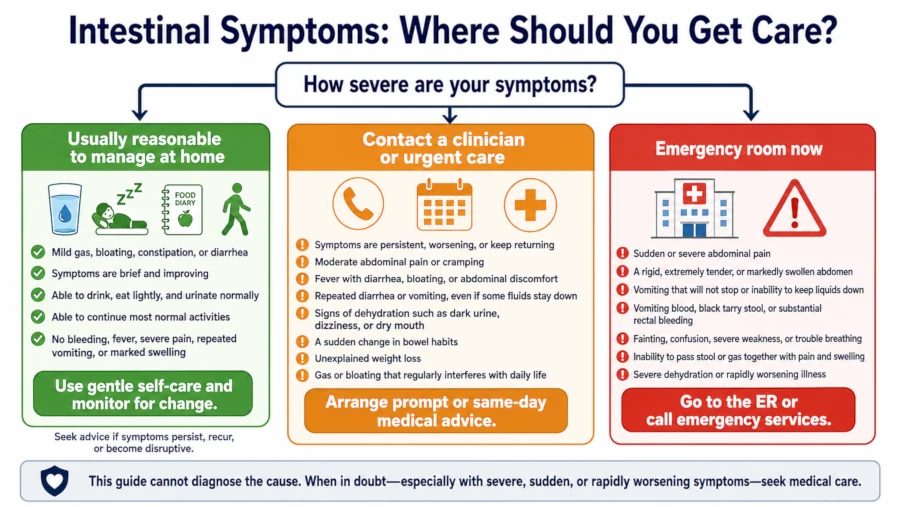
None of that means every twinge deserves a scan. It means these particular signals are worth a phone call rather than another week of tea.
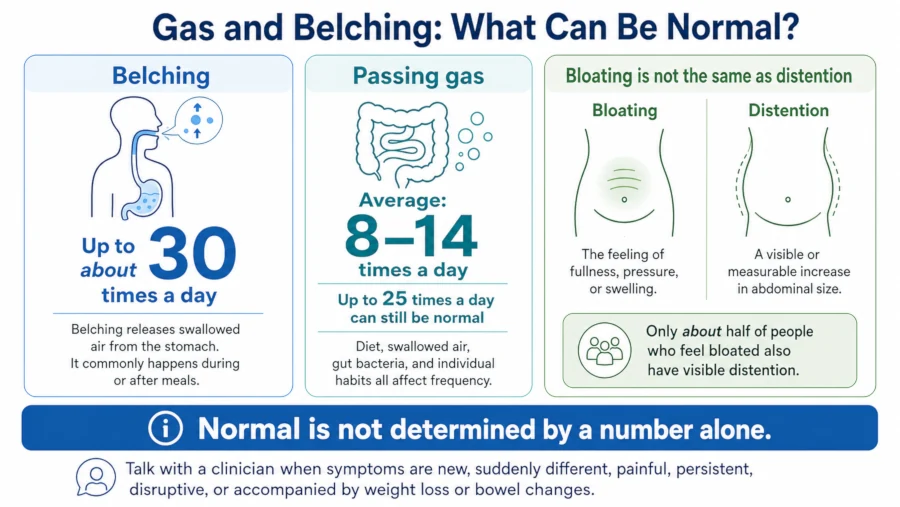
What counts as normal
A surprising amount of what people treat as a disorder is ordinary digestive function. People typically belch up to 30 times a day. Passing gas 8 to 14 times a day is average, and up to 25 times is still considered normal. Only about half of people who feel bloated actually have visible abdominal distention NIDDK on gas symptoms, 2021. Gas becomes a problem when it happens often enough to bother you or interfere with your day — not when it exceeds some number.
The common intestinal disorders, in plain terms
These overlap heavily, which is why self-diagnosis is unreliable and why the same handful of measures help across several of them.
| Condition | What it actually is | What usually helps |
| Gas and bloating | Swallowed air plus normal bacterial fermentation of carbohydrates the small intestine did not absorb. Often traced to a specific food or to eating fast. | Identify triggers with a food-and-symptom diary; eat more slowly; cut carbonated drinks and gum; treat any underlying cause. |
| Constipation | Fewer than three bowel movements a week, or stools that are hard, painful, or feel incomplete. | Soluble fiber, fluids, movement, and a consistent morning routine; a bulk-forming fiber supplement if food alone is not enough. |
| Acute gastroenteritis | Short-lived inflammation of the stomach and intestines, usually viral. Norovirus is the leading cause of vomiting and diarrhea in the United States. | Fluids and electrolytes. Most people recover in 1 to 3 days. Antibiotics do not treat viral causes. |
| Irritable bowel syndrome | Recurrent abdominal pain tied to changes in stool frequency or form, without structural disease. A disorder of gut–brain interaction. | Soluble fiber, a supervised low-FODMAP trial, peppermint oil, and gut-directed psychological therapies. |
| Altered gut bacteria | A real phenomenon after antibiotics or illness, but “dysbiosis” is not a formal diagnosis and there is no validated home test for it. | A varied, fiber-rich diet. Probiotics are worth discussing but the evidence is genuinely mixed. |
| Intestinal parasites | Uncommon in healthy adults in the United States without specific exposures. Pinworm is the most common worm infection here and mainly causes anal itching. | Stool or tape testing, then a targeted prescription medicine — not a herbal cleanse. |
What actually helps, graded by the evidence
Soluble fiber: the best-supported first step
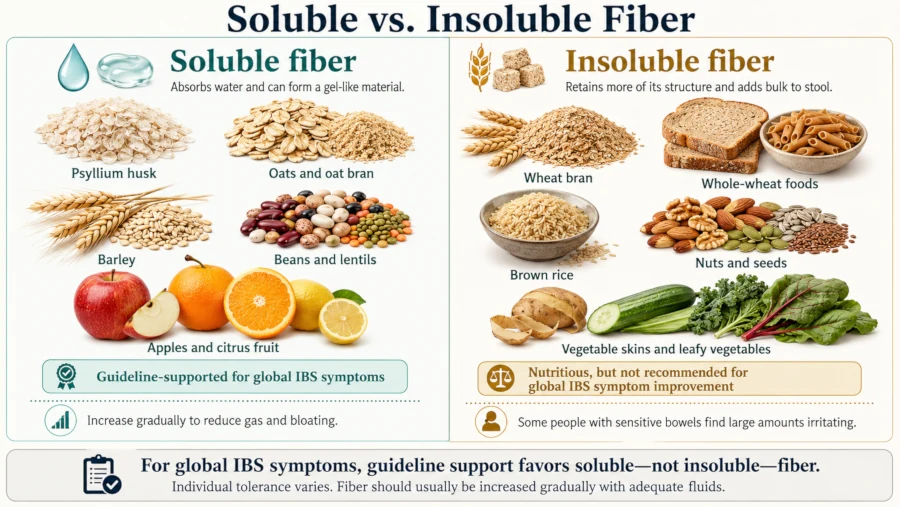
This is the closest thing to a reliable, broadly useful measure. The American College of Gastroenterology gives a strong recommendation, based on moderate-quality evidence, for soluble but not insoluble fiber in irritable bowel syndrome. In the pooled trials, ispaghula (psyllium) helped, with a number needed to treat of about 7, while wheat bran did not ACG clinical guideline on IBS, 2021. Soluble fiber comes from psyllium, oats, barley, and beans; insoluble fiber from wheat bran and whole grains.
Practical version: add fiber slowly, drink enough water with it, and give it two to four weeks. Adding a large amount overnight reliably produces gas and bloating, which is how people conclude fiber “does not work.” Food sources come first — our guide to foods that help with constipation ranks them by evidence — with a psyllium supplement as the next step if diet alone falls short.
Peppermint oil for IBS: promising, on modest evidence
Peppermint is the one herb on the traditional intestinal list with genuine trial support. ACG suggests it for global IBS symptoms, though as a conditional recommendation on low-quality evidence. Across seven randomized trials, symptom improvement favored peppermint oil over placebo, with a number needed to treat of 3 ACG clinical guideline on IBS, 2021. The honest caveat: a well-run 2021 trial in 133 people found no difference from placebo over six weeks NCCIH on IBS, 2023. Encouraging, not settled.
The formulation matters. Enteric-coated capsules release the oil past the stomach, which is both where it works and how it avoids heartburn. Side effects are usually mild — reflux, heartburn, belching, perianal burning — and peppermint oil should not be taken by people with a hiatal hernia or GERD, especially at higher doses NCCIH on IBS, 2023. More detail in our page on peppermint benefits and safety.
Fluids and electrolytes for a stomach bug
For acute gastroenteritis, rehydration is the treatment. Most people get better within one to three days, and there is no specific medicine for norovirus — antibiotics will not help, because they fight bacteria rather than viruses. Over-the-counter oral rehydration fluids are the most helpful option for mild dehydration; drinks without caffeine or alcohol can help but replace fewer minerals CDC on norovirus, 2024. Severe dehydration may need intravenous fluids, so call your doctor rather than waiting it out.
Probiotics: genuinely mixed, and the sources disagree
This is a case where reputable bodies land in different places, and it would be misleading to pick one. ACG suggests against probiotics for global IBS symptoms, a conditional recommendation on very low quality evidence ACG clinical guideline on IBS, 2021. NCCIH describes the picture as inconclusive rather than negative: some reviews find combination probiotics modestly helpful for pain, bloating, and gas, while a 2022 review in constipation-predominant IBS found improved stool consistency but no benefit for pain, bloating, or quality of life NCCIH on IBS, 2023. Trials have used many different strains at many doses, which is much of the reason the results scatter.
A reasonable reading: probiotics are low-risk for most healthy adults and worth a defined four-to-eight-week trial if you want to test them, but no specific product has earned a confident recommendation. Risk is higher for people who are seriously ill or immunocompromised.
Carminative herbs: traditional use, thin evidence, low risk
Fennel, caraway, anise, chamomile, dill, and similar aromatic plants have a long history as carminatives — herbs used to ease gas and cramping. For most of them the human evidence is sparse and of limited quality, which is a different statement from “they do nothing.” As teas in normal culinary amounts they are low-risk and some people find them settling. Treat them as comfort measures rather than treatments, and do not let them delay evaluation of a symptom that needs it.
Stimulant laxative herbs: use briefly, if at all
Cascara sagrada and aloe appear on older herbal constipation lists. In the United States they are no longer permitted as over-the-counter laxative ingredients: after manufacturers submitted no carcinogenicity data, the FDA issued a final rule in 2002 declaring aloe and cascara sagrada ingredients not generally recognized as safe and effective for that use FDA final rule on aloe and cascara sagrada, 2002. Senna and bisacodyl were handled separately and remain available. Stimulant laxatives of any kind are for short-term use; if constipation is not resolving, that is a reason to be seen rather than to escalate the dose.
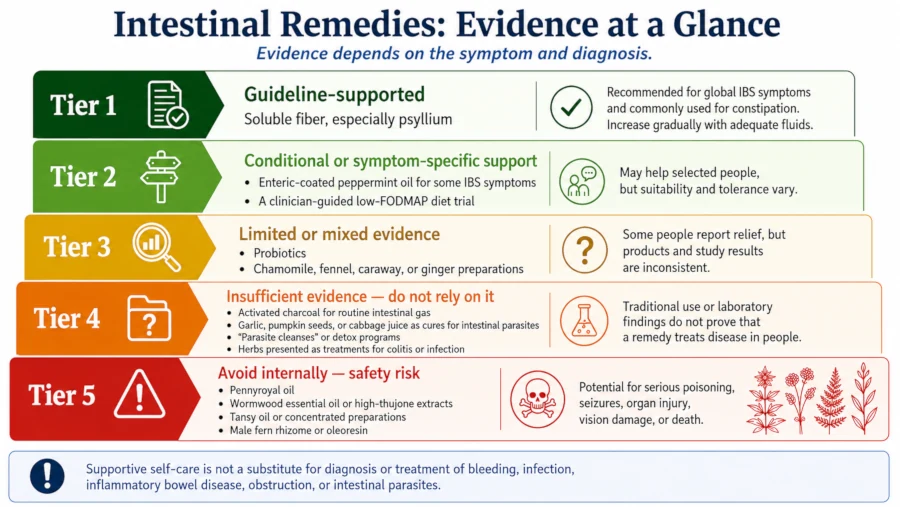
Evidence at a glance
| Approach | Evidence level | What that means in practice |
| Soluble fiber (psyllium, oats, beans) | Strong recommendation, moderate-quality evidence | A sensible first step for most people; add it gradually |
| Rehydration for gastroenteritis | Established standard care | The main treatment; watch for dehydration |
| Enteric-coated peppermint oil for IBS | Conditional recommendation, low-quality evidence | Reasonable to try; one good trial found no benefit |
| Low-FODMAP diet (supervised) | Conditional recommendation, very low quality evidence | Best done with a dietitian; not a permanent diet |
| Probiotics | Mixed and disputed between sources | Low-risk to trial; no specific product is proven |
| Fennel, caraway, anise, chamomile teas | Traditional use; limited human data | Comfort measures, not treatments |
| Cascara sagrada, aloe as laxatives | Not permitted for OTC laxative use in the US | Avoid; choose an approved option instead |
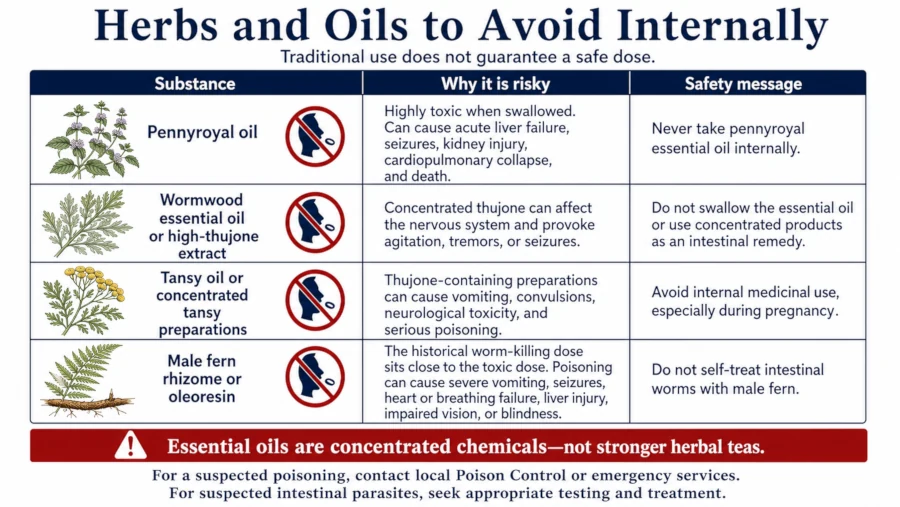
| Wormwood, tansy, pennyroyal oil, male fern | Toxicity outweighs any evidence | Do not use internally |
Safety: side effects, interactions, and who should avoid these
Herbs on older intestinal lists that are not safe to take internally
Pennyroyal is the clearest example. Pennyroyal tea and leaf extracts have been used without serious effects, but pennyroyal oil taken by mouth is highly toxic: even a tablespoon can cause fainting, seizures, coma, cardiovascular collapse, acute liver injury, kidney failure, and multi-organ failure. It is not recommended for internal use in any amount NIH LiverTox on pennyroyal oil, 2020. Wormwood, mugwort, and epazote contain thujone or ascaridole and carry seizure and neurotoxicity risk at higher doses; male fern and tansy were abandoned as deworming agents once safer drugs existed. Our review of antiparasitic herbs and their real evidence goes through these one by one.
Interactions worth checking before you start anything
- Fiber supplements can affect the absorption and timing of other medicines. Separate them from your prescriptions and ask a pharmacist about your specific list.
- Garlic and high-dose ginger may add to the effect of blood thinners.
- Antacids and acid reducers can break down a peppermint capsule’s enteric coating too early, undoing the point of the coating.
- Herbal supplements are not regulated like prescription drugs, so potency and purity vary between products and batches.
Pregnancy, breastfeeding, children, and specific conditions
Peppermint in food and tea amounts is likely fine in pregnancy and breastfeeding, but the safety of medicinal oil doses has not been established NCCIH on IBS, 2023. Menthol should never be applied to an infant’s or young child’s face, and peppermint oil should not be used for colic. Pennyroyal oil, wormwood, mugwort, and epazote should be avoided entirely in pregnancy.
Also check with a doctor before starting an herbal or fiber product if you have inflammatory bowel disease, celiac disease, a known bowel narrowing or previous obstruction, difficulty swallowing, recent bowel surgery, liver or kidney disease, a seizure disorder, or a weakened immune system — or if the product is for a child.
A note on parasites and cleanses
Parasite cleanses are marketed hard and rarely warranted. Pinworm is the most common worm infection in the United States and mostly causes itching around the anus, often with disturbed sleep; some people have no symptoms at all. It is diagnosed with a tape test or by looking for worms a few hours after sleep, and treated with two doses of medication two weeks apart, given to the whole household CDC on pinworm infection, 2024. The reason this matters is not purity of method. It is that a cleanse aimed at a parasite you do not have delays finding out what you do have.
What to actually do this week
- Keep a short food-and-symptom diary for two weeks. It is unglamorous and it is the single most informative thing most people can do.
- Add fiber in small increments, with water, and judge it after two to four weeks rather than two days.
- Slow down at meals, and drop carbonated drinks, chewing gum, and hard candy for a fortnight if belching is the main complaint.
- Move daily. A twenty-minute walk after a meal is enough to matter for constipation.
- During a stomach bug, sip oral rehydration fluid steadily rather than drinking large volumes at once.
- Give any single change a fair trial before adding another, so you can tell what worked.
| HEALTH DISCLAIMER: This article is for general education and information. It is not medical advice, and it is not a substitute for diagnosis or treatment by a qualified healthcare professional. Herbal products and supplements can cause side effects and interact with medications, and they are not regulated in the same way as prescription drugs. If you are pregnant or breastfeeding, giving a product to a child, taking prescription medication, or managing a condition such as inflammatory bowel disease, celiac disease, a bowel narrowing, liver or kidney disease, or a seizure disorder, speak with your doctor or pharmacist before using any herbal remedy. Seek prompt medical care for the warning signs listed near the top of this page, and call 911 for severe abdominal pain, vomiting blood, black tarry stools, or signs of severe dehydration. |
Frequently Asked Questions
How much gas is too much gas?
Passing gas 8 to 14 times a day is average and up to 25 times is still normal, and belching up to 30 times a day is typical NIDDK on gas symptoms, 2021. The number matters less than the pattern: talk to a clinician if gas symptoms bother you, change suddenly, or come with abdominal pain, constipation, diarrhea, or weight loss.
Do herbal teas actually help with bloating and cramping?
Aromatic carminative herbs such as fennel, caraway, anise, and chamomile have long traditional use for exactly this, and as ordinary teas they are low-risk. The human evidence is thin, so the fair answer is that some people find them settling and no one can promise you will. Peppermint is the one with real trial data, and in the trials it was enteric-coated oil capsules rather than tea.
Should I take a probiotic for gut problems?
You will find respectable sources on both sides. ACG suggests against probiotics for overall IBS symptoms ACG clinical guideline on IBS, 2021, while NCCIH describes the evidence as suggestive but not conclusive, with combination products faring better than single strains in some reviews NCCIH on IBS, 2023. If you want to try one, set a four-to-eight-week window and a specific symptom to watch, and stop if nothing changes.
How long should a stomach bug last?
Most people with norovirus feel better within one to three days, though they can still spread it for two weeks or more after recovering CDC on norovirus, 2024. Get medical advice sooner if you cannot keep fluids down, if you notice decreased urination, dry mouth, or dizziness on standing, or if there is blood in your stool.
Do I need a parasite cleanse?
Almost certainly not. Parasitic infections are uncommon in healthy adults in the United States without specific exposures, and everyday symptoms such as bloating and irregular stools usually have other causes. If a parasite is a real possibility, testing tells you which organism you have, and treatments differ sharply between them CDC on pinworm infection, 2024.
When is constipation an emergency?
Go to an emergency room if you are unable to pass stool or gas and have a swollen, painful abdomen with vomiting, which can indicate an obstruction. See a doctor right away for rectal bleeding, blood in the stool, constant abdominal pain, fever, lower back pain, or weight loss you did not intend NIDDK on constipation, 2018.
References
- Lacy BE, Pimentel M, Brenner DM, et al. “ACG Clinical Guideline: Management of Irritable Bowel Syndrome.” American Journal of Gastroenterology, American College of Gastroenterology, 2021;116(1):17–44. View source
- National Center for Complementary and Integrative Health. “Irritable Bowel Syndrome: What You Need To Know.” NCCIH, U.S. National Institutes of Health, updated April 2023. View source
- National Institute of Diabetes and Digestive and Kidney Diseases. “Symptoms & Causes of Gas in the Digestive Tract.” NIDDK, National Institutes of Health, last reviewed June 2021. View source
- National Institute of Diabetes and Digestive and Kidney Diseases. “Symptoms & Causes of Constipation.” NIDDK, National Institutes of Health, last reviewed May 2018. View source
- Centers for Disease Control and Prevention. “About Norovirus.” CDC, National Center for Immunization and Respiratory Diseases, last reviewed April 24, 2024. View source
- Centers for Disease Control and Prevention. “About Pinworm Infection.” CDC, National Center for Emerging and Zoonotic Infectious Diseases, last reviewed September 9, 2024. View source
- Food and Drug Administration. “Status of Certain Additional Over-the-Counter Drug Category II and III Active Ingredients.” Final rule, 67 FR 31125, Federal Register, May 9, 2002. View source
- “Pennyroyal Oil.” In: LiverTox: Clinical and Research Information on Drug-Induced Liver Injury. National Institute of Diabetes and Digestive and Kidney Diseases, updated March 28, 2020. View source
