Here is the honest truth when it comes down to natural remedies for dandruff and oily hair. A few natural approaches for real evidence behind them, several are harmless but unproven, and a handful of popular “cures” can irritate your scalp or make things worse. The best-supported natural option is a shampoo containing about 5% tea tree oil, and even that rests on one modest study. Most flaking is not caused by a vitamin deficiency or by “toxins” — it usually comes from a mix of a common scalp yeast called Malassezia, the oil your scalp makes, and how sensitive your skin is to both [Mayo Clinic]. Knowing that changes what actually helps.
Dandruff is common, it is not contagious, and it is not harmful — but it does tend to return, so the realistic goal with any natural remedy for dandruff and oily hair is steady control rather than a permanent cure [Mayo Clinic].
What causes dandruff and oily hair
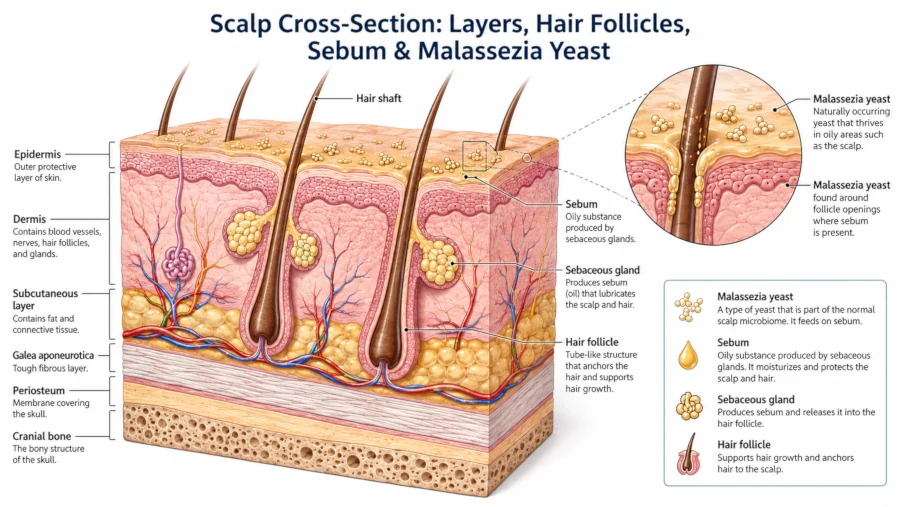
Dandruff shows up as small flakes of dead skin on your scalp and hair, sometimes on your eyebrows or shoulders, often with an itch. It is a mild form of seborrheic dermatitis [Mayo Clinic]. Several things feed it: oily, irritated skin; dry skin; sensitivity to a hair product (a form of contact dermatitis); and Malassezia, a yeast that lives on most adult scalps and feeds on natural oils [Mayo Clinic]. Other conditions — psoriasis, eczema, or a fungal infection of the scalp — can look like dandruff too [American Academy of Dermatology].
Some people are simply more prone to it. Flaking is more common in men, often begins in young adulthood and continues into middle age, and can flare when you are stressed or during cold, dry weather. Conditions that affect the nervous system, such as Parkinson’s disease, and a weakened immune system (including HIV) also raise the risk [Mayo Clinic].
Oily hair belongs to the same story. Your scalp holds a large number of oil glands, and when they produce plenty of sebum, hair looks greasy sooner — and that extra oil gives Malassezia more to feed on. Heat, humidity, hormones, and stress can each nudge oil production up. Because oil and flaking are linked, the habits that help one usually help the other.
One myth is worth clearing up: everyday dandruff is not mainly a sign that you are missing a nutrient, and no single food “binds” skin cells into flakes. Eating well is good for your skin, but treating dandruff as a deficiency to correct tends to steer people away from the steps that work.
Natural remedies for dandruff: what the evidence says
It helps to sort the options by how much evidence stands behind them, rather than by how often they are recommended online.
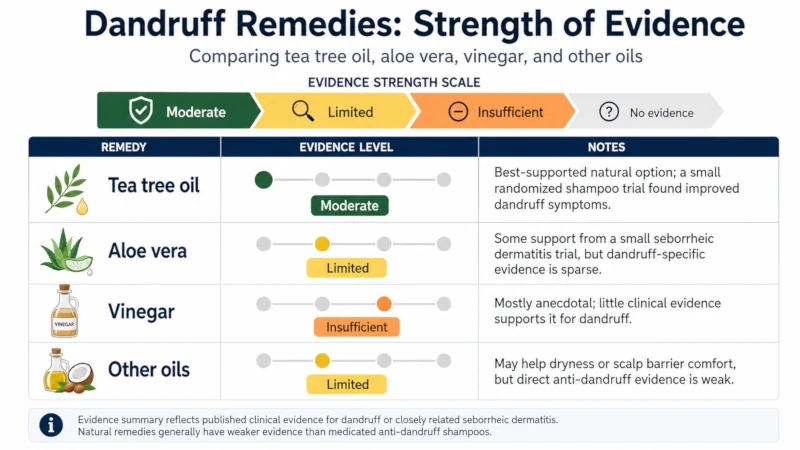
| Remedy | What the evidence shows | Strength |
| Gentle, regular washing | Reduces the oil and dead-skin buildup that feed mild flaking; standard first-line self-care | Well established |
| Tea tree oil shampoo (~5%) | One 4-week trial showed more improvement than placebo | Limited (single small trial) |
| Aloe vera | One trial in seborrheic dermatitis eased scaling and itch | Limited (single small trial) |
| Apple cider vinegar, baking soda, lemon rinses | No good clinical evidence for treating dandruff; harsh versions may irritate | Insufficient |
| Heavy oils left on the scalp | May soothe dryness, but can feed the yeast behind dandruff | Mixed / theoretical concern |
Tea tree oil shampoo
Tea tree oil is the natural remedy with the most credible support. In a four-week study of 126 people with mild-to-moderate dandruff, a 5% tea tree oil shampoo used daily improved a scalp severity score by 41%, compared with 11% for a placebo shampoo [Satchell et al., 2002]. That is a real, measurable benefit — but it is one modest, single-blind study, which is why the evidence is best called promising rather than proven. As Mayo Clinic notes, research has not definitively shown that tea tree oil treats dandruff, although that one 5% shampoo helped over four weeks [Mayo Clinic].
Practical version: choose a shampoo already formulated at roughly 5% tea tree oil rather than adding drops of essential oil yourself, work it into the scalp, and give it a few minutes before rinsing. Do not apply undiluted tea tree oil straight to your scalp — that is the main way people end up irritated [Mayo Clinic].
Aloe vera
Aloe has a little clinical support at the seborrheic-dermatitis end of the spectrum. In a double-blind trial of 44 adults, an aloe vera emulsion reduced scaliness, itch, and the number of affected areas compared with placebo — though it did not significantly improve redness, and the study was small [Vardy et al., 1999]. If you want to try it, plain aloe vera gel on the scalp is low-risk for most people; roughly 1 in 200 people are allergic, so do a small patch test first. If you are curious about the plant itself, see our overview of the aloe vera plant and its skin uses.
Apple cider vinegar, baking soda, and lemon rinses
These appear on every “natural dandruff” list, and they are mostly untested. There is no good clinical evidence that apple cider vinegar, baking soda, or lemon rinses treat dandruff, and the harsher ones — baking soda, or undiluted vinegar or lemon — can disturb the scalp’s surface and leave it drier or more irritated. If you like a well-diluted vinegar rinse for how your hair feels afterward, that is fine; just do not expect it to clear flaking, and stop if your scalp stings or reddens.
A note on oils
Because Malassezia feeds on oils, coating the scalp in heavy oils such as coconut or olive oil and leaving them on can backfire for some people — even though those same oils can soothe genuinely dry skin. If your problem is a dry, tight scalp rather than greasy flaking, a light conditioning oil may help. If your scalp is oily and flaky, leave-on oils are a gamble.
The unglamorous winner: how you wash
The most reliable “natural” step is also the least exciting — wash regularly and gently. For mild dandruff, consistent shampooing with a gentle product reduces the oil and dead-skin buildup that feed flaking [Mayo Clinic]. If you use a dedicated dandruff shampoo, let it sit on the scalp for a few minutes before rinsing, and if one stops working, rotate to a shampoo with a different active ingredient [American Academy of Dermatology]. Because dandruff comes back, treat this as upkeep rather than a one-time fix.
Natural remedies for oily hair
Oily hair responds to routine more than to any single remedy. A few habits do most of the work:
- Wash often enough for your hair type. If your scalp runs oily, washing more frequently genuinely helps [American Academy of Dermatology].
- Go easy on brushing. Over-brushing drags oil from the roots down the strands, so hair looks greasy faster.
- Rinse thoroughly. A well-diluted vinegar or lemon-water rinse can leave fine hair feeling lighter by removing residue — this is about cleanliness and feel, not a treatment.
- Keep rich leave-in oils and heavy conditioners on the ends, away from the scalp.
- Mind heat and humidity, which push oil production up.
Since an oily scalp and dandruff often travel together, the dandruff steps above frequently improve oiliness at the same time.
Diet, biotin, and supplements: the honest take
It is tempting to treat flaking as something you can eat your way out of. For ordinary dandruff, the evidence does not support that. Biotin is a good example: despite claims that high-dose biotin is an “anti-dandruff” nutrient, the amount in foods is measured in micrograms, not milligrams, and there is no solid evidence that biotin supplements clear everyday dandruff. Genuine biotin deficiency is uncommon and causes a broader rash, not garden-variety flakes.
A balanced diet supports healthy skin, and correcting a real, clinician-diagnosed deficiency matters — but supplements are not a substitute for the topical steps that actually reduce flaking. If you are weighing supplements for your skin or hair, that is a conversation for a healthcare professional rather than a self-prescribed high dose.
When natural is not enough: medicated options worth knowing
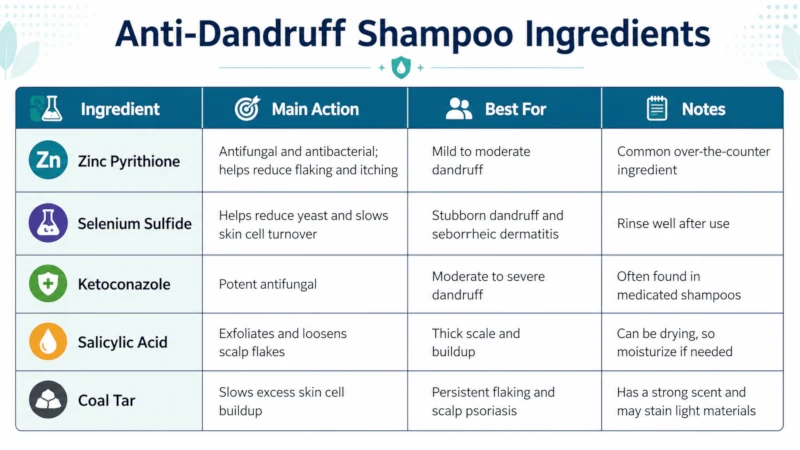
If a few weeks of gentle washing and a tea-tree shampoo do not settle things, medicated shampoos are effective, inexpensive, and widely available — there is no reason to avoid them. Dermatologists point to shampoos containing zinc pyrithione, selenium sulfide, ketoconazole, salicylic acid, sulfur, or coal tar; if one does not work, alternating between products with different active ingredients often does [American Academy of Dermatology].
One correction is worth making, because it circulates widely: selenium sulfide is not something to fear. It is an established antifungal, anti-flaking ingredient that has been used for dandruff and seborrheic dermatitis for decades [Cleveland Clinic]. Its label simply tells you to keep it out of your eyes and to rinse thoroughly, since poor rinsing can occasionally discolor hair; a temporary increase in shedding is an uncommon side effect [Cleveland Clinic]. Avoiding eye contact is sensible; avoiding the ingredient altogether is not necessary for most people.
| Active ingredient | What it does |
| Zinc pyrithione | Antifungal and antibacterial; a common option for regular use |
| Ketoconazole | Antifungal that targets Malassezia yeast |
| Selenium sulfide | Antifungal that also slows skin-cell turnover |
| Salicylic acid | Helps lift and loosen scale |
| Sulfur | Mild antifungal and scale-loosening action |
| Coal tar | Slows skin-cell turnover; can make the scalp more sun-sensitive |
Safety, side effects, and who should be careful
Natural does not automatically mean gentle. A few cautions are worth keeping in mind.
- Tea tree oil. Never swallow it — by mouth it is toxic and can cause confusion, loss of coordination, and, in serious cases, coma [Mayo Clinic]. On skin it can trigger allergic rashes, and reactions are more likely with old or oxidized oil, so do not use it undiluted, and skip it if you have eczema or very sensitive skin [NCCIH]; [Mayo Clinic]. One case report described breast-tissue swelling in a young boy after topical lavender and tea tree oils, so it is reasonable to be cautious with leave-on essential oils for children, although the link is not proven [Mayo Clinic]. Keep essential oils away from pets. Tea tree oil is not known to interact with medications [Mayo Clinic].
- Pregnancy and breastfeeding. Topical tea tree oil products are generally considered possibly safe during pregnancy and breastfeeding, but the evidence is limited, so check with your clinician first [NCCIH]. For medicated shampoos, ask a pharmacist or doctor — some labels advise caution in pregnancy.
- Aloe vera. Allergic skin reactions occur in a minority of people; patch test, and stop if you develop redness or itching.
- Everyone. If a remedy stings, burns, worsens redness, or spreads a rash, stop and reassess rather than pushing through.
When to see a doctor
Most dandruff is manageable at home, but book a visit if any of the following apply:
- your flaking has not improved after a few weeks of regular dandruff-shampoo use [Mayo Clinic];
- your scalp is very red, swollen, painful, weeping, or crusted, or you notice pus — possible signs of infection;
- you have hair loss, bald patches, or broken hairs along with the flaking;
- the rash spreads beyond the scalp, or you suspect psoriasis or eczema [American Academy of Dermatology];
- an infant has thick, stubborn scaling (cradle cap) that is spreading or inflamed;
- you have a weakened immune system, which can make scalp problems more stubborn [Mayo Clinic].
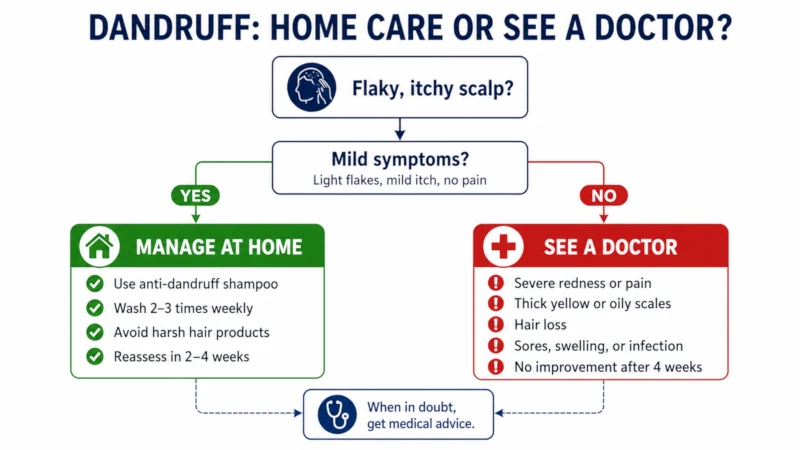
A dermatologist can tell whether something other than dandruff is going on and prescribe stronger treatment when needed [American Academy of Dermatology]. For related conditions, our guides on seborrheic dermatitis and other forms of dermatitis and on fungal skin infections go into more detail.
| Health disclaimer: This article is for general education and is not medical advice. It should not replace diagnosis or treatment from a qualified healthcare professional. Natural and over-the-counter remedies can still cause side effects or interact with existing health conditions. If you are pregnant or breastfeeding, have a weakened immune system, are treating a child, or have a scalp problem that is severe, painful, spreading, or simply not improving, talk with a doctor or pharmacist before starting or continuing any remedy. |
Frequently Asked Questions
What is the most effective natural remedy for dandruff?
A shampoo with about 5% tea tree oil has the strongest evidence, though it comes from one modest study; consistent, gentle washing is the reliable foundation underneath it [Satchell et al., 2002]; [Mayo Clinic].
Can natural remedies cure dandruff for good?
No. Dandruff tends to recur, so the realistic aim is control rather than a permanent cure [Mayo Clinic].
Does apple cider vinegar get rid of dandruff?
There is no good evidence that it treats dandruff, and undiluted rinses can irritate the scalp. A well-diluted rinse is fine for feel, not as a treatment.
Is it bad to wash oily hair every day?
For an oily scalp, frequent washing is fine and often helps control both grease and flaking [American Academy of Dermatology].
Will coconut oil on my scalp help?
It may soothe a dry scalp, but because the yeast behind dandruff feeds on oil, leave-on oils can worsen flaking for some people. Results vary.
Is selenium sulfide shampoo safe?
For most people, yes. Keep it out of your eyes and rinse thoroughly [Cleveland Clinic].
References
- Dandruff — Symptoms and Causes. Mayo Clinic, 2025. View source
- How to Treat Dandruff. American Academy of Dermatology, 2023. View source
- Satchell AC, Saurajen A, Bell C, Barnetson RS. Treatment of dandruff with 5% tea tree oil shampoo. Journal of the American Academy of Dermatology, 2002;47(6):852–855. DOI: 10.1067/MJD.2002.122734 (PMID 12451368). View source
- Tea Tree Oil (Drugs and Supplements). Mayo Clinic, 2025. View source
- Tea Tree Oil. National Center for Complementary and Integrative Health (NCCIH), accessed 2026. View source
- Vardy DA, Cohen AD, Tchetov T, Medvedovsky E, Biton A. A double-blind, placebo-controlled trial of an Aloe vera (A. barbadensis) emulsion in the treatment of seborrheic dermatitis. Journal of Dermatological Treatment, 1999;10(1):7–11. DOI: 10.3109/09546639909055904. View source
- Selenium Sulfide Shampoo. Cleveland Clinic, 2026. View source
