
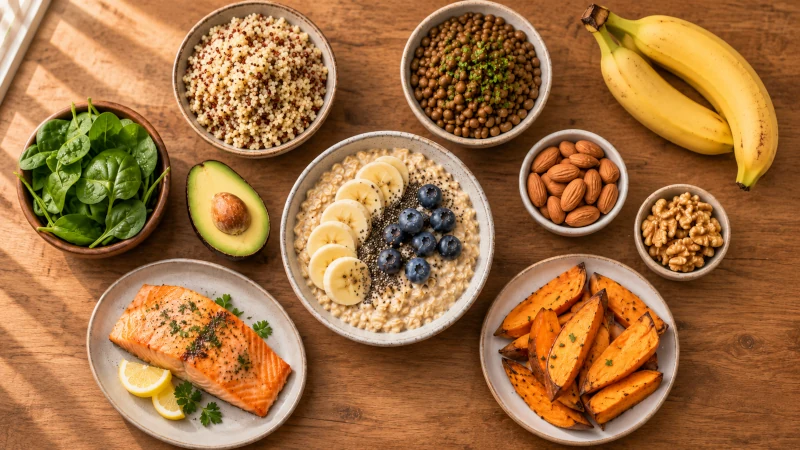
Every food with calories technically counts as fuel, so the useful question is which foods give you energy that lasts. The best energy-rich foods pair carbohydrate with fiber, protein, or fat: oats and other whole grains, beans and lentils, nuts and seeds, fruit, eggs, yogurt, and fish. Fiber slows digestion, so whole, minimally processed carbohydrates raise blood sugar more gently than refined starches and sugary snacks [Harvard Nutrition Source, n.d. (blood sugar)].
Food can only do so much, though. If you’re eating well and still worn out, the cause may be sleep, stress, a medicine, or a deficiency that needs a blood test. You’ll find the signs that call for a doctor below the food list.
What “energy” in food actually means
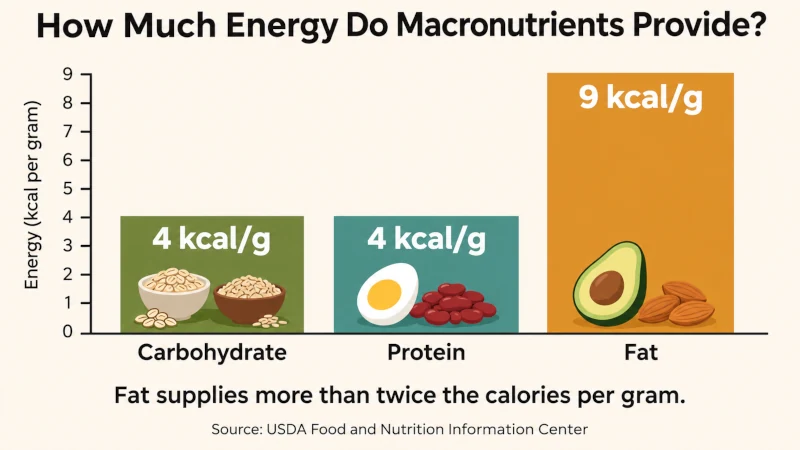
Food energy is measured in calories (strictly, kilocalories), and it comes from three nutrients. Carbohydrate and protein each supply about 4 calories per gram; fat supplies about 9 [USDA NAL, n.d.].
That 4-4-9 rule explains why a small handful of almonds carries more energy than a big bowl of watermelon. Neither is better in the abstract. A long hike calls for dense food that fits in a pocket. An afternoon at a desk usually doesn’t.
Vitamins and minerals add no calories, but running low on some of them, especially iron and vitamin B12, can leave you tired and weak [NIH ODS, n.d. (iron)] [NIH ODS, n.d. (vitamin B12)]. That’s why low-calorie foods like spinach still earn a spot on this list.
Why some energy-rich foods last longer than others
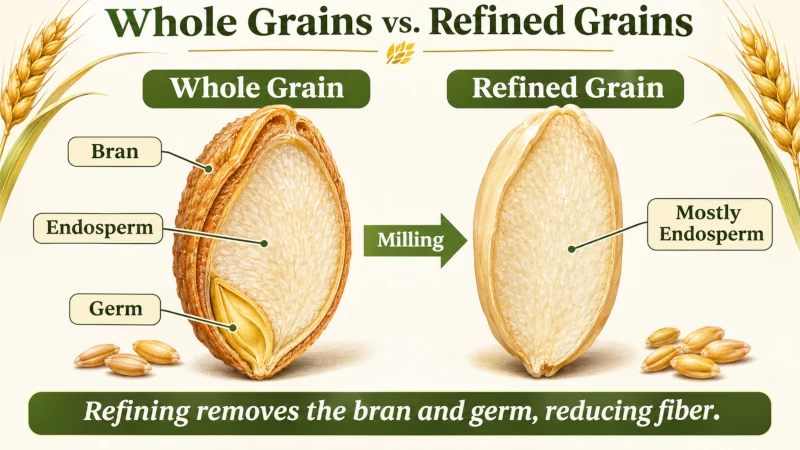
Milling strips grains of their bran and germ, and with them nearly all the fiber [Harvard Nutrition Source, n.d. (whole grains)]. Without fiber to slow things down, refined starches and sugary foods tend to cause sharp rises in blood sugar, while minimally processed whole grains produce a more gradual one [Harvard Nutrition Source, n.d. (blood sugar)]. Oatmeal and brown rice, for example, sit in the medium glycemic-load range, below white-flour pasta, French fries, and sugar-sweetened drinks [Harvard Nutrition Source, n.d. (blood sugar)].
In practice, that means building meals around whole grains, legumes, vegetables, and fruit, and keeping refined carbohydrates and added sugars as the exception. Current federal guidance points the same way [USDA, 2026]. For a longer rundown of starches and sugars, see our list of healthful carbohydrate foods.
How much energy should come from carbs, fat, and protein?
There’s no single perfect ratio. For adults, the National Academies set wide ranges: 45–65% of calories from carbohydrate, 20–35% from fat, and 10–35% from protein [National Academies, 2024]. These Acceptable Macronutrient Distribution Ranges are meant to cover nutrient needs while lowering chronic disease risk, and plenty of eating styles fit inside them.
| Nutrient | Adult range (% of calories) | Calories on a 2,000-calorie day | Grams on a 2,000-calorie day |
| Carbohydrate | 45–65% | 900–1,300 | About 225–325 g |
| Fat | 20–35% | 400–700 | About 44–78 g |
| Protein | 10–35% | 200–700 | About 50–175 g |
Ranges from the National Academies [National Academies, 2024]; grams calculated with 4-4-9 calories per gram [USDA NAL, n.d.].
The Dietary Guidelines for Americans, 2025–2030, released in January 2026, lean more on food quality than on percentages: include protein at every meal, focus on whole grains and sharply cut refined carbohydrates, limit added sugars and highly processed foods, and eat an amount that suits your age, sex, size, and activity level [USDA, 2026].
That last point matters with the densest foods here. Nuts, nut butters, and dried fruit are easy to overeat, and the extra calories add up. If weight loss is your goal, our guide to filling foods that support weight loss is a better starting point.
20 energy-rich foods worth keeping on hand
They’re grouped by the kind of energy they give. Most are plant foods, but eggs, yogurt, and fish belong here too.
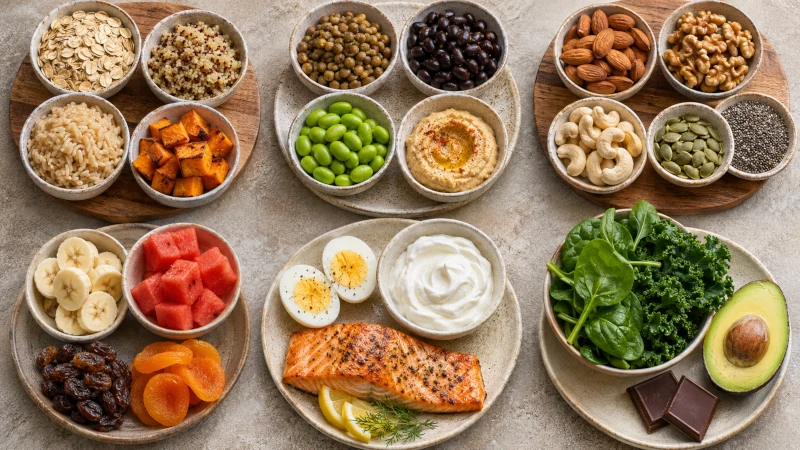
Whole grains and starchy vegetables: oats, brown rice, quinoa, popcorn, sweet potatoes
Oats, brown rice, and quinoa keep their bran and germ, so their carbohydrate comes with fiber, B vitamins, and minerals [Harvard Nutrition Source, n.d. (whole grains)]. Quinoa is also a complete protein, with all nine essential amino acids. Unless the package says it’s pre-rinsed, rinse it in a fine strainer first; leftover saponins taste bitter [Harvard Nutrition Source, n.d. (quinoa)].
Popcorn is whole-grain corn [Harvard Nutrition Source, n.d. (whole grains)], and air-popped it makes a bulky, satisfying snack. Butter and salt are where it goes wrong. Sweet potatoes are a starchy vegetable that also supplies plenty of potassium [National Kidney Foundation, 2021].
Beans, lentils, and soy: beans and lentils, edamame, hummus
Legumes give you carbohydrate, protein, and fiber in one food, which makes them some of the steadiest fuel you can eat. White beans, kidney beans, and lentils also supply iron [NIH ODS, n.d. (iron)], and beans, lentils, and soybeans are good potassium sources [NIH ODS, n.d. (potassium)]. Edamame are young soybeans. Hummus blends chickpeas with tahini and olive oil, so it carries more fat and more calories per spoonful than plain beans.
Nuts, seeds, and nut butters: almonds, walnuts, cashews, pumpkin, chia and sunflower seeds, peanut butter
At about 9 calories per gram of fat [USDA NAL, n.d.], nuts and seeds pack a lot of energy into a small portion. They’re also among the better sources of magnesium [NIH ODS, n.d. (magnesium)]. That density helps when you need portable fuel and works against you when you’re eating from the jar. Measure a serving once so you know what it looks like. Our guide to which high-fat foods to favor covers the fat side in more detail.
Fruit: bananas, dried fruit, watermelon
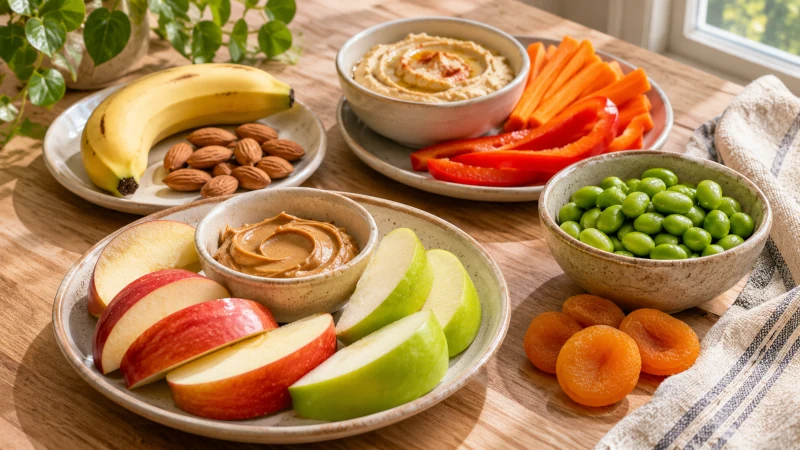
Bananas are an easy grab-and-go carbohydrate and a well-known potassium source [NIH ODS, n.d. (potassium)]. Dried fruit squeezes fruit’s sugar into a few bites, and raisins add a little iron [NIH ODS, n.d. (iron)]. That makes it handy on a long walk or bike ride and easy to overdo at a desk. Watermelon is refreshing and naturally sweet, but it’s mostly water, so it won’t carry you far on its own.
Eggs, Greek yogurt, and fish: salmon and tuna
These supply protein, and they’re natural sources of vitamin B12, which plant foods lack unless fortified [NIH ODS, n.d. (vitamin B12)]. Fish also provides heme iron, the form your body absorbs most easily [NIH ODS, n.d. (iron)]. Salmon and canned light tuna are on the FDA’s lower-mercury “Best Choices” list [FDA, n.d. (fish advice)].
Leafy greens, avocado, and dark chocolate
Spinach and kale are low in calories, so they aren’t energy-dense. They’re here for what they carry: magnesium, and in spinach’s case iron [NIH ODS, n.d. (magnesium)] [NIH ODS, n.d. (iron)]. Your body absorbs plant iron less efficiently than iron from meat, poultry, or seafood. Eating greens with vitamin C-rich foods such as tomatoes, sweet peppers, citrus, or strawberries helps [NIH ODS, n.d. (iron)].
Avocado is mostly fat, which makes it calorie-dense, and it’s high in potassium [National Kidney Foundation, 2021]. Dark chocolate contains a little caffeine [FDA, n.d. (caffeine)], along with sugar and fat. Enjoy it as a treat, not an energy plan.
| Food | Main source of energy | Also brings | Works well for |
| Oats | Carbohydrate with fiber | B vitamins, minerals | Breakfast |
| Brown rice | Carbohydrate with fiber | B vitamins, minerals | Main meals |
| Quinoa | Carbohydrate and complete protein | Fiber | Bowls, salads |
| Sweet potatoes | Starch | Potassium | Main meals |
| Popcorn (air-popped) | Whole-grain carbohydrate | Fiber | Snacks |
| Beans and lentils | Carbohydrate and protein | Fiber, iron, potassium | Main meals |
| Edamame | Protein and carbohydrate | Potassium | Snacks |
| Hummus | Carbohydrate, protein, fat | Fiber | Snacks with vegetables |
| Nuts | Fat and protein | Magnesium | Portable snacks |
| Seeds | Fat and protein | Magnesium | Toppings for oats, yogurt |
| Peanut butter | Fat and protein | — | Snacks with fruit or toast |
| Bananas | Natural sugar | Potassium | Before activity |
| Dried fruit | Concentrated sugar | Potassium, some iron | Long walks, rides |
| Watermelon | A little natural sugar | Mostly water | Hot days |
| Eggs | Protein and fat | Vitamin B12 | Breakfast |
| Greek yogurt | Protein | Vitamin B12 | Breakfast, snacks |
| Salmon, tuna | Protein and fat | Vitamin B12, heme iron | Main meals |
| Spinach, kale | Very little | Magnesium; iron (spinach) | Adding to any meal |
| Avocado | Fat | Potassium | Toast, bowls |
| Dark chocolate | Fat and sugar | A little caffeine | Occasional treat |
Nutrient notes reflect the sources cited in the sections above.
Plant foods or animal foods: do you have to choose?
You’ll sometimes read that plant foods give “better” energy than animal foods. Calorie for calorie, they don’t. A gram of carbohydrate, protein, or fat supplies the same energy whatever its source [USDA NAL, n.d.]. The differences lie in what comes along with the calories.
Whole plant foods bring fiber. Animal foods are the only natural source of vitamin B12, and their heme iron is absorbed more easily [NIH ODS, n.d. (vitamin B12)] [NIH ODS, n.d. (iron)]. People who don’t eat meat, poultry, or seafood need almost twice as much iron as people who do [NIH ODS, n.d. (iron)].
A plant-forward plate makes sense for many people. If you eat little or no animal food, plan for B12 from fortified foods or a supplement, and pay attention to iron. Our guide to protein-rich vegetarian foods covers the protein side.
Putting energy-rich foods together
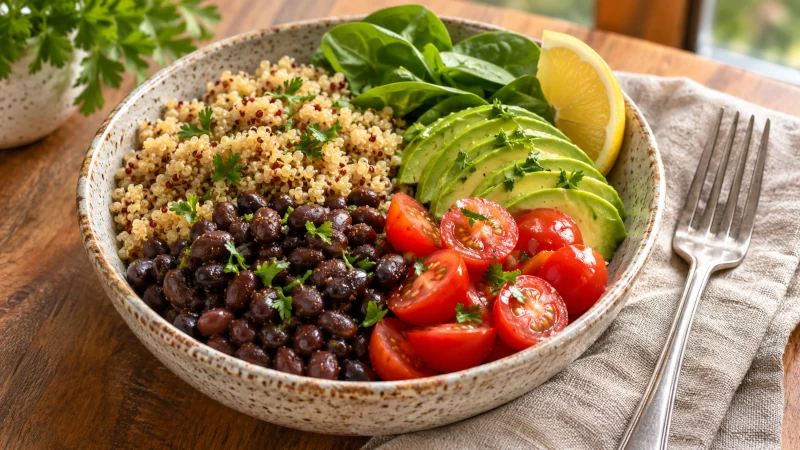
A few combinations that are easy to put together:
- Breakfast: oatmeal topped with nuts or seeds and a sliced banana, or Greek yogurt with fruit.
- Lunch: a bowl of brown rice or quinoa with beans, spinach, avocado, and a squeeze of lemon. The vitamin C helps you absorb the plant iron.
- Afternoon: hummus with vegetables, a cup of edamame, or an apple with peanut butter.
- Before a long walk or ride: a banana or a small handful of dried fruit.
- Dinner: salmon, a baked sweet potato, and greens.
Notice how long each option keeps you going. People respond differently, and the meals you enjoy are the ones you’ll keep eating. Sleep, movement, and fluids matter at least as much as the menu; see how to boost your energy levels naturally.
When tiredness isn’t about food
If you’re eating reasonably and still exhausted, look beyond the plate. Common causes include poor sleep, stress, depression, hormonal changes, illness, and some medicines [NHS, n.d.]. Most adults need 7 or more hours of sleep a night [CDC, n.d.]. Medical causes range from iron deficiency (with or without anemia) and thyroid problems to sleep apnea, diabetes, and heart, kidney, or liver disease [MedlinePlus, n.d.].
Iron and B12 shortfalls are easy to miss. Women with heavy periods, pregnant people, frequent blood donors, and people who avoid animal foods are more likely to run low on iron [NIH ODS, n.d. (iron)]. B12 deficiency is more common in vegans, older adults, and people taking metformin or acid-reducing medicines [NIH ODS, n.d. (vitamin B12)]. Both are confirmed with a blood test. Don’t start iron pills on a hunch: people with hereditary hemochromatosis should avoid iron supplements, and accidental iron overdose is a leading cause of fatal poisoning in children under 6 [NIH ODS, n.d. (iron)].
Who should be careful with some of these foods
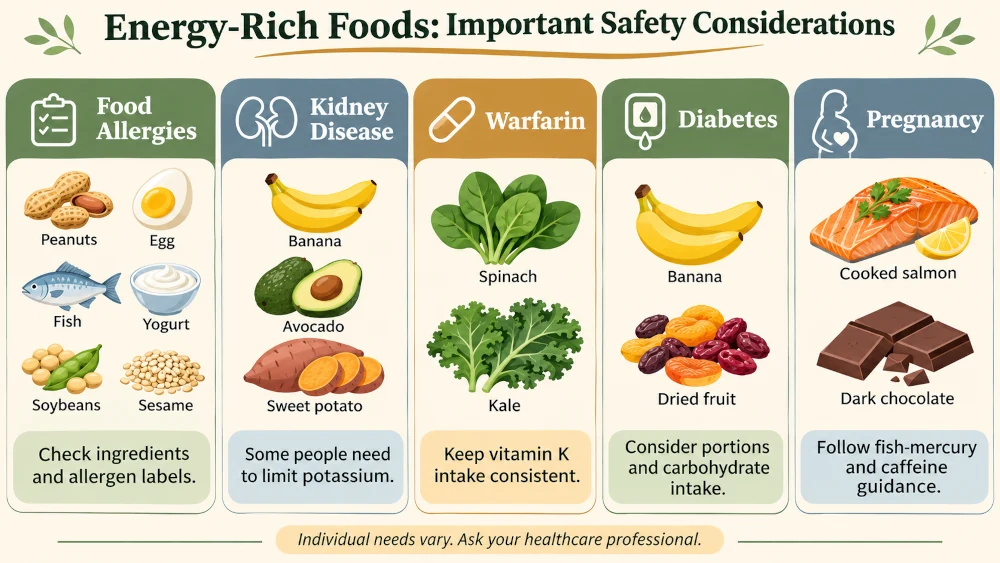
Food allergies
Several foods on this list are major allergens: milk (Greek yogurt), eggs, fish, tree nuts, peanuts, soybeans (edamame), and sesame (the tahini in hummus) [FDA, n.d. (allergens)]. Read labels if you or someone you feed has a food allergy.
Kidney disease and certain blood pressure medicines
Bananas, avocados, sweet potatoes, dried fruit, beans, lentils, nuts, seeds, and yogurt are all high in potassium [National Kidney Foundation, 2021]. With chronic kidney disease, blood potassium can climb too high even from ordinary food [NIH ODS, n.d. (potassium)], and too much potassium can cause muscle weakness and an irregular heartbeat [National Kidney Foundation, 2021]. ACE inhibitors, angiotensin receptor blockers, and potassium-sparing diuretics can raise potassium too, especially when the kidneys aren’t working well [NIH ODS, n.d. (potassium)]. If any of this applies to you, ask your doctor or a kidney dietitian how much potassium is right for you.
Warfarin (Coumadin)
Spinach, kale, and other leafy greens are rich in vitamin K. If you take warfarin, the advice is to keep your vitamin K intake about the same from day to day; a sudden drop can raise bleeding risk, and a sudden jump can raise clotting risk [NIH ODS, n.d. (vitamin K)]. Tell your doctor or pharmacist before making big changes to how many greens you eat.
Diabetes and prediabetes
Bananas and dried fruit are quick carbohydrates, and refined starches cause sharper blood sugar rises than legumes or whole grains [Harvard Nutrition Source, n.d. (blood sugar)]. Portion size and what you pair them with matter more if you manage your glucose. Our guide to normal blood sugar levels explains the ranges, and your care team can tailor targets to you.
Pregnancy and breastfeeding
Fish is worth eating. The FDA advises 2 to 3 servings (4 ounces each) a week from its lower-mercury Best Choices list, such as salmon and canned light tuna, or 1 serving a week from its Good Choices list, which includes albacore tuna. Skip king mackerel, marlin, orange roughy, shark, swordfish, tilefish from the Gulf of Mexico, and bigeye tuna [FDA, n.d. (fish advice)].
For caffeine, ACOG says intake under 200 mg a day doesn’t appear to be a major factor in miscarriage or preterm birth [ACOG, reaffirmed 2023]. Chocolate counts toward your daily caffeine [FDA, n.d. (caffeine)]. Outside pregnancy, the FDA cites 400 mg a day as an amount not generally linked to negative effects in most healthy adults [FDA, n.d. (caffeine)].
When to see a doctor about low energy
Book an appointment if [NHS, n.d.] [MedlinePlus, n.d.]:
- you’ve felt tired for a few weeks and don’t know why
- tiredness is getting in the way of daily life
- fatigue comes with unexplained weight loss, fever, sweats, or mood changes
- someone has told you that you gasp, snort, or choke in your sleep
- you also have constipation, dry skin, weight gain, or trouble tolerating cold
- you think a medicine you take may be making you drowsy
Contact a doctor right away if fatigue comes with confusion or dizziness, blurred vision, little or no urine, or new swelling and weight gain [MedlinePlus, n.d.]. If you’re having thoughts of harming yourself, call or text 988 in the US, any time [988 Lifeline, n.d.]. If you’re in immediate danger, call 911.
| HEALTH DISCLAIMER: This article is for general education and is not a substitute for advice from a doctor or registered dietitian who knows your health history. If you have a medical condition, take prescription medicine, or are pregnant or breastfeeding, check with your healthcare provider before making major changes to your diet. Tiredness that lasts for weeks deserves a medical evaluation, not just a change of menu. |
Frequently Asked Questions
What food gives you the most energy?
Measured in calories, fat-rich foods such as nuts, seeds, nut butters, and avocado, because fat supplies about 9 calories per gram versus about 4 for carbohydrate and protein [USDA NAL, n.d.]. For energy that lasts through the morning or afternoon, fiber-rich carbohydrates like oats, beans, and whole grains are the better base.
What can I eat for a quick energy boost?
A banana or a small handful of dried fruit gets natural sugar into you fast. If you have a little time, add something with protein or fat, such as yogurt or a few nuts, so the snack is more filling.
Do I need carbohydrates for energy?
Carbohydrate isn’t the only source of calories; fat and protein supply energy too [USDA NAL, n.d.]. Still, the National Academies’ range for adults is 45–65% of calories from carbohydrate [National Academies, 2024], and the type you choose matters: whole, fiber-rich carbohydrates raise blood sugar more gently than refined ones [Harvard Nutrition Source, n.d. (blood sugar)]. If you follow a low-carbohydrate diet for a medical reason, work out your targets with your clinician.
Why am I tired even though I eat well?
Food is only one piece. Short or poor sleep, stress, depression, medicines, and conditions such as iron deficiency, thyroid problems, sleep apnea, and diabetes can all cause fatigue [NHS, n.d.] [MedlinePlus, n.d.]. If it lasts more than a few weeks, see a doctor.
Should I take iron or B12 supplements for tiredness?
Only after a blood test shows you need them. Both deficiencies can cause tiredness [NIH ODS, n.d. (iron)] [NIH ODS, n.d. (vitamin B12)], but extra iron can be harmful for some people, including those with hereditary hemochromatosis [NIH ODS, n.d. (iron)].
References
- U.S. Department of Agriculture, National Agricultural Library. View source
- National Academies of Sciences, Engineering, and Medicine. View source
- U.S. Department of Agriculture. View source
- Harvard T.H. Chan School of Public Health, The Nutrition Source. Carbohydrates and Blood Sugar. View source
- Harvard T.H. Chan School of Public Health, The Nutrition Source. Whole Grains. View source
- Harvard T.H. Chan School of Public Health, The Nutrition Source. Quinoa. View source
- National Institutes of Health, Office of Dietary Supplements. Iron: Fact Sheet for Consumers. View source
- National Institutes of Health, Office of Dietary Supplements. Vitamin B12: Fact Sheet for Consumers. View source
- National Institutes of Health, Office of Dietary Supplements. Vitamin K: Fact Sheet for Consumers. View source
- National Institutes of Health, Office of Dietary Supplements. Magnesium: Fact Sheet for Consumers. View source
- National Institutes of Health, Office of Dietary Supplements. Potassium: Fact Sheet for Consumers. View source
- National Kidney Foundation. If You Need to Limit Potassium (patient handout). View source
- National Health Service (UK). Tiredness and fatigue. View source
- U.S. National Library of Medicine, MedlinePlus Medical Encyclopedia. Fatigue. View source
- Centers for Disease Control and Prevention. About Sleep. View source
- U.S. Food and Drug Administration. Advice about Eating Fish: For Those Who Might Become or Are Pregnant or Breastfeeding and Children Ages 1-11 Years. View source
- U.S. Food and Drug Administration. Spilling the Beans: How Much Caffeine Is Too Much? View source
- American College of Obstetricians and Gynecologists, Committee on Obstetric Practice. View source
- U.S. Food and Drug Administration. Allergic to Sesame? Food Labels Now Must List Sesame as an Allergen. View source


