
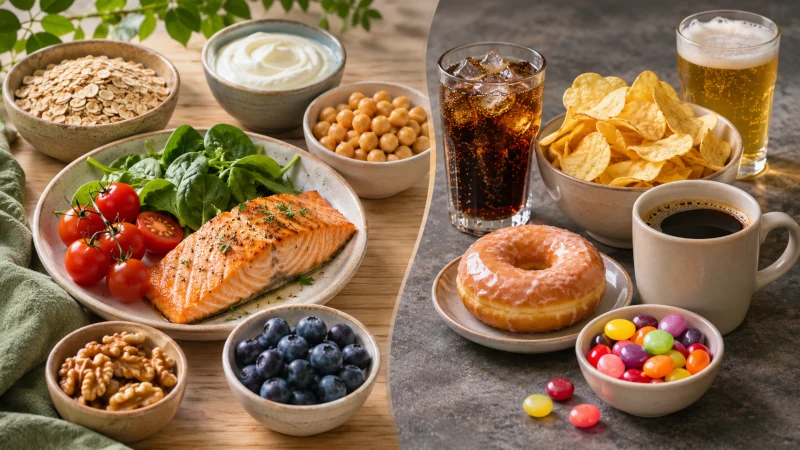
No single food switches off anxiety, and no diet treats an anxiety disorder on its own. What you eat and drink can still push your nerves in one direction or the other. The most useful anti-anxiety foods are ordinary ones: fatty fish, beans, nuts and seeds, vegetables, whole grains and yogurt, eaten as part of a pattern that goes easy on caffeine, alcohol and ultra-processed snacks. Here is what the research supports, where it is thin, and how to use it safely.
It helps to be clear about what kind of anxiety you are dealing with. Everyone feels anxious sometimes. An anxiety disorder is different: the worry doesn’t go away, shows up in many situations, and can get worse over time [NIMH, 2024]. Food can support treatment for that kind of anxiety. It can’t stand in for it.
What the research on food and anxiety shows
The broadest look at this question is a 2021 scoping review that screened nearly 56,000 records and kept 1,541 studies [Aucoin et al., 2021]. Lower anxiety went along with more fruits and vegetables, omega-3 fats, “healthy” eating patterns, eating breakfast, probiotics, and minerals such as magnesium, zinc and selenium. Higher anxiety went along with high-fat diets, too little protein, lots of sugar and refined carbohydrates, and “unhealthy” patterns overall.
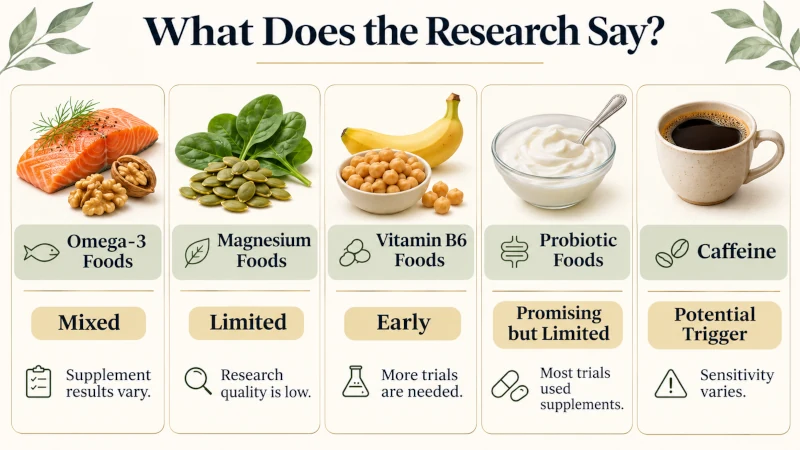
The authors are upfront about the catch. Most of those studies were in animals or were observational, and only about one in ten intervention studies included people with a diagnosed anxiety disorder. The fair reading is “these patterns are linked,” not “these foods treat anxiety.”
The same caution applies to ultra-processed food. A 2024 umbrella review in The BMJ found that people eating the most ultra-processed food had about 48% higher odds of anxiety than people eating the least [Lane et al., 2024]. The link was consistent across studies, but the certainty of the evidence was graded low, and studies that measure diet and anxiety at the same moment can’t show which came first. Stress can steer people toward convenience food just as easily as the reverse.
The best anti-anxiety foods to eat more often
Fatty fish and other omega-3 foods
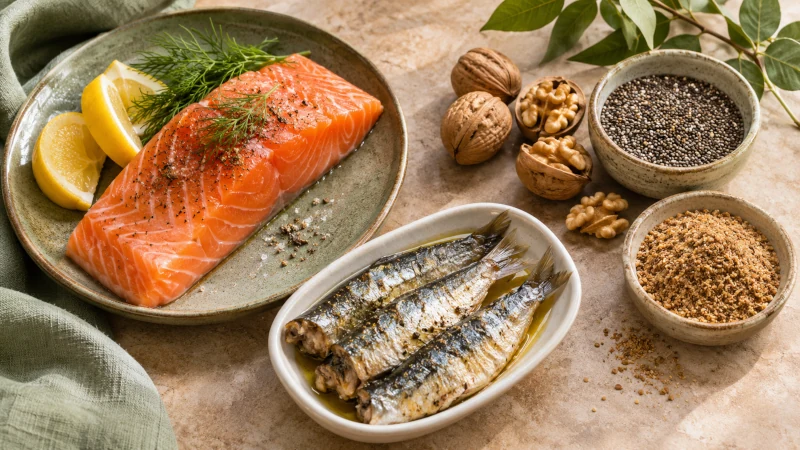
Salmon, mackerel, herring, sardines and trout supply the long-chain omega-3 fats EPA and DHA. Flaxseed, chia seeds, walnuts, and canola and soybean oils supply a plant omega-3 called ALA [NIH ODS, Omega-3].
Evidence: mixed. A 2018 meta-analysis of 19 trials with 2,240 participants linked omega-3s to a small-to-moderate drop in anxiety symptoms [Su et al., 2018]. Look closer, though, and the benefit sat in people who already had a clinical diagnosis; people without one saw essentially no change. In 2023 the journal published a reanalysis after one of the included studies was retracted [JAMA Netw Open, 2023]. A larger review of 31 longer trials, with more than 41,000 participants, asked whether extra omega-3 prevents anxiety and concluded it probably has little or no effect [Deane et al., 2021].
The practical takeaway: eat fish and plant omega-3 foods because they are good food, not as an anxiety treatment. The trials tested supplements, and supplements come with their own cautions (see the safety section below).
Magnesium-rich seeds, nuts, beans and greens
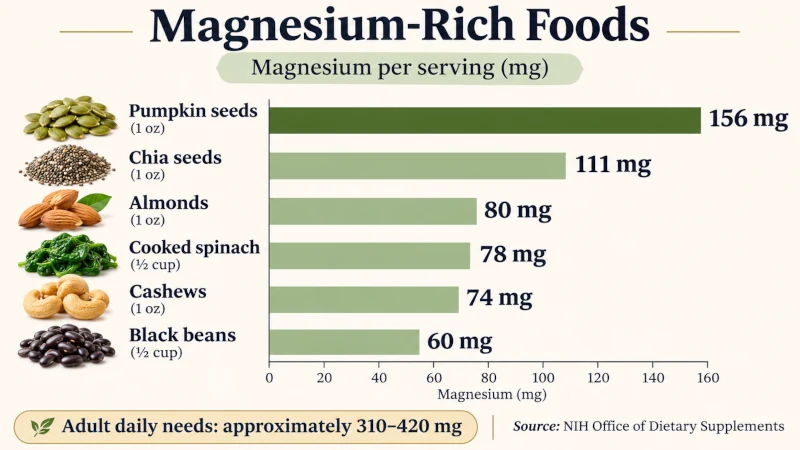
Pumpkin seeds lead the list at about 156 mg of magnesium per ounce. Chia seeds (111 mg per ounce), almonds (80 mg), cooked spinach (78 mg per half cup), cashews (74 mg) and black beans (60 mg per half cup) are also strong sources. Most adults need 310 to 420 mg a day [NIH ODS, Magnesium]. For a longer list, see our guide to magnesium-rich foods.
Evidence: limited and low quality. A systematic review of 18 studies found hints that magnesium helped people who were already prone to anxiety, such as mildly anxious adults and women with premenstrual syndrome. It made no difference to postpartum anxiety. The reviewers rated the overall quality of the evidence as poor, and part of the work was industry-funded [Boyle et al., 2017]. Getting enough magnesium from food is a sensible goal. Taking a supplement for anxiety is a separate decision, best made with your doctor.
Foods that supply vitamin B6
Chickpeas are one of the richest everyday sources, with about 1.1 mg per cup. Tuna, salmon, chicken breast, potatoes and bananas follow; a medium banana has about 0.4 mg. Adults need 1.3 to 1.7 mg a day [NIH ODS, Vitamin B6]. Our vitamin B6 guide covers food sources in more detail.
Evidence: early. In a one-month, placebo-controlled trial of 478 mostly young adults, a high-dose B6 supplement reduced self-reported anxiety [Field et al., 2022]. Published reports of the trial put the dose at 100 mg a day, roughly 75 times the adult requirement and far beyond what any diet provides. That one study needs repeating before anyone treats it as settled. Bananas and chickpeas are worth eating; they won’t recreate this result.
Yogurt, kefir and other fermented foods
Evidence: promising but limited, and mostly about supplements. A meta-analysis of 34 controlled trials found that probiotics produced small but statistically significant improvements in anxiety, while prebiotics did no better than placebo [Liu et al., 2019]. Those trials tested specific bacterial strains in measured doses, which is not the same as a bowl of yogurt.
Yogurt can carry beneficial microbes, but not every fermented food with live cultures contains proven probiotic strains. Sourdough bread and most commercial pickles have no live cultures left by the time you eat them, and sauerkraut, kimchi, kombucha and miso usually lack well-studied strains [NIH ODS, Probiotics]. If you enjoy them, plain yogurt or kefir with live cultures is an easy daily habit. If your anxiety tends to show up in your gut, our IBS diet guides cover which foods tend to help and which to limit.
Vegetables, fruit, whole grains and enough protein
These foods don’t have headline trials of their own, but they sit on the right side of nearly every association in the 2021 review [Aucoin et al., 2021]. More fruit and vegetables and a healthier overall pattern went with less anxiety; heavy intake of sugar and refined carbohydrates went with more. Swapping pastries and white bread for oats, brown rice, beans and other complex-carbohydrate foods is a reasonable place to start.
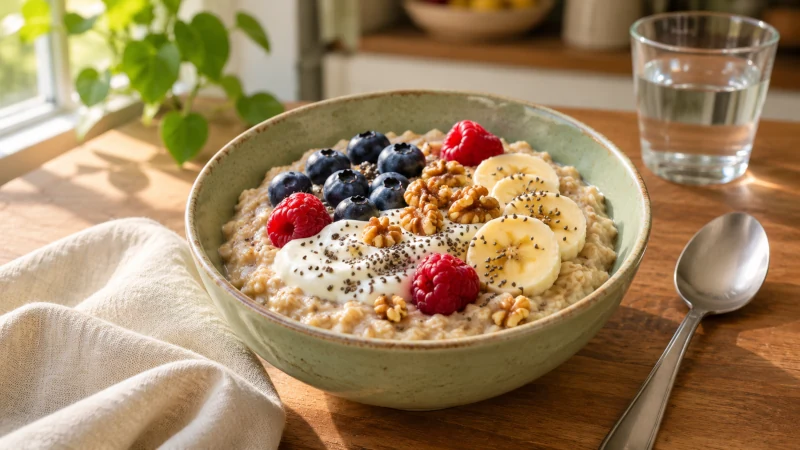
Protein matters too. Low protein intake lined up with higher anxiety in the same review. Some natural-health sources tell people with anxiety to cut out meat; the evidence above doesn’t support that. If you do eat less meat, make sure beans, lentils, fish, eggs, dairy or tofu fill the gap.
Foods and drinks that can make anxiety worse
Caffeine
Caffeine is the clearest dietary trigger. The FDA lists anxiety and jitters among the signs of too much, and says that about 400 mg a day, roughly two to three 12-ounce cups of coffee, is generally not linked to harmful effects in healthy adults [FDA, n.d.]. Coffee varies widely: a 12-ounce cup of brewed coffee can hold anywhere from 113 to 247 mg, and energy drinks span a similar range.
People with panic disorder are more sensitive. Across caffeine-challenge studies, about half of patients with panic disorder had a panic attack after a large dose, and none did after a placebo [Klevebrant & Frick, 2022]. Those doses were high, around 400 mg and up in one sitting. A 2025 trial using 150 mg, closer to a single ordinary cup, found it did not raise anxiety more in people with panic disorder than in healthy volunteers, although it did increase physical arousal in both groups [Hoppe et al., 2025].
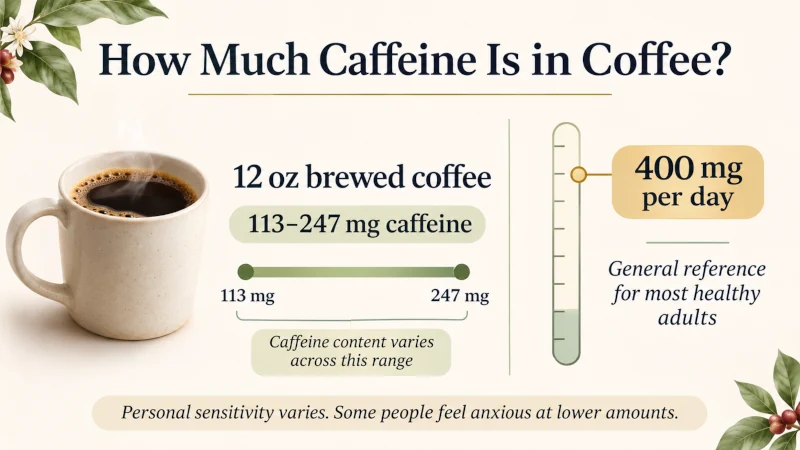
If you notice that coffee, energy drinks or pre-workout products set you off, cut back gradually and see what changes. Reducing caffeine and getting enough sleep can ease anxiety symptoms when paired with standard care [NIMH, 2025].
Alcohol
A drink can feel calming in the moment. The trouble comes later. According to the National Institute on Alcohol Abuse and Alcoholism, anxiety-like symptoms can follow even a single heavy drinking episode, the “hangxiety” many people recognize, and they can build between drinking episodes and peak during withdrawal. Over time, heavy drinking and repeated withdrawal can escalate both the anxiety and the drinking. Among people treated for anxiety disorders, 20% to 40% also have an alcohol use disorder [NIAAA, n.d.].
If you have been using alcohol to take the edge off, tell your clinician. Recovery is more likely when both conditions are treated.
Ultra-processed snacks and sugary foods
As noted above, the link between ultra-processed food and anxiety is consistent but can’t prove cause. Cutting back still costs you nothing and leaves more room for foods with better track records.
Anti-anxiety foods at a glance
| Food or drink | Examples | Evidence for anxiety | Practical note |
| Fatty fish, omega-3 foods | Salmon, sardines, mackerel, walnuts, chia | Mixed. Modest benefit in supplement trials, mainly in people with a diagnosis; little or no effect for prevention | Eat for overall health |
| Magnesium-rich foods | Pumpkin seeds, almonds, spinach, black beans | Limited. Small, low-quality supplement studies | Easy to meet needs from food |
| Vitamin B6 foods | Chickpeas, tuna, potatoes, bananas | Early. One trial of a high-dose supplement | Food can’t match trial doses |
| Fermented foods | Plain yogurt, kefir | Promising but limited. Strain-specific supplement trials | Choose products with live cultures |
| Fruit, vegetables, whole grains | Berries, leafy greens, oats, brown rice | Observational links only | The base of a healthy pattern |
| Caffeine | Coffee, energy drinks, pre-workout | Strong for panic disorder at high doses | Cut back if you notice a link |
| Alcohol | Beer, wine, spirits | Well established that heavy use worsens anxiety | Don’t use it to self-treat |
| Ultra-processed foods | Packaged snacks, sugary drinks | Consistent association, low certainty | Limit |
Safety: supplements, medications and pregnancy
Food sources of these nutrients are very unlikely to cause problems. Supplements are different, and several interact with common medications.
- Magnesium supplements: the upper limit for supplemental magnesium is 350 mg a day for adults. Higher doses commonly cause diarrhea, nausea and cramping, and people with kidney disease face a higher risk of toxicity. Magnesium can reduce absorption of osteoporosis drugs such as alendronate and of tetracycline and quinolone antibiotics, so doses need spacing. Some diuretics and long-term use of acid-reducing PPIs can lower magnesium levels [NIH ODS, Magnesium].
- Vitamin B6 supplements: the U.S. upper limit is 100 mg a day, and European regulators set a lower limit of 12 mg because of concern about nerve damage. Long-term high doses can cause sensory neuropathy; stop and see a doctor if you notice tingling or numbness. Some seizure medicines (valproic acid, carbamazepine, phenytoin) interact with B6 [NIH ODS, Vitamin B6].
- Fish oil: side effects are usually mild, such as a fishy taste, heartburn, nausea or diarrhea. Fish oil may raise INR in people taking warfarin, so periodic monitoring is advised. The FDA considers up to 5 g a day of EPA and DHA from supplements safe, and 4 g a day for several years slightly raised the risk of atrial fibrillation in people with or at high risk of heart disease [NIH ODS, Omega-3].
- Probiotic supplements: generally safe for healthy people. Serious infections have occurred mostly in people who were severely ill or had weakened immune systems, and the FDA warns against giving probiotics to preterm infants [NIH ODS, Probiotics].
- Pregnancy and breastfeeding: ask your provider whether you should limit caffeine [FDA, n.d.]. Federal guidance recommends 8 to 12 ounces a week of lower-mercury seafood such as salmon, sardines and trout during pregnancy [NIH ODS, Omega-3]. Check any supplement with your obstetric provider before starting it.
- Prescribed anxiety medication: don’t stop or change it because you have changed your diet, and tell your prescriber or pharmacist about any supplement you take.
When anxiety needs more than diet
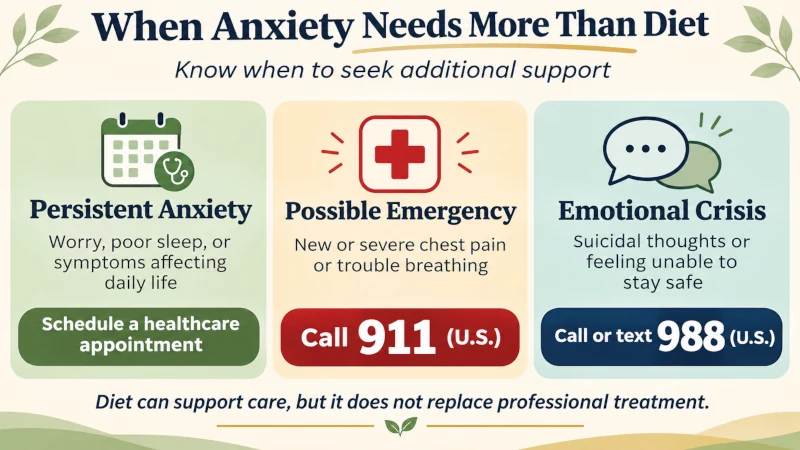
See a healthcare professional if worry is hard to control on most days, or if it comes with restlessness, irritability, trouble concentrating, poor sleep, or physical symptoms such as headaches, muscle tension or stomach upset [NIMH, 2025]. Anxiety is very treatable. Cognitive behavioral therapy is considered the gold standard of talk therapy, and medicines such as SSRIs and SNRIs are widely used. Healthy habits, diet included, help but can’t replace treatment, and a provider can check that a physical problem isn’t behind your symptoms [NIMH, n.d.].
Get help right away if:
- you have chest pain, a pounding or racing heart, or trouble breathing. Panic attacks can feel like a heart attack [NIMH, n.d.], and only a medical evaluation can tell them apart. If symptoms are severe or new, call 911.
- you are having thoughts of suicide or feel you can’t cope. In the U.S., call or text 988 or chat at 988lifeline.org. In a life-threatening emergency, call 911 [NIMH, 2025].
- you drink heavily and your anxiety spikes when you stop. Withdrawal is when anxiety symptoms tend to peak [NIAAA, n.d.]; get medical advice before cutting back on your own.
Anxiety and depression often travel together. Our evidence-based guide to foods that help with depression covers the overlap.
| HEALTH DISCLAIMER:This article is for general education and is not a substitute for advice, diagnosis or treatment from a qualified healthcare professional. Diet changes can support anxiety treatment but should not replace therapy or prescribed medication. Talk to your doctor or pharmacist before starting any supplement, especially if you are pregnant or breastfeeding, have kidney disease, take blood thinners, seizure medicines, antibiotics, diuretics or acid-reducing drugs, or are being treated for a mental health condition. If you are in crisis, call or text 988 (U.S.) or call 911. |
Frequently Asked Questions
Do bananas help with anxiety?
Bananas provide some vitamin B6, about 0.4 mg in a medium fruit [NIH ODS, Vitamin B6], and they fit well in a healthy eating pattern. The B6 trial that showed a benefit for anxiety used a high-dose supplement rather than food, so think of bananas as part of a good diet, not a treatment.
Is coffee bad for anxiety?
Not for everyone. Most healthy adults tolerate up to about 400 mg of caffeine a day [FDA, n.d.]. People with panic disorder are more sensitive to large doses [Klevebrant & Frick, 2022], though a single ordinary cup didn’t raise anxiety more than in healthy volunteers in a 2025 trial [Hoppe et al., 2025]. Your own experience is the best guide.
Should I take magnesium for anxiety?
The research is too weak to recommend magnesium supplements for anxiety [Boyle et al., 2017]. Try to meet your needs from seeds, nuts, beans and greens first. If you want to try a supplement, ask your doctor, stay at or under 350 mg a day from supplements, and check for interactions [NIH ODS, Magnesium].
Can changing my diet replace therapy or medication?
No. Healthy habits, including diet, can support treatment but can’t replace it [NIMH, n.d.]. Think of food as one part of a plan that may also include therapy, medication, sleep and exercise.
What is a good breakfast for anxiety?
Eating breakfast at all was linked to lower anxiety in the 2021 scoping review [Aucoin et al., 2021], though that link is observational. A practical option is oatmeal with plain yogurt, chia seeds and walnuts, which brings together whole grains, live cultures, magnesium and plant omega-3s, with coffee kept to an amount that suits you.
References
- Aucoin M, LaChance L, Naidoo U, et al. Diet and anxiety: a scoping review. Nutrients. View source
- Boyle NB, Lawton C, Dye L. The effects of magnesium supplementation on subjective anxiety and stress—a systematic review. View source
- Deane KHO, Jimoh OF, Biswas P, et al. Omega-3 and polyunsaturated fat for prevention of depression and anxiety symptoms: View source
- U.S. Food and Drug Administration. Spilling the beans: how much caffeine is too much? View source
- Field DT, Cracknell RO, Eastwood JR, et al. High-dose vitamin B6 supplementation reduces anxiety and strengthens visual surround suppression. Hum Psychopharmacol. View source
- Hoppe JM, Björkstrand J, Vegelius J, et al. Acute effects of 150 mg caffeine on subjective, physiological, and behavioral components of anxiety in panic disorder and healthy controls. View source
- Klevebrant L, Frick A. Effects of caffeine on anxiety and panic attacks in patients with panic disorder: a systematic review and meta-analysis. View source
- Lane MM, Gamage E, et al. Ultra-processed food exposure and adverse health outcomes: umbrella review of epidemiological meta-analyses. View source
- Liu RT, Walsh RFL, Sheehan AE. Prebiotics and probiotics for depression and anxiety: a systematic review and meta-analysis of controlled clinical trials. View source
- National Institute on Alcohol Abuse and Alcoholism. Mental health issues: alcohol use disorder and common co-occurring conditions. View source
- NIH Office of Dietary Supplements. Magnesium: fact sheet for health professionals. View source
- NIH Office of Dietary Supplements. Omega-3 fatty acids: fact sheet for health professionals. View source
- NIH Office of Dietary Supplements. Probiotics: fact sheet for health professionals. View source
- NIH Office of Dietary Supplements. Vitamin B6: fact sheet for health professionals. View source
- National Institute of Mental Health. Anxiety disorders. View source
- National Institute of Mental Health. Generalized anxiety disorder: when worry gets out of control. View source
- National Institute of Mental Health. Panic disorder: when fear overwhelms. View source
- Su KP, Tseng PT, Lin PY, et al. Association of use of omega-3 polyunsaturated fatty acids with changes in severity of anxiety symptoms: a systematic review and meta-analysis.View source
- JAMA Network Open. Reanalysis after retraction of included article. View source


