
The herbs with real evidence behind them for women’s health make a short list: ginger and fennel for period cramps, chasteberry for premenstrual breast tenderness, shepherd’s purse for heavy periods that a doctor has already checked, and black cohosh or sage for hot flashes. Even for these, the studies are small and the benefits modest. That is the honest version of the top herbs for women, and it comes with a second list that matters just as much: traditional “women’s herbs” that can seriously hurt you.
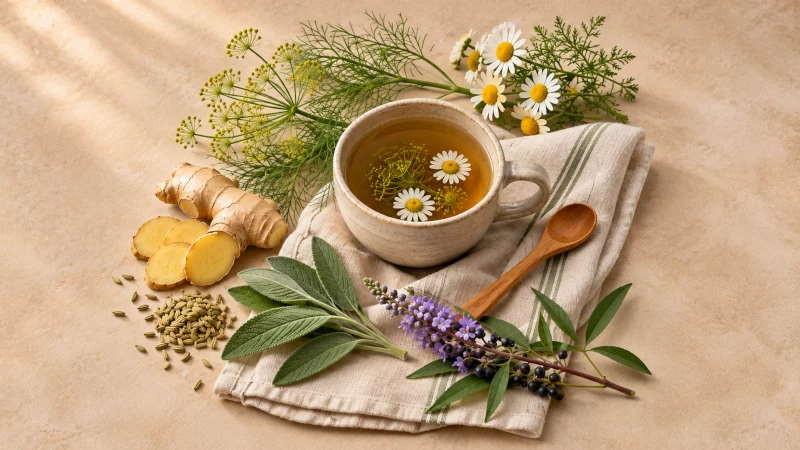
Herbal tradition is full of plant lists for menstruation, childbirth and breastfeeding. Some of those plants are pleasant teas. Others, like pennyroyal and birthwort, have caused liver failure, kidney failure and death. Below, each herb is sorted by what it’s actually used for, how strong the evidence is, and who should leave it alone.
The top herbs for women at a glance
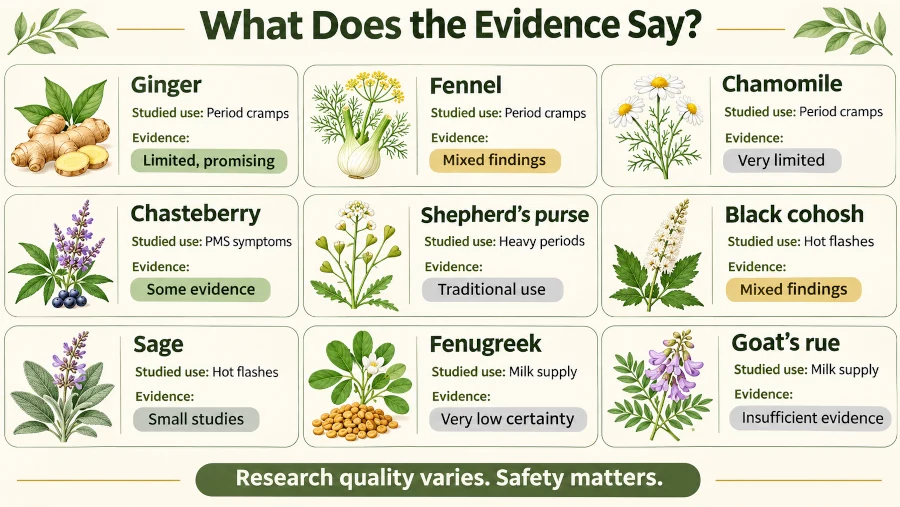
| Herb | Best-studied use | Evidence | Main caution |
| Ginger | Period cramps | Limited but fairly consistent | Heartburn, stomach upset |
| Fennel | Period cramps | Mixed — reviews disagree | Concentrated products in pregnancy and for babies |
| Chamomile | Period cramps | Very limited | Ragweed-family allergy; warfarin |
| Chasteberry | PMS breast pain | Low-to-moderate quality | Not in pregnancy, breastfeeding or hormone-sensitive cancers |
| Shepherd’s purse | Heavy periods, after a medical check | Traditional use, regulator-recognized | Not in pregnancy, breastfeeding or under 18 |
| Black cohosh | Hot flashes | Mixed | Rare liver injury |
| Sage | Hot flashes | A few small studies | Thujone toxicity; not in pregnancy |
| Fenugreek | Milk supply | Very low certainty | Blood sugar, warfarin, legume allergy |
| Goat’s rue | Milk supply | No valid trials | Low blood sugar |
Period pain: where the evidence is deepest
Cramps are the best-researched corner of women’s herbal medicine, which says less than it sounds. A 2016 Cochrane review of dietary supplements for period pain found no high-quality evidence for any of them and rated every comparison as low or very low certainty [Pattanittum et al., Cochrane, 2016]. A few herbs still keep showing a signal.
Ginger
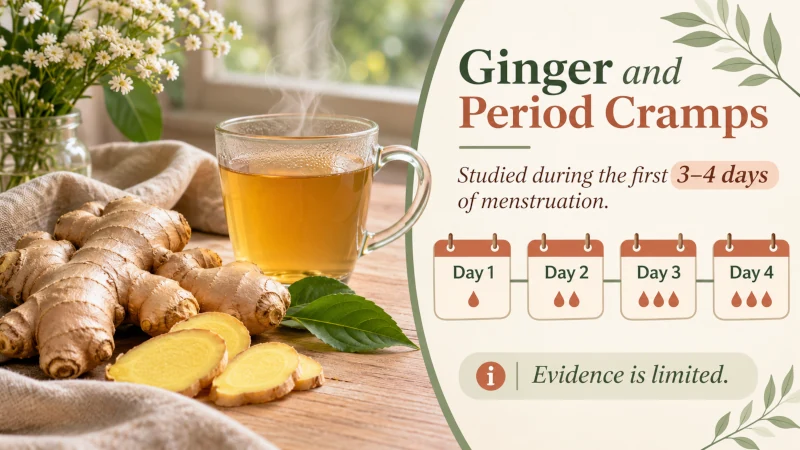
Ginger has the most consistent results. A 2015 meta-analysis pooled four placebo-controlled trials and found suggestive evidence that 750 to 2,000 mg of ginger powder a day, taken during the first three or four days of a period, reduces pain [Daily et al., 2015]. NCCIH reaches a similar conclusion: ginger supplements may lessen how severe cramps get [NCCIH, 2025]. The Cochrane reviewers were more cautious and called the evidence very limited [Pattanittum et al., Cochrane, 2016].
If you want to try it, start when your period starts rather than halfway through the worst day. Side effects are usually mild: abdominal discomfort, heartburn, diarrhea, or mouth and throat irritation [NCCIH, 2025]. If you take regular medication, run it past your pharmacist first.
Fennel: the reviews disagree
Fennel is where the research splits. A 2020 meta-analysis of 12 randomized trials found fennel beat placebo and worked about as well as NSAID pain relievers, but the trials varied enormously and the authors rated the overall robustness of their findings as low [Lee et al., 2020]. The Cochrane review found no consistent evidence that fennel outperforms placebo [Pattanittum et al., Cochrane, 2016].
Read that as “possibly helpful, unproven.” Fennel tea in kitchen amounts is a reasonable experiment. Concentrated fennel oil and supplements raise separate concerns during pregnancy and for babies, which our guide to fennel seeds explains.
Chamomile
Chamomile’s reputation for cramps runs ahead of its data. Cochrane found only very limited evidence that it eased pain better than NSAIDs [Pattanittum et al., Cochrane, 2016]. It is likely safe in food amounts; side effects are uncommon and include nausea, dizziness and allergic reactions, which are more likely if you react to ragweed, chrysanthemums, marigolds or daisies. Chamomile has also been reported to interact with warfarin [NCCIH, 2024]. Our German chamomile guide covers the anxiety and sleep research.
Cramp bark, lady’s mantle and other traditional antispasmodics
Cramp bark (Viburnum opulus) earned its name from centuries of use for uterine cramps, and lady’s mantle (Alchemilla vulgaris) has a similar folk history. Neither appears among the trials in the reviews cited here, so treat them as traditional remedies rather than tested ones. Our pages on cramp bark and lady’s mantle describe how they have been used; with cramp bark, only the bark is used, because the berries are poisonous. For a side-by-side look at cramp options, see herbs for menstrual cramps.
Heavy periods: shepherd’s purse, with one condition
Shepherd’s purse is the only herb here with formal regulatory recognition for a women’s-health use. The European Medicines Agency lists it as a traditional herbal medicine for reducing heavy menstrual bleeding in women with regular cycles, but only after a doctor has ruled out serious conditions [EMA HMPC, 2011].
That condition is the point. Heavy bleeding can come from fibroids, polyps or other problems that need treatment, and an herb can hide them while they grow. EMA does not recommend shepherd’s purse during pregnancy or breastfeeding, or for anyone under 18 [EMA HMPC, 2011]. Our shepherd’s purse guide walks through the small trials, doses and interactions.
PMS and breast tenderness: chasteberry
Chasteberry (Vitex agnus-castus) is the herb most often suggested for premenstrual symptoms. Studies of low-to-moderate quality suggest it may ease PMS symptoms such as breast pain and tenderness [NCCIH, 2025]. Side effects tend to be mild — nausea, stomach pain, diarrhea, headache or itching — and fruit extracts have been used safely in studies lasting up to three months [NCCIH, 2025].
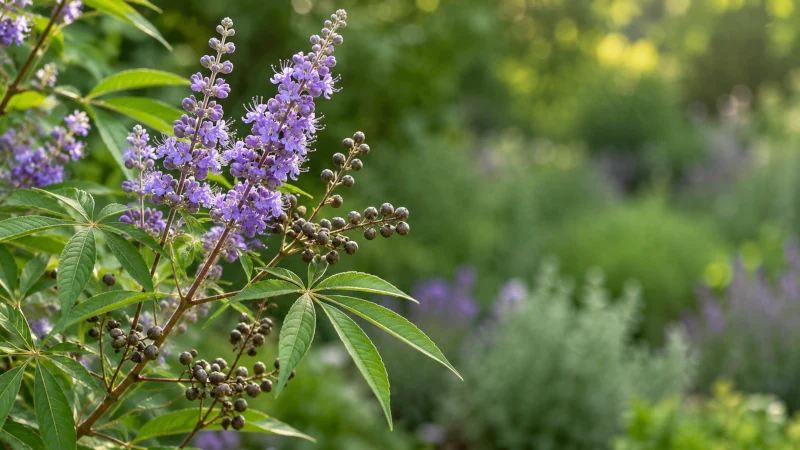
Here the cautions outweigh the benefits for some women. Chasteberry may not be safe for anyone with a hormone-sensitive condition such as breast, uterine or ovarian cancer, and it may be unsafe during pregnancy or breastfeeding [NCCIH, 2025]. If you are trying to conceive or take prescription medicine, talk with your clinician before starting it.
Menopause: black cohosh, sage and a reality check
Menopause has the widest gap between supplement marketing and medical advice. The Menopause Society’s 2023 position statement on nonhormone treatments does not recommend herbal or dietary supplements for hot flashes. The options it does recommend include cognitive behavioral therapy, clinical hypnosis, weight loss, certain antidepressants, gabapentin, oxybutynin, stellate ganglion block and fezolinetant [The Menopause Society, 2023].
Black cohosh shows why the picture looks mixed. NCCIH cites a 2023 review of 22 studies finding that black cohosh products may help overall menopause symptoms and hot flashes, though not anxiety or low mood [NCCIH, 2024]. Rare, sometimes serious liver injuries have been reported in people taking black cohosh products. It isn’t clear the herb caused them, and some products turned out to contain other plants. If you take it and notice dark urine or unusual fatigue, see a clinician [NCCIH, 2024].
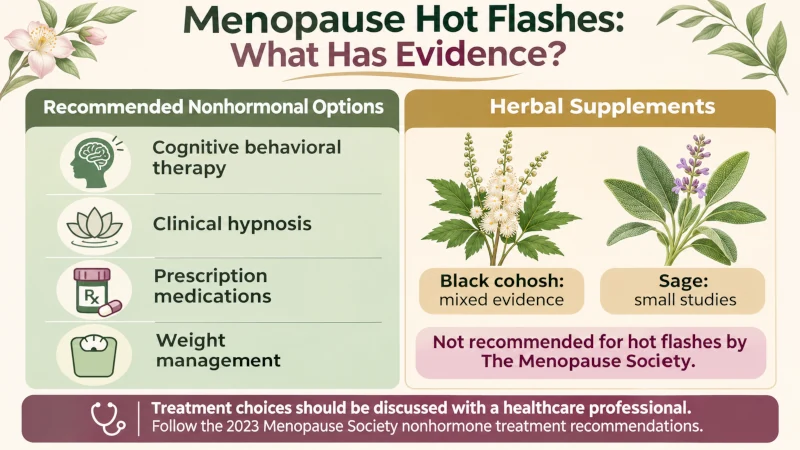
Common sage has a few small studies suggesting it may cut how often hot flashes happen [NCCIH, 2025]. It also contains thujone, which can be toxic in large amounts, so high doses or long-term use may be unsafe, and sage may be unsafe in pregnancy [NCCIH, 2025]. Our sage guide covers forms and sensible limits.
Hot flashes that wreck your sleep are a reason to see your doctor, not to stack supplements. Effective treatments exist, hormonal and non-hormonal.
Breastfeeding: herbs for milk supply
Herbal galactagogues — fenugreek, goat’s rue, fennel and the nursing teas that blend them — are popular and thinly supported. A 2020 Cochrane review found 13 studies of natural galactagogues that measured milk volume, but the results were too inconsistent to combine and the certainty of evidence was very low [Foong et al., Cochrane, 2020].
Fenugreek’s results are mixed. Reported side effects include stomach upset, allergic reactions (including cross-reactions with chickpeas, peanuts and other legumes), worsening asthma and liver toxicity; at high doses it may lower blood sugar, and it can raise bleeding risk in people taking warfarin [Drugs.com/LactMed, 2026]. Goat’s rue has no scientifically valid trials behind it and may lower blood sugar, so take care if you use diabetes medicine [Drugs.com/LactMed, 2026]. In one report, two breastfed infants developed poor feeding, lethargy and low muscle tone after their mothers drank a tea containing goat’s rue, fennel and anise; both improved once the tea stopped, and the authors suspected the anise-fennel component [Drugs.com/LactMed, 2026]. More detail is in our goat’s rue guide.
Before reaching for herbs, a lactation consultant can check latch, feeding frequency and other common causes of low supply. And if a breast becomes painful, warm, swollen or red — especially with a fever of about 101°F (38.3°C) or chills — that may be mastitis, which needs a clinician rather than a tea [Mayo Clinic, accessed 2026].
Vaginal infections: leave out the herbal douche
Some herbal sources recommend rinsing the vagina with herb decoctions to treat infections. Current advice runs the other way. The U.S. Office on Women’s Health says doctors recommend against douching: women who douche about once a week are roughly five times more likely to develop bacterial vaginosis, and douching is linked to yeast infections, sexually transmitted infections, pelvic inflammatory disease, ectopic pregnancy and preterm birth [OWH, 2025]. Unusual or foul-smelling discharge deserves an exam [MedlinePlus, 2026], because the right treatment depends on the cause.
Traditional “women’s herbs” to skip
Old lists of emmenagogues — plants said to bring on a period — mix harmless kitchen herbs with genuinely dangerous ones. Several were historically used to try to end pregnancies, which is exactly what makes them risky. If a tea blend, product or article suggests any of these to “regulate” your cycle, put it down.
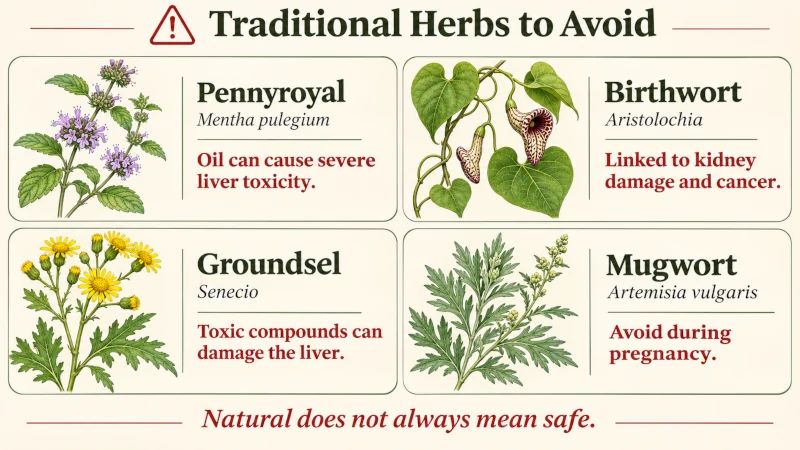
| Herb | Why to avoid it |
| Pennyroyal (Mentha pulegium) | The oil is highly toxic to the liver. Poisoning can lead to liver and kidney failure, bleeding, seizures and death; young women have died using it to try to induce abortion [Poison Control, 2016]. |
| Birthwort / birchwort (Aristolochia) | Contains aristolochic acid, which the FDA warned can cause permanent kidney damage, kidney failure needing transplant, and a raised risk of urinary-tract cancer [FDA alert via MSK, 2001]. |
| Groundsel and other Senecio species | Contain pyrrolizidine alkaloids, which injure the liver through hepatic sinusoidal obstruction syndrome and can progress to liver failure; several are genotoxic [EMA HMPC, 2016] [Neuman et al., 2015]. |
| Mugwort (Artemisia vulgaris) | Very little human research exists, there isn’t enough evidence to call it safe or useful, and NCCIH says it should not be used during pregnancy [NCCIH, 2025]. |
Using herbs safely
- Pregnancy. Skip medicinal doses unless your OB or midwife agrees. Chasteberry, sage, mugwort, black cohosh and shepherd’s purse are all flagged as possibly unsafe or not recommended in pregnancy [NCCIH, 2025] [NCCIH, 2025] [NCCIH, 2025] [NCCIH, 2024] [EMA HMPC, 2011]. Ginger is the exception: NCCIH says supplements may be safe for pregnancy nausea, with your provider’s approval [NCCIH, 2025].
- Breastfeeding. For most herbs, little is known about safety while nursing, and your baby is exposed too.
- Medications. Chamomile has a reported interaction with warfarin, fenugreek can raise bleeding risk with it, and fenugreek and goat’s rue may lower blood sugar [NCCIH, 2024] [Drugs.com/LactMed, 2026] [Drugs.com/LactMed, 2026]. Bring your bottles to your pharmacist.
- Allergies. Chamomile is in the daisy family; if ragweed sets you off, be cautious [NCCIH, 2024].
- Product quality. Dietary supplements don’t need extensive FDA approval before they’re sold [Drugs.com/LactMed, 2026], and some black cohosh products have contained other herbs [NCCIH, 2024]. Choose products with third-party testing.
- Give it a fair trial, then stop. If an herb hasn’t helped after two or three cycles, it probably won’t.
When to see a doctor
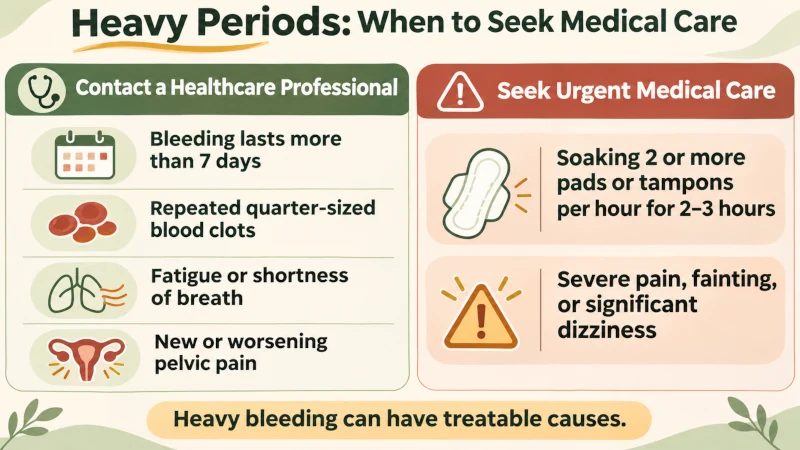
Herbs are for mild, familiar symptoms. Get medical care if any of these apply:
- Soaking through a pad or tampon every hour for more than two hours in a row, passing quarter-sized clots more than once or twice, or periods lasting longer than seven days [Cleveland Clinic, 2024].
- Emergency: soaking through two or more products an hour for two to three hours straight [Cleveland Clinic, 2024].
- Feeling tired or short of breath with heavy periods, which can signal anemia [Cleveland Clinic, 2024].
- Fever with pelvic pain; sudden severe pain, especially if your period is more than a week late and you’re sexually active; period pain that persists after three months of treatment; or pain outside your period [MedlinePlus, 2026].
- Unusual or foul-smelling vaginal discharge [MedlinePlus, 2026].
- A painful, red breast with fever while breastfeeding [Mayo Clinic, accessed 2026].
- Dark urine or unusual fatigue while taking black cohosh [NCCIH, 2024].
Our overview of common female disorders explains what these symptoms can point to, and what dysmenorrhea is covers the difference between ordinary cramps and pain caused by an underlying condition.
| HEALTH DISCLAIMER: This article is for general education and is not a substitute for advice, diagnosis or treatment from a qualified healthcare professional. Herbs can cause side effects, interact with prescription medicines, and be unsafe during pregnancy or breastfeeding. Talk with your doctor, midwife or pharmacist before starting any herbal product — especially if you are pregnant, trying to conceive, breastfeeding, under 18, managing a chronic condition, or taking medication. If you have very heavy bleeding, severe pelvic pain, or fever, seek medical care promptly. |
Frequently Asked Questions
What is the best herb for period cramps?
Ginger has the most consistent evidence. A meta-analysis found suggestive benefit from 750–2,000 mg of ginger powder daily during the first three or four days of a period [Daily et al., 2015], though Cochrane rates the evidence very limited [Pattanittum et al., Cochrane, 2016]. Fennel may help, but reviews disagree [Lee et al., 2020].
Are there herbs that balance female hormones?
No herb has been shown to “balance hormones” in a general sense. Some have modest evidence for specific symptoms, such as chasteberry for PMS breast tenderness [NCCIH, 2025]. For menopause, The Menopause Society does not recommend herbal supplements for hot flashes [The Menopause Society, 2023].
Which herbs should I avoid while pregnant?
Avoid pennyroyal, birthwort and groundsel entirely [Poison Control, 2016] [FDA alert via MSK, 2001] [EMA HMPC, 2016]. Mugwort, chasteberry, sage, black cohosh and medicinal shepherd’s purse are flagged as unsafe or not recommended in pregnancy [NCCIH, 2025] [NCCIH, 2025] [NCCIH, 2025] [NCCIH, 2024] [EMA HMPC, 2011]. Ask your OB or midwife before using any herbal product.
Do herbal teas increase breast milk?
The evidence is weak. A Cochrane review rated the certainty for natural galactagogues as very low [Foong et al., Cochrane, 2020], and heavy use of one fennel-anise-goat’s rue tea was linked to symptoms in two infants [Drugs.com/LactMed, 2026]. A lactation consultant is a better first step.
Is black cohosh safe?
Many people use it without problems, but rare, sometimes serious liver injuries have been reported with black cohosh products, and it may not be safe during pregnancy or breastfeeding [NCCIH, 2024]. Stop and see a clinician if you develop dark urine or unusual fatigue.
References
- Pattanittum P, Kunyanone N, Brown J, et al. Dietary supplements for dysmenorrhoea. View source
- Daily JW, Zhang X, Kim DS, Park S. Efficacy of ginger for alleviating the symptoms of primary dysmenorrhea: a systematic review and meta-analysis of randomized clinical trials. Pain Med. View source
- National Center for Complementary and Integrative Health. Ginger. View source
- Lee HW, Ang L, Lee MS, Alimoradi Z, Kim E. Fennel for reducing pain in primary dysmenorrhea: a systematic review and meta-analysis of randomized controlled trials. Nutrients. View source
- National Center for Complementary and Integrative Health. Chamomile. View source
- National Center for Complementary and Integrative Health. Chasteberry. View source
- National Center for Complementary and Integrative Health. Black Cohosh. View source
- National Center for Complementary and Integrative Health. Sage. View source
- The North American Menopause Society (The Menopause Society). View source
- European Medicines Agency, HMPC. Community herbal monograph on Capsella bursa-pastoris (L.) Medikus, herba. View source
- Cleveland Clinic. Menorrhagia (heavy menstrual bleeding). View source
- MedlinePlus (U.S. National Library of Medicine). Painful menstrual periods. View source
- Foong SC, Tan ML, Foong WC, Marasco LA, Ho JJ, Ong JH. Oral galactagogues (natural therapies or drugs) for increasing breast milk production in mothers of non-hospitalised term infants. View source
- Drugs.com. Fenugreek use while breastfeeding (reproduces NLM LactMed). View source
- Drugs.com. Goat’s rue use while breastfeeding (reproduces NLM LactMed). View source
- Mayo Clinic. Mastitis: symptoms and causes. View source
- Office on Women’s Health, U.S. Department of Health and Human Services. Douching. View source
- National Center for Complementary and Integrative Health. Mugwort. View source
- Poison Control, National Capital Poison Center. Pennyroyal oil: a potentially toxic folk remedy. View source
- Memorial Sloan Kettering Cancer Center. View source
- European Medicines Agency, HMPC. Public statement on the use of herbal medicinal products containing toxic, unsaturated pyrrolizidine alkaloids. View source
- Neuman MG, Cohen L, Opris M, Nanau RM, Jeong H. Hepatotoxicity of pyrrolizidine alkaloids. J Pharm Pharm Sci. View source


