
If you’re looking for the best herbs for eczema, start with an honest answer: a small handful of plant-based remedies can genuinely soothe irritated skin, but none of them cures eczema, and a couple of plants that still show up on old herbal lists can seriously hurt you. Eczema — atopic dermatitis, most commonly — is a long-term condition of a damaged skin barrier and an over-reactive immune system. It can be controlled well, but it cannot be cured [AAD, 2026]. Any page that promises otherwise is selling you something.
One thing to clear away first, because the older version of this very article leaned on it: your skin is not a drain for “toxins in the blood,” and eczema is not caused by “dirty blood.” Skin inflammation comes from barrier damage, immune reactivity, irritants, allergens, and infection — not from waste your liver and kidneys already handle. “Blood-purifying” or “depurative” herbs are aimed at a problem that doesn’t exist, so the benefit they promise doesn’t either.
First, the part no herb replaces
Before any botanical, the unglamorous basics do most of the work. Dermatologists recommend a moisturizer for everyone with atopic dermatitis, because keeping skin hydrated prevents the cracks that lead to worse rash, more itch, and infection [AAD, 2026]. Alongside that sits trigger management — identifying and avoiding the things that set your skin off. Common culprits are skin-care products, hot or cold weather, wool clothing, stress, fragrance, and harsh detergents, and they differ from person to person [AAD, 2026].
When that isn’t enough, effective medical treatments exist: topical corticosteroids, topical calcineurin inhibitors like tacrolimus, newer non-steroid creams such as crisaborole, roflumilast, ruxolitinib, and tapinarof, plus light therapy and — for moderate-to-severe disease — systemic options and biologics like dupilumab [AAD, 2026]. That’s the backbone. Think of herbs as, at most, a comfort layer on top of it, never a replacement. Our overview of day-to-day eczema and dermatitis care covers the routine in more depth.
How to read the evidence on the best herbs for eczema
Not every “eczema herb” sits in the same tier. Here’s the honest sort:
| Remedy (topical unless noted) | Most-studied use for skin | How strong is the evidence? |
| Colloidal oatmeal | Eczema itch, barrier | Reasonable — long-used skin protectant |
| Sunflower seed / coconut oil | Dryness, barrier, itch | Limited but promising (small RCTs) |
| Licorice, applied to skin | Atopic dermatitis | Promising but limited (one small trial) |
| German chamomile | Irritated skin | Traditional; thin human data; allergy risk |
| Aloe vera gel | Burns first | Reasonable for burns; not enough for eczema |
| Carrot, nettle, dandelion, pansy, yarrow, etc. | Eczema (folk use) | Traditional only — no rigorous human trials |
| Evening primrose / borage oil (oral) | Eczema | Good evidence of NO benefit |
| Castor seeds; bittersweet nightshade | — | Avoid — documented toxicity |
The herbs and plant remedies with the most support
Colloidal oatmeal
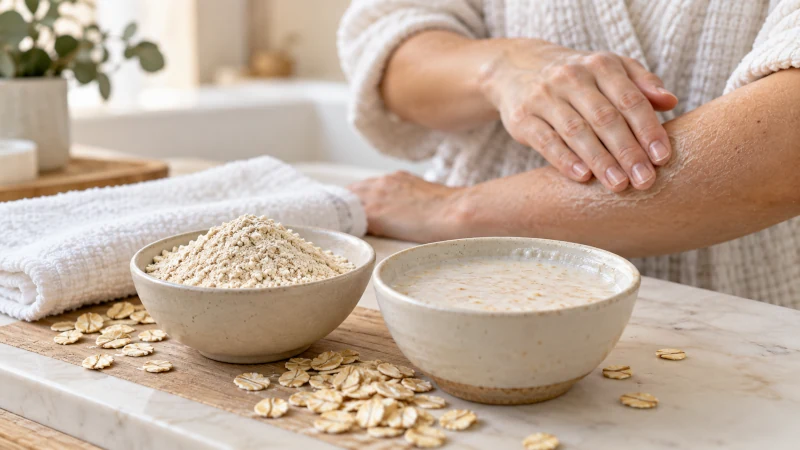
Finely milled oat suspended in a cream or bath is the plant-derived remedy with the steadiest track record for eczema. It’s a long-established skin protectant that helps calm itch, support the barrier, and normalize skin pH, and it’s used as the base in modern eczema trials [Khan et al., 2026]. It’s cheap, widely available, and gentle enough for children. If you try one plant-based thing, this is the sensible place to start.
Emollient plant oils: sunflower seed and coconut
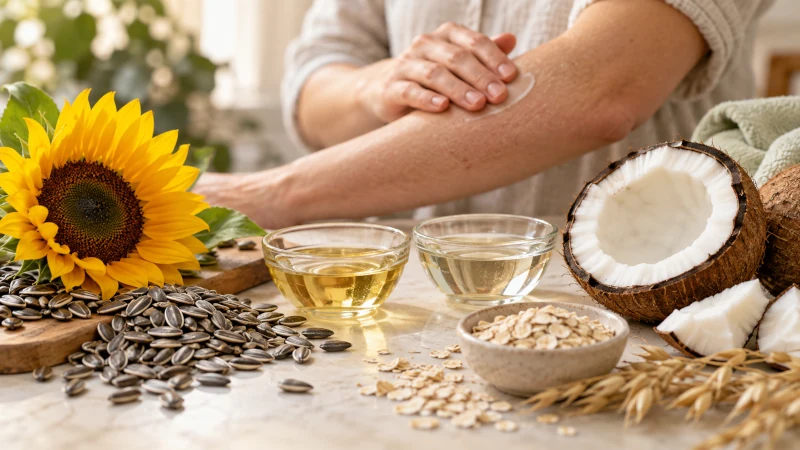
Certain plant oils work as emollients — they don’t treat the disease, they support the skin barrier. In a randomized pediatric trial, an emollient built on coconut- and sunflower-seed-oil fatty esters, layered with colloidal oatmeal, improved eczema and itch and let children use less topical steroid than the control cream [Khan et al., 2026]; a separate adult study found similar itch and steroid-sparing benefits [IDEAS trial, 2024]. The evidence is limited and mostly about barrier support rather than cure. A practical caveat: not all “natural” oils behave the same way — sunflower seed oil tends to support the barrier, while some studies found olive oil can worsen it, so oil choice matters.
Licorice, applied to the skin
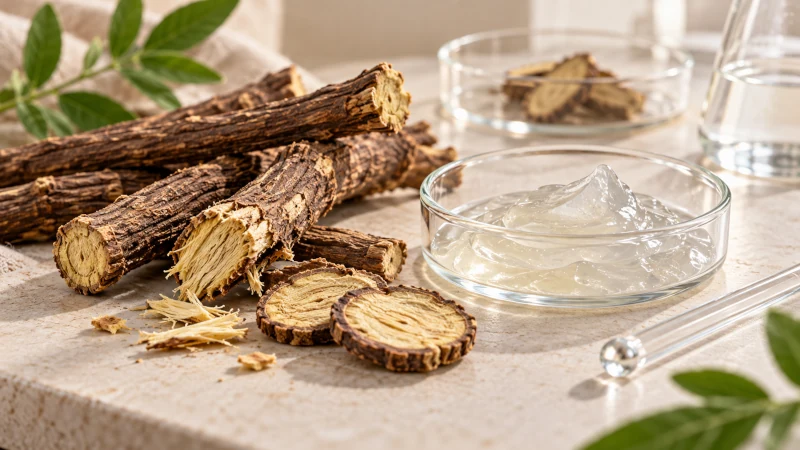
Topical licorice (Glycyrrhiza glabra) is the closest thing on the traditional list to a plausible active remedy. In a small double-blind trial, 1% and 2% licorice gels applied for two weeks improved redness, swelling, and itching in atopic dermatitis compared with a plain base gel, with the 2% gel doing better than the 1% [Saeedi et al., 2003]. That’s one small, short study — promising, not proven — but it’s a real human trial, which sets licorice apart from most of the folk list. Eating large amounts of licorice is a different matter and carries its own risks (it can raise blood pressure and lower potassium), so this is about a topical product, not the candy.
German chamomile — soothing by tradition, but a common allergen
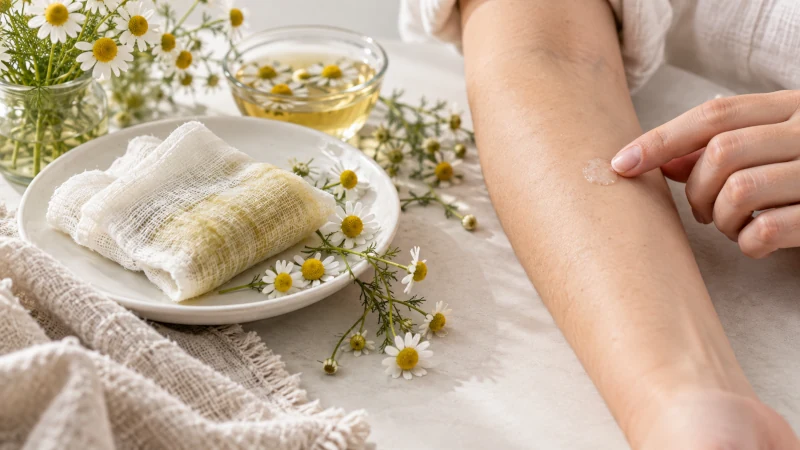
Chamomile compresses have been used on inflamed skin for centuries, and the plant does contain anti-inflammatory compounds. What’s thin is rigorous human trial data for eczema specifically; studies of chamomile’s clinical usefulness haven’t produced enough reliable evidence to rate it [NCCIH, 2024]. There’s also a catch that matters more here than almost anywhere: chamomile is in the daisy (Asteraceae) family, and people allergic to ragweed, chrysanthemums, marigolds, or daisies are more likely to react to it [NCCIH, 2024]. Rubbing a potential allergen onto already-inflamed skin can backfire. Treat chamomile as a gentle traditional soother to patch-test cautiously, not a treatment.
Aloe vera — good for burns, thin for eczema
Aloe gel has reasonable evidence for speeding burn healing, but for eczema specifically there isn’t enough reliable information to say it helps [NCCIH, via herbs-for-skin]. Topical gel is generally well tolerated on intact skin. Swallowing aloe is a different and riskier proposition — oral aloe latex causes cramping and diarrhea, and whole-leaf extracts have been linked to liver problems — so if you use it, keep it to the gel, on the skin, and don’t give it to babies by mouth.
Traditional remedies with little or no eczema evidence
Most of the plants on classic “herbs for eczema” lists — carrot poultices, oak-bark compresses, bilberry, watercress, nettle, soapwort, fumitory, dandelion, purple loosestrife, psyllium, white birch, wild teasel, milfoil (yarrow), and pansy — rest on tradition and old herbal encyclopedias, not on human trials for eczema. That doesn’t make them all worthless; some may be mildly soothing, and a cool, plain compress can genuinely ease itch. But it does mean you should expect comfort at best, not resolution, and you shouldn’t pay a premium or delay real treatment for them.
A few carry specific cautions: yarrow and dandelion are also daisy-family plants, so the same ragweed/daisy allergy risk applies [NCCIH, 2024]. The broad picture agrees — reviews and the American Academy of Dermatology’s guidelines find inconsistent-to-no evidence for herbal and supplement approaches to atopic dermatitis [NCCIH, 2021]. For a wider evidence-graded look, see our guide to herbs for skin issues.
What the evidence says does not work: oral evening primrose and borage oil
This one is worth being blunt about, because the previous version of this article called evening primrose an excellent treatment. It isn’t. A Cochrane systematic review of 27 randomized trials in 1,596 adults and children found that oral evening primrose oil and borage oil offered no meaningful improvement in eczema over placebo — and the authors concluded further trials would be hard to justify [Cochrane/Bamford, 2013]. The AAD’s guidelines reach the same conclusion for these and other oral supplements [NCCIH, 2021]. If someone recommends evening primrose capsules for eczema, the best available evidence says save your money.
Two plants on old eczema lists you should not use
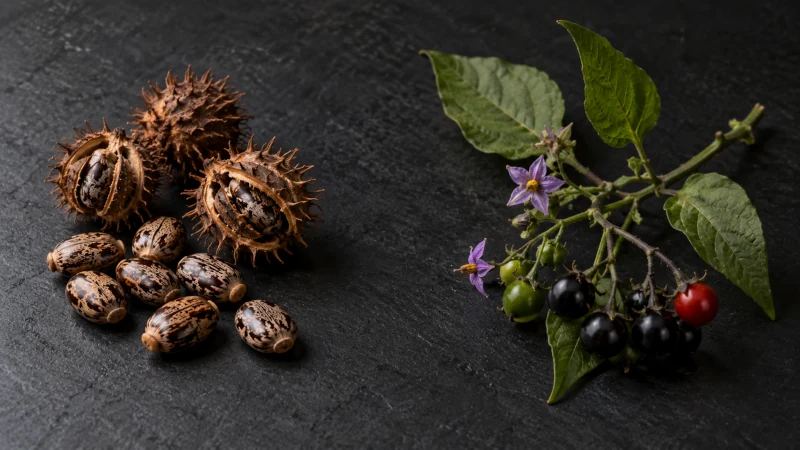
| ⚠ Do not use these on or in your body Castor “bean” seeds. Castor oil is processed and safe for external use, but the raw seeds of Ricinus communis contain ricin, one of the most toxic substances known. Poison-control experts are explicit: never use castor beans as a health remedy, and never crush or chew them [Poison Control]. The older version of this article recommended applying the seeds — that advice is unsafe and has been removed. Bittersweet nightshade (Solanum dulcamara). All parts are toxic; it contains solanine, and handling the plant can itself cause skin irritation or dermatitis, with ingestion causing far worse [NC State Extension]. It has no place in an eczema routine, especially not on broken skin or around children. In a poisoning emergency, call Poison Help at 1-800-222-1222 (U.S.). For a medical emergency, call 911. |
If you still want to try an herb: safety, side effects, and who should skip it
Side effects and allergic contact dermatitis
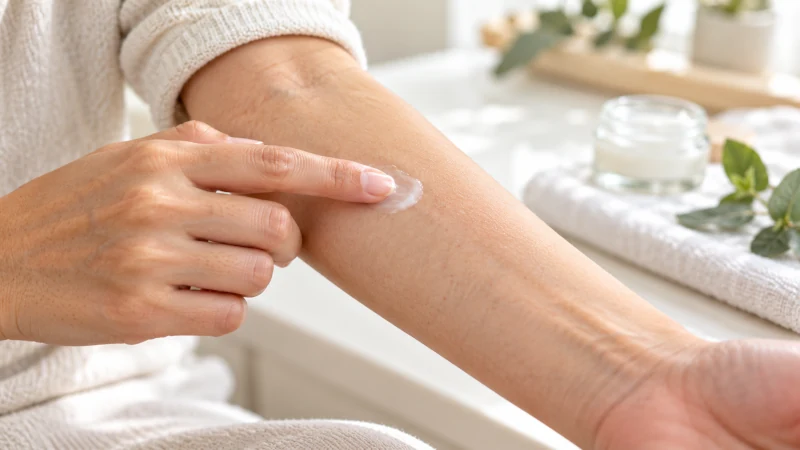
Here’s the irony at the heart of “natural” eczema remedies: the biggest risk is your skin reacting to the remedy. Botanicals are a well-recognized cause of allergic contact dermatitis, and topical herbal products are especially likely to sensitize when applied to damaged, weeping, or broken skin — exactly the skin eczema gives you [Herbal ACD study, 2018] [NCCIH, 2024]. So the single most useful safety habit is a patch test: dab a small amount on your inner forearm, leave it 48 hours, and only use it more widely if nothing happens. If a product stings, burns, spreads, or worsens the rash, stop immediately. Our guide to patch testing walks through both the at-home version and the medical version that pinpoints a specific allergen.
Drug interactions worth knowing
“Herbal” doesn’t mean “no interactions.” Chamomile, for instance, may have mild estrogen-like effects, might reduce the effectiveness of birth control pills, and has reported interactions with warfarin and with drugs processed by the liver [NCCIH, 2024]. If you take prescription medicines, your pharmacist can screen a specific herb for interactions in about a minute, no appointment needed.
Pregnancy, breastfeeding, babies, and who should avoid herbs
For most herbs, the honest answer in pregnancy and breastfeeding is that they simply haven’t been studied enough to call safe — chamomile included [NCCIH, 2024] — so ask your OB-GYN or pharmacist first. Some people should be especially cautious with self-treating: babies and young children (their skin absorbs more and tolerates less), anyone immunosuppressed or on chemotherapy, people with diabetes and a foot wound, and anyone with widespread or broken eczema, where the damaged barrier raises the risk of both absorption and new allergies. In all of these cases, herbs are the wrong first move. If diet is your angle instead, see our evidence-checked list of foods for eczema.
Red flags: when to stop self-treating and see someone
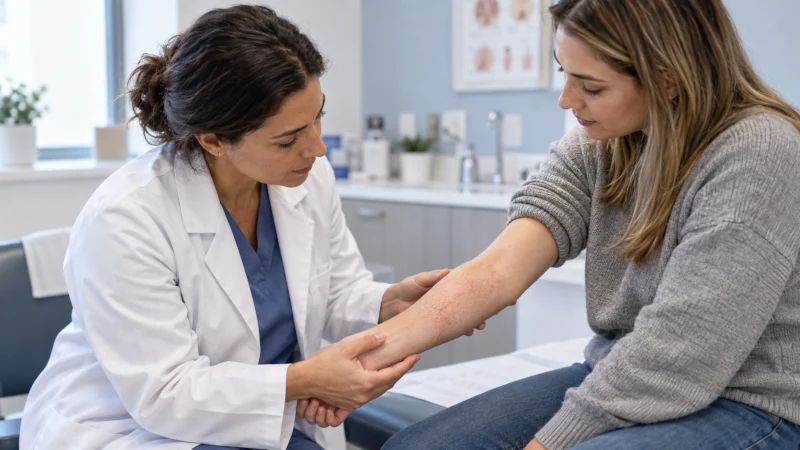
Book an appointment — don’t reach for an herb — if any of these apply:
- Your eczema isn’t controlled despite regular moisturizing and gentle care.
- A rash is spreading quickly, or a wound isn’t healing.
- You see signs of skin infection: skin that’s increasingly painful, warm, swollen, or oozing; expanding redness or discoloration; fever with chills. Infected eczema needs medical treatment, not a compress — and spreading infection can become serious.
- A new rash appears after starting a medication.
- You notice a changing mole or a sore that won’t heal.
Get emergency care for swelling of the face or throat, trouble breathing, or a widespread reaction after applying a product — these can signal a severe allergic reaction.
| HEALTH DISCLAIMER: This article is for general education and is not medical advice, a diagnosis, or a treatment plan. Eczema can look like other skin conditions that are treated very differently, so what you assume is eczema may be something else. Talk with your doctor, dermatologist, or pharmacist before using any herbal product — especially if you are pregnant or breastfeeding, treating a child, taking prescription medicines, living with a long-term condition, or have a weakened immune system. If a skin problem is spreading, painful, infected, or not improving, seek medical care rather than continuing to self-treat. In a poisoning emergency, call Poison Help at 1-800-222-1222 (U.S.); for a medical emergency, call 911. |
Frequently Asked Questions
Can herbs cure eczema?
No. Atopic dermatitis has no cure, though the right routine controls it well — reducing flares, itch, and pain [AAD, 2026]. A few topical botanicals have shown symptom improvement in small studies, but nothing in the herbal category resolves the condition.
What is the single most useful “natural” option for eczema?
For most people, colloidal oatmeal (in a cream or bath) and a good fragrance-free moisturizer do more, more reliably, than any exotic herb — and they’re gentle enough for children [Khan et al., 2026] [AAD, 2026].
Does evening primrose oil help eczema?
The best evidence says no. A large Cochrane review found oral evening primrose and borage oil worked no better than placebo for eczema [Cochrane/Bamford, 2013].
Are “blood-purifying” or detox herbs good for the skin?
There’s no evidence for the idea behind them. Eczema isn’t caused by toxins in the blood, and your liver and kidneys already clear metabolic waste. The mechanism being sold isn’t real.
Can I use an herbal cream alongside my prescription cream?
Sometimes, but ask first and don’t layer them at the same moment — one can dilute or unpredictably increase absorption of the other. Your pharmacist can tell you quickly whether a specific combination is sensible.
How long should I try something before deciding it isn’t working?
Two to four weeks is enough to judge a topical. If it isn’t helping, stop — and if it stings, burns, or spreads, stop right away.
References
- American Academy of Dermatology. “Eczema types: Atopic dermatitis diagnosis and treatment.” Updated Jul 13, 2026; reviewed by board-certified dermatologists. View source
- Bamford JTM, Ray S, Musekiwa A, et al. “Oral evening primrose oil and borage oil for eczema.” Cochrane Database of Systematic Reviews. 2013;(4):CD004416. DOI 10.1002/14651858.CD004416.pub2. PMID 23633319. View source
- National Center for Complementary and Integrative Health. “Skin Conditions and Complementary Health Approaches: What the Science Says.” Clinical Digest, Aug 2021. View source
- National Center for Complementary and Integrative Health. “Chamomile: Usefulness and Safety.” Updated Nov 2024. View source
- National Eczema Association. “Alternative & Complementary Therapies for Eczema.” View source
- Saeedi M, Morteza-Semnani K, Ghoreishi MR. “The treatment of atopic dermatitis with licorice gel.” Journal of Dermatological Treatment. 2003;14(3):153-157. DOI 10.1080/09546630310014369. PMID 14522625. View source
- Khan Z, Dulai AS, O’Neill A, et al. “Impact of Isosorbide Diesters from Coconut and Sunflower Fatty Acids on Pediatric Atopic Dermatitis and the Skin Microbiome.” Journal of Clinical Medicine. 2026;15(2):829. DOI 10.3390/jcm15020829. PMC12842038. View source
- “Prospective Randomized Double-Blind Vehicle-Controlled Study of Topical Coconut and Sunflower Seed Oil-Derived Isosorbide Diesters on Atopic Dermatitis.” PMID 38394048. View source
- Poison Control (National Capital Poison Center). “What happens if I eat castor beans?” View source
- NC State Extension Gardener Plant Toolbox. “Solanum dulcamara (Bittersweet Nightshade).” View source
- “Allergic contact dermatitis caused by topical herbal remedies: importance of patch testing with the patients’ own products.” Contact Dermatitis, 2018. PMID 29214642. View source


